
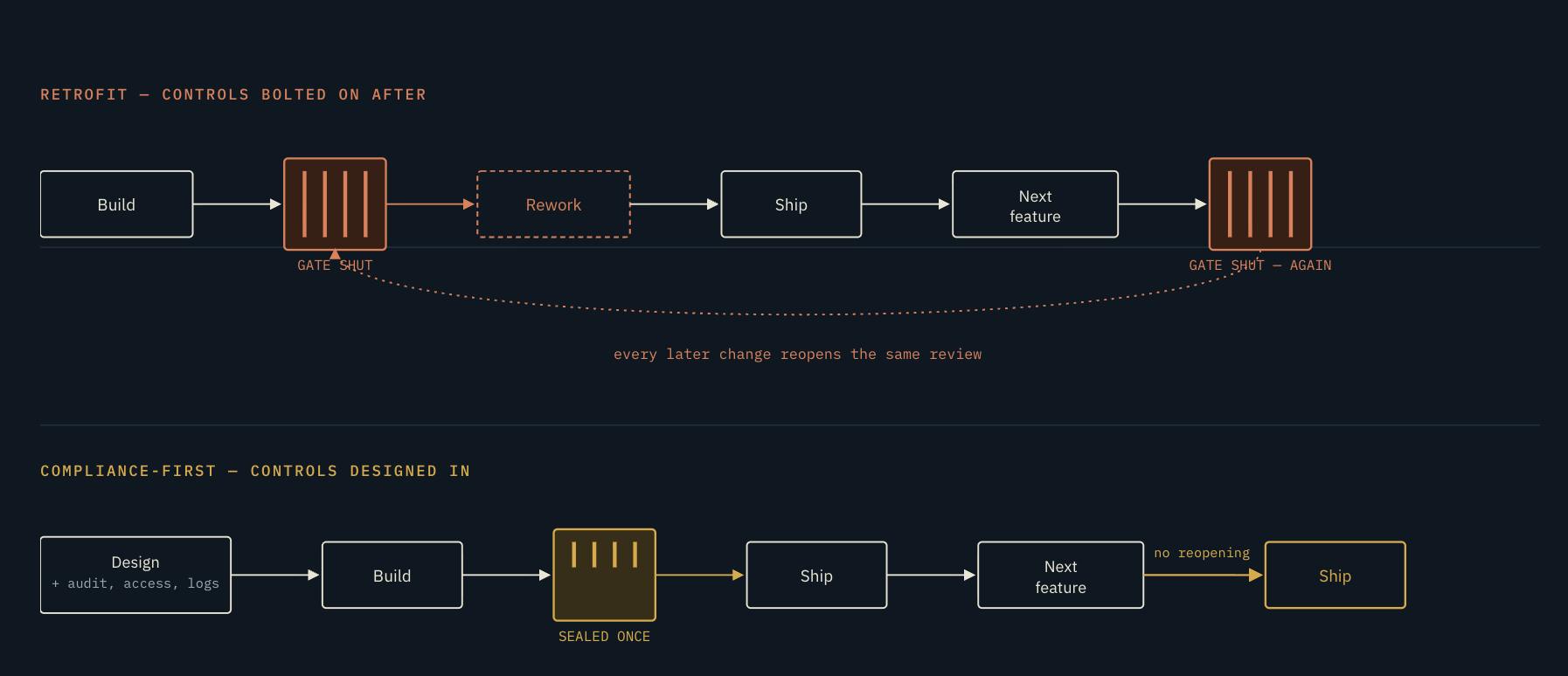
Shipping software in regulated financial services gets called "slower" than shipping consumer software. I'd frame it differently: the pace problem isn't the regulation itself. It's how teams treat regulation, as legal red tape bolted on at the end instead of a design requirement built in from the start. That mistake, not the rules themselves, is what actually slows teams down. Across roles spanning credit risk, payments data platforms, and financial-crime compliance, here are three lessons that reshaped how I think about shipping in this space.Lesson 1: Compliance-First Architecture Isn't Slower. Retrofitting It Is.Early in my career, I worked on migrating a KYC (know-your-customer) workflow from a manual workflow to a cloud platform, covering onboarding, sanctions screening, and identity verification for tens of thousands of business clients. The instinct on a project like that is to build the workflow first and bolt on audit trails and access controls once compliance signs off.We did the opposite: access controls, entitlement review, and audit logging were part of the initial design, not a phase-two addition. That decision is what let us later automate an identity entitlement review process that had been consuming hours of manual review annually, and redesign the onboarding journey with data-driven verification that cut onboarding completion time, without reopening a compliance review, because the controls the reduction relied on were already validated as part of the original architecture.The lesson generalizes: in regulated environments, "move fast" and "compliance-first" aren't opposites. The teams that ship slowly are usually the ones that treated compliance as a gate at the end instead of a set of requirements at the start. That difference means every later change has to reopen that gate.Lesson 2: At Scale, GTM and Pricing Are Technical Roadmap DecisionsI built a customer analytics platform on top of a transaction data set processing trillions of transactions, and that scale changed what "shipping a feature" even meant. At that volume, decisions that look like pure go-to-market choices (how you tier pricing, which API endpoints you expose to which customer segment, how you throttle access) are actually architectural decisions with real infrastructure consequences.Scaling that platform from an MVP to a product with monthly active users wasn't just a product-adoption story. It required BI infrastructure that could support tiered access patterns, SQL-driven insight delivery to non-technical stakeholders, and enough headroom to layer in AI/ML-driven features without destabilizing the core analytics pipeline. The GTM strategy and the technical roadmap were the same roadmap, not two documents that got reconciled in a status meeting.The lesson: in data-heavy fintech products, product managers who treat pricing strategy as separate from technical architecture end up shipping a business model the system can't actually support. Once you're operating at trillions of records, every commercial decision is also a capacity-planning decision.Lesson 3: Risk Models Need Product Ownership, Not Just Data Science OwnershipLeading roadmap and risk strategy for credit decisioning and lifecycle monitoring in merchant lending taught me the clearest version of this lesson: a credit model that's technically excellent can still fail in production if no one owns the translation between "risk appetite" and "engineering requirement."Data science can build a model that outperforms its predecessor on every backtest metric. But someone has to decide what monitoring SLA applies to that model in production, what the rollback criteria are, how override logic interacts with the model's decisions, and how "responsible lending" (expanding merchant access to capital without expanding default risk) gets encoded as testable system behavior rather than a value statement in a design doc. That translation role doesn't belong to data science, and it doesn't belong to engineering. It's product work, and when it's missing, guardrails get designed reactively, after a near-miss, instead of proactively.The Common ThreadThree companies, three different problem domains (KYC and fin-crime, payments infrastructure, and credit risk), but the same underlying pattern: regulated fintech product work is distributed systems design where some of the hardest constraints are legal and regulatory rather than purely technical. Latency budgets, consistency guarantees, and failure modes are still all there. They're just joined by audit requirements, model governance, and exposure limits as first-class constraints on the system.Teams that internalize that early build faster, not slower, because they're not reopening compliance review every time they ship. Teams that treat regulation as something to route around end up rebuilding the same feature twice: once to make it work, and once to make it defensible.
Compliance Isn't the Bottleneck: Seven Years of Lessons From Building Regulated Financial Products
Full Article
Original Source
Read the full article at Hackernoon →KhanList aggregates and links to publicly available news content. We do not host full articles from third-party sources. Always verify important information with original sources.