
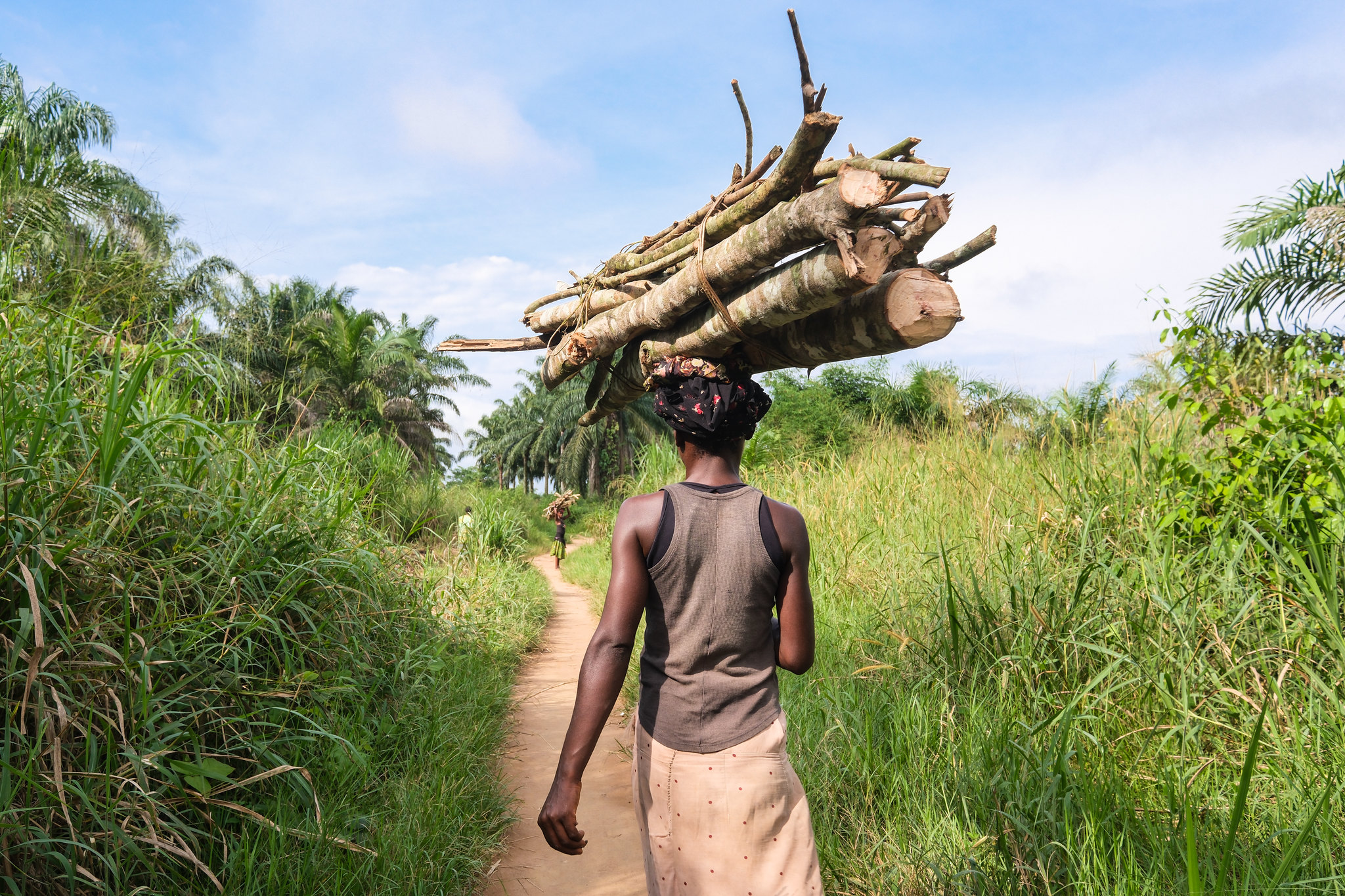
As an initiative aimed at securing land rights, strengthening community governance, and preserving forests, community forestry is gaining significant ground in the Democratic Republic of Congo, where it’s generating genuine interest among communities.However, at the local level, the implementation of measures designed to regulate its management faces several challenges, as two experts point out in an interview with Mongabay.In particular, Blaise Mudodosi and Védaste Cituli highlight the obstacles to the profitability of these conservation initiatives; the lack of synergy among public services; and the lack of coordination in community forestry processes.Communities that have prospered and are now beginning to generate significant income are those that are developing activities related to cacao and coffee cultivation, particularly on fallow land, as well as sustainable fishing. LUBUMBASHI, Democratic Republic of Congo — In the Democratic Republic of Congo, an initiative is underway to award community-based forestry land titles to 7.1 million hectares of land, or about 17.5 million acres — an area the size of Ireland. This is one of several conservation strategies aimed at protecting the DRC’s biodiversity while recognizing customary rights over the land. Apart from the protected areas that have been formally established to date and the vast Kivu-Kinshasa green corridor, the number of local community forest concessions (CFCLs) has risen from eight in 2017 to more than 350 in 2026, of which at least 236 have been legally established. However, while they provide the legal framework that protects communities from unjust or arbitrary expropriation, and allow certain communities to benefit from their forests, CFCLs also have the task of creating opportunities for communities. Without these opportunities, some communities are tempted to illegally exploit their own forests. One decade after the ministerial decree that established the rules for managing and operating these concessions, Mongabay’s Didier Makal speaks with two experts in the sector to get their take on progress. Official presentation of forest concession titles from local communities (CFCL) to the members of the community of Bafwalungu (territory of Bafwasende). Image courtesy of Tropenbos. Blaise Mudodosi, a doctoral researcher at the University of Goma in the DRC, works on the implementation and evaluation of community forestry projects and serves as the national coordinator of the NGO Actions for the Promotion and Protection of Threatened Peoples and Species (APEM), an environmental organization founded in 2013. His work and observations focus in particular on the security and governance of CFCL, as well as the economic utilization of forest resources and institutional support mechanisms. Védaste Cituli, who holds a Ph.D. focused in particular on CFCLs in South Kivu province, in the eastern DRC, is a researcher at the Higher Institute for Rural Development in Bukavu (ISDR-Bukavu), where he examines power dynamics within communities, the participation of women and Indigenous peoples in forest management bodies, and issues related to securing land rights and preserving Indigenous knowledge. Mudodosi and Cituli point to, among other challenges and obstacles to the profitability of these conservation projects, a lack of synergy between government agencies and a lack of coordination in community forestry processes. They also discuss of solutions to help community forestry projects generate profits and continue to engage local communities. The Congo river. According to recent research, the degradation of tropical forests in Amazonia and Southeast Asia may soon make them net emitters of carbon, leaving the Congo Basin as possibly the last significant land-based tropical carbon sink. Image by Ahtziri Gonzalez/CIFOR via Flickr (CC BY-NC-ND 2.0). The following interview has been translated from French and lightly edited for length and style. Mongabay: How would you assess community forestry in the DRC after about 10 years of implementation? Blaise Mudodosi: This is a process in which the communities have placed a great deal of hope. Some results are beginning to show, particularly in terms of areas that have already been secured. That’s the most important part. But when it comes to the management, use, and production of resources, things are still moving a bit slowly. On the other hand, there are many constraints, particularly regarding the communities’ financial and technical capabilities. But for the communities, the fact that they already have a concession provides a sense of security. Védaste Cituli: The community forest approach is to be applauded. It is truly a vital initiative for forest conservation, but also for the preservation of Indigenous knowledge that contributes to their conservation. Unfortunately, at the local level, implementing the measures that have been put in place poses a problem. [Sometimes,] communities have been forced to pay large sums of money [to officials and government agencies], contrary to the law, which stipulates that the permit should be issued free of charge. As a result, corruption is taking root throughout the entire process of obtaining the permit. It should also be noted that in some societies, women are still disadvantaged. They face difficulties gaining access to forest management or governance committees established at the local level. The same is true for Indigenous peoples. Since they are a minority, they continue to face discrimination and have difficulty accessing decision-making positions in forest management committees. Let me give an example: When management committees are formed, voting is done by a show of hands. Yet we thought this approach should include all social strata as much as possible. Mongabay: What are the main obstacles to communities’ economic use of forest resources? In other words, their capacity to sustainably use the resources as a basis of their livelihoods. Védaste Cituli: Local communities don’t really always have the knowledge needed to manage these community forests. There is also the issue of support. After obtaining the governor’s decree [establishing a CFCL], the NGOs [supporting communities in this process] are often limited in their capacity and rarely assist communities all the way through the development of basic management plans. Blaise Mudodosi: The first obstacle is technical capacity, which, in principle, must come from outside — from the support provider. The country is one of the few where access is difficult, not only to the nearest market but also to sales outlets. You have to travel. There are places where even basic items like salt or soap have to be flown in. There are [also] places without electricity or roads. Under these conditions, making the most of local resources can be very complicated. Another factor I’d like to mention is local entrepreneurship, which isn’t sufficiently developed. Participatory mapping session organized in the village of Bolemba (within the Bobalimba Community Forestry Commission, Banalia territory). This exercise allows communities to collectively delineate and document their forest area in order to strengthen community management of natural resources. Image courtesy of Tropenbos. Mongabay: Deforestation and forest degradation have been observed in some CFCLs. What are the causes of these practices? Védaste Cituli: In South Kivu, according to the law, each CFCL must have a basic management plan that identifies all available resources and establishes a system for managing and utilizing them. But these plans are lacking. [Editor’s note: Only 67 out of 358 CFCLs have such plans, and only those have been approved.] I remember that, in some communities, people told me: “We were told that after this, there would be carbon markets. But we no longer see anyone who could buy [carbon credits] from us or compensate us. So we’re forced to exploit our forest just like in the old days.” Blaise Mudodosi: The truth is that [logging within the CFCLs] occurs in concessions that do not yet have even a basic management plan. When you don’t have that, the concession will be managed as it was before. We’ve seen management plans that are truly [good] documents, but which aren’t even very well understood by the communities themselves. Mongabay: Does the granting of a CFCL title protect communities from overlapping rights, particularly with mining titles? Blaise Mudodosi: First, it’s important to understand that the CFCL title is a forest title. In our country, each [government] sector works within its own area of responsibility, but, unfortunately, the sectors don’t often coordinate with one another. That is why, in some places, we see overlapping titles [a forest title and a mining title]. In my view, having a CFCL is already a safeguard, because it is a title that covers a specific area, even if it is a land title. Under our legal system, mining and hydrocarbons are subject to a special regime that takes precedence. In the event of expropriation for public use, the community must be compensated. Védaste Cituli: CFCLs provide land security for communities in the face of the [current legal vacuum] regarding the management of lands belonging to local communities and Indigenous peoples. Mongabay: What sustainable economic alternatives would allow communities to increase their incomes without destroying the forests? Blaise Mudodosi: There are pilot projects that can strengthen the system. First, we must start with a basic principle: everything we envision must be based on the potential that already exists. Our CFCLs are useful for making the most of the resources available to communities. I’ve seen communities that have prospered and are now beginning to generate significant income. Many are involved in cacao and coffee, particularly on fallow land. Some produce improved chikwangue [a cassava-based food paste that’s widely consumed, especially in Kinshasa]. Others practice sustainable fishing. When I look at what has been done in Maï-Ndombe, at [CFCL Manzono], with bonobo [conservation], it’s clear that there are opportunities to generate income without deforestation. Védaste Cituli: There needs to be government support, which is [currently] truly lacking. There’s also the issue of carbon credits behind the whole approach. But we realize that, in the context of Kivu, carbon credits do little to benefit local communities. Shoots growing on tree stumps in CFCL Katanga, Haut-Katanga. Image by Didier Makal for Mongabay. Mongabay: What recommendations do you have for improving community forestry, particularly in terms of financing, governance, and partnerships? Védaste Cituli: To improve the situation, we also need to raise awareness among communities. Because they possess knowledge that must be preserved, that must be protected. Blaise Mudodosi: When we look at the funding that has been allocated to other forms of forest management in the DRC, community forestry still accounts for, I believe, less than 10%. So we need sufficient resources. We also need to build capacity: above all, we must ensure that the people called upon to make decisions have the necessary skills. This interview was first published by here in French on Nov. 23, 2026. Banner image: Une femme transportant du bois de chauffe à Yangambi, Tshopo, en RDC. Image d’Axel Fassio/CIFOR via Flickr (CC BY-NC-ND 2.0). Credits Topics
Community forests offer hope for conservation in DRC, but major hurdles remain
Full Article
Original Source
Read the full article at News →KhanList aggregates and links to publicly available news content. We do not host full articles from third-party sources. Always verify important information with original sources.