
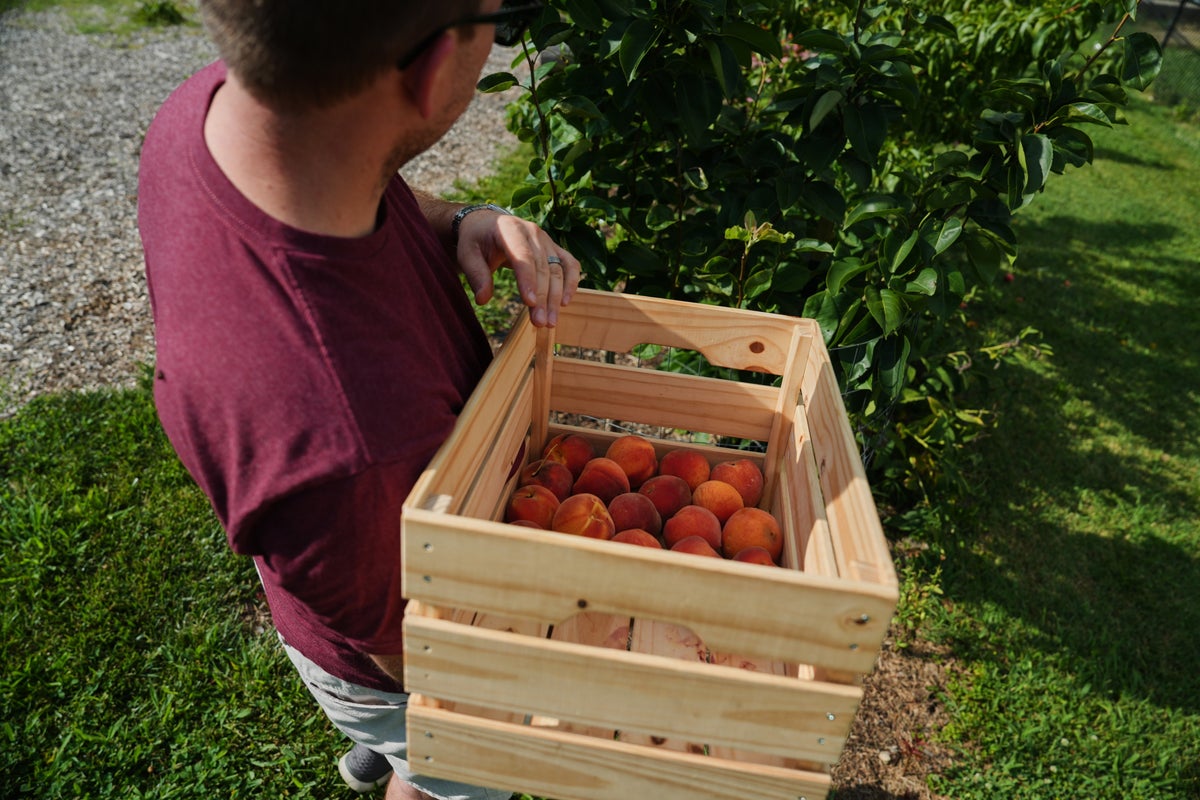
Roughly a dozen people gather around Chris Smyth, leaning on their upright shovels next to saplings prepared for planting, as they listen to an encouraging pep talk before beginning work.Come afternoon, fruit trees will stand in a small plot of public green space surrounded by densely packed housing. The site marks one of over 40 compact orchards across the Cincinnati region established by Smyth and volunteers over the last nine years."A lot of groups, their goal is planting trees. Ours is not that, it's growing food for people," said Smyth, founder of The Common Orchard Project.Experts note that food forests — edible plant communities occurring naturally or designed to recreate natural systems — are expanding across the United States. They offer fresh produce to neighborhoods where such foods are scarce, serving as one way communities build resilience as human-caused climate change disrupts global food networks.Smyth hopes people will connect with one another and nature by tending trees and harvesting fruit.Volunteers listen as Chris Smyth, left, director of The Common Orchard Project, gives instructions before planting an orchard Saturday, Oct. 10, 2026 (AP Photo/Joshua A. Bickel)"To grow food right in a neighborhood, you can see it," he said. "You can trust quite definitively that this is safe, good and healthy … which hopefully inspires us to remember that we can trust each other because we live in a world with a lot of suspicion of our neighbor."What is a food forest?Food forests require less upkeep than traditional agricultural systems. They feature layered perennial vegetation — including fruit trees and species supporting native pollinators — that not only grow food for humans, but also sustain animals, insects, and broader plant life within an interdependent ecosystem."It gets to the ideas about mutual nurture," said Anne C. Bellows, a professor of food studies at Syracuse University. "You nurture the environment, the environment nurtures you."And that idea is central to Smyth's mission.Partnering with private landowners, non-profits, and municipal authorities, Smyth plants orchards in accessible spaces designed to sustain diverse living species beyond humans. Across many orchards, animals forage for fruit while pollinators visit flowers, with native plants and herbs filling spaces between trees.Building community and sharing knowledgeCrucial to these orchards' success is a steward — a volunteer who maintains the plot post-planting, vital during early years as young trees establish and remain vulnerable to diseases and pests. Beyond physical care, stewards engage local residents, explaining the orchard is there for their enjoyment.For Jessica Wieman, who manages an orchard on a grassy lot she owns in northeast Cincinnati, passing along knowledge about cultivating food motivated her decision to join."I think people today, through no fault of their own, are pretty disconnected from where their food comes from," she said. "And a lot of times just don’t even realize what’s possible, like what kind of things they can do in their own yard."Apples grow on a tree Friday, Sept. 4, 2026, at The Common Orchard Project farm (AP Photo/Joshua A. Bickel)Maintaining an orchard is a multi-decade commitment. When saplings are young, work centers on weeding, pruning, and spraying, but as trees mature, harvesting will become a massive task in its own right, Wieman said.Yet because these spaces mirror natural ecosystems, they should prove easier to maintain and enjoy greater longevity, she added.Smyth estimates that within two years, fruit production across the city's orchards could double to roughly 10,000 pounds, encompassing peaches, apples, and pears alongside rarer varieties such as pawpaws and persimmons.Orchards sit within walking distance of 1,000 residents, enabling neighbors to observe trees and gather fruit. Some feature cards displaying photographs and bilingual English and Spanish instructions outlining when and how to harvest.If demand increases and residents gather all available fruit from these orchards, then "let’s build more is my solution until we can just flat out overwhelm people with food," Smyth said.Mitigating climate impactsAt an orchard in northern Cincinnati, Ben Stockwell bends down under early September sunlight to pull weeds surrounding a young Asian pear tree.Harvest finished almost four weeks early this year due to summer heat and rain, noted Stockwell, who has stewarded this orchard for three years. Only two persimmon trees remain.He believes local food production must expand as extreme weather and climate change complicate food delivery systems. Contributing to a community solution motivated his choice to manage an orchard."Who knows if those systems are going to be as robust or as cheap as they are now?" he said. "I do worry about being able to go to a store and get the foods that I need or want."Food forests also help reduce urban heat effects. A 2025 study in the journal Sustainability showed maximum temperatures inside a food forest were 2.2 degrees Celsius (4 degrees Fahrenheit) lower than surrounding city areas.Chris Smyth, director of The Common Orchard Project, harvests apples Friday, Sept. 4, 2026 (AP Photo/Joshua A. Bickel)Bellows noted many food forests sit in neighborhoods with low tree canopy and elevated food insecurity and poverty. Though food forests cannot end hunger, they can potentially restore communities "estranged from the environment and food systems.""You’re looking at places with less green, less shade, less resilience against the vagaries of climate change," she said.Inspiring change in the food systemCommon Orchard stewards also partner with local food banks, donating uncollected orchard fruit. Ultimately, Smyth hopes these orchards become community focal points where residents recognize local growing as a practical method to feed themselves.During a planting in Newport, Kentucky, Paula Cely and Kyle Randall volunteered in a district where per capita income averages about $26,000 annually, according to U.S. Census data.Living nearby, the couple said they sometimes skip buying fresh store produce because of high prices. Having free fruit access was "a big deal," Randall said.Bellows said municipalities should offer public land for community self-sustenance through food forests, shared gardens, or prioritized local food markets. Policies, she added, must focus on marginalized citizens' needs.Chris Smyth, director of The Common Orchard Project, places a bag of recently harvested apples into a free food pantry's refrigerator (AP Photo/Joshua A. Bickel)Smyth admits local orchards cannot replace global food networks. But if national orchard networks begin feeding citizens, communities might address hunger while gaining empowerment to pursue "structural changes" in culture and the economy.He believes such transformation sparks when residents connect and collaborate within community settings. Yet even if broader goals remain unfulfilled, cultivating food for neighbors remains inherently worthwhile."At the end of the day, we get apples," he said. "And that's enough."
Community ‘food forests’ are expanding as Americans struggle to afford fresh food
Full Article
Original Source
Read the full article at Independent →KhanList aggregates and links to publicly available news content. We do not host full articles from third-party sources. Always verify important information with original sources.