
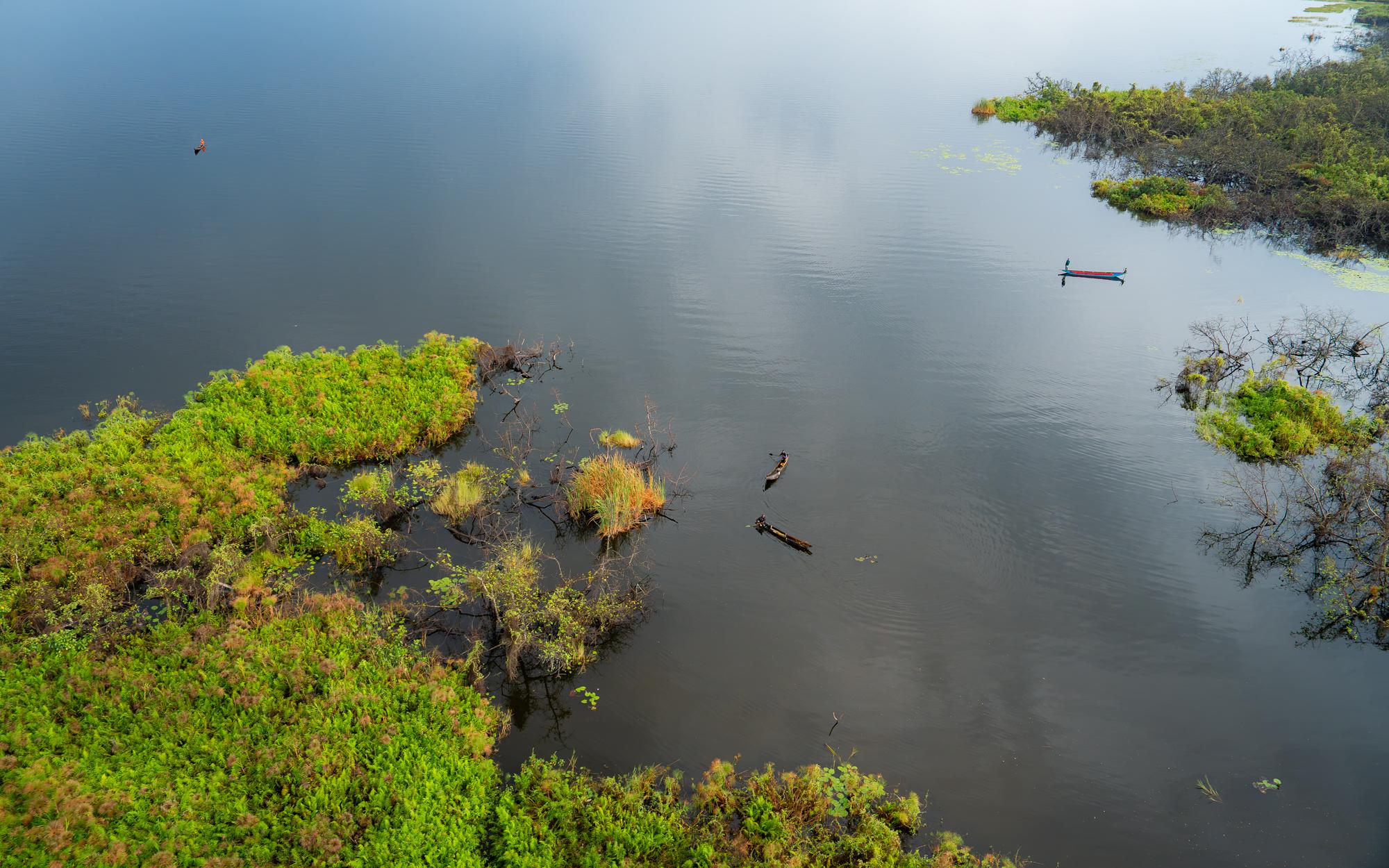
A growing body of research underscores the tensions that can arise when conservation efforts overlap with community need for resources.A recent study examines the perceptions of injustice by residents of Kisandji village near Upemba National Park in the Democratic Republic of Congo, where local residents say they face limited access to the park forest, which they depend on for food, medicine and farming.Kisandji residents have repeatedly been victims of displacement due to ongoing conflicts, mining and other forms of extraction; this has all contributed to a persistent sense of instability and distrust.Experts suggest more community involvement in conservation decision-making and resource management can help ease the strain between conservation efforts and the need for resources. A forest can be many things to the communities that live in and around it. It can serve as farmland, a pharmacy, a food source or a cultural center. The forest can be a lifeline to residents who depend on it for survival. Yet access to that land can be restricted if it lies within a protected area. This is a common scenario in many parts of the world, where areas of high ecological value are also home to ecosystems that local communities depend on for survival. A growing body of research underscores the tensions that can arise when protected areas under conservation overlap with community lands. One case in point is Kisandji, an ethnically diverse village in the southeastern part of the Democratic Republic of Congo about 13 kilometers (8 miles) from Upemba National Park in Haut-Katanga province. The residents of Kisandji use the natural resources found in the park for food, medicine and farming. But since 2015, access to the parkland has become difficult for residents amid national efforts to combat poaching and wildlife crimes. The park’s territory has been a source of livelihood for surrounding communities, including in Kisandji, where around 85% of households depend primarily on farming. Without electricity, piped water or healthcare, Kisandji residents also depend heavily on nature for food, medicine and income. Additionally, in a landscape shaped by war, displacement, poverty, mining and other extractive activities that interfere with people’s subsistence activities and lives, the forests within the park remain their go-to source of sustenance. Savanna in Upemba National Park. Image by Justin Sullivan via Forgotten Parks. A recent study published by the Royal Swedish Academy of Sciences assesses the relationships between local communities and nature where protected areas and communities coexist in a region marked by conflict and poverty. The paper examines people’s use of the land and their perceptions of surrounding ecosystems. The findings highlight the need for conservation strategies that balance both ecological and community needs and priorities, particularly in areas shaped by mining and other extractive economies. The research focused on Kisandji and found that resident livelihoods depend heavily on natural resources found in the park, but access to the park is increasingly difficult for locals. The area, a biodiversity hotspot, is also rich in resources such as copper, cobalt and zinc, and the presence of mining is intertwined with conflict. “Armed groups target villages near resource-rich areas,” the study authors write. “These attacks disrupt livelihoods and conservation, forcing residents to flee, often without any belongings … Conflict is also a driver of poverty. Attacks often result in the loss of agricultural land and livestock, worsening economic hardship.” This puts enormous pressure on the local population. The study found that around 43% of household food resources come from agriculture, 34% from the forest and 23% from water bodies. The residents also rely heavily on the forest for medicine, where more than 93% of natural remedies are found. According to the study, “food insecurity is widespread,” with 94% of those surveyed reporting shortages. Beyond that, the forest is linked to their identity and belonging, showing that for them the forest is not just habitat; it is their livelihood, culture and social infrastructure. Damage to one of the buildings in Upemba National Park’s headquarters. Image via Forgotten Parks. Resident voices However, since 2015, Kasanji residents have had more and more difficulties accessing the forest due to the enforcement of the park boundaries. Residents associate those restrictions to access directly with Upemba National Park. According to some residents interviewed for the study, the park has annexed areas belonging to the village. “Some areas of the village have been considered areas of the park,” one of the respondents said. “The park should respect the limits of its boundaries, as shown on the map.’’ Another said, “The park has taken areas reserved for the village, contrary to the maps originally planned. The rights and culture of the community are not respected or recognized.’’ According to the study, many residents say the park has expanded into areas they consider village land and that it does not respect its original boundaries. However, the study researchers examined historical maps and concluded that the actual boundary changes around villages appear to be relatively limited, making it difficult to attribute change in access to the park boundary changes. “For many years, the park had been completely abandoned,” Christine (Tina) Lain, director of Upemba National Park, said in an interview. “People therefore came to believe that they could do whatever they wanted, wherever they wanted. When management returned and began enforcing the law to protect the park, communities started to feel that things were changing. But this does not mean that the park had become larger.” According to the study, the reason Kisandji residents associate their restriction to land with Upemba National Park is that the park and the residents value many of the same resources, though for different reasons. The residents need land, forest and natural resources for their livelihood, but the park needs those ecosystems for biodiversity conservation, and this creates a direct point of tension. The study authors write that residents reported “a sense of injustice” regarding park access and natural resource management — something that is not limited to Kisandji. “Kisandji residents’ perceptions resonate with findings from other regions where protected areas intersect with human settlements. Their sense of injustice, particularly regarding access, boundaries, and benefits, reflect how perceived equity in conservation is shaped by resources availability,” the study states. Yet the authors’ findings suggest otherwise; they show that the most decisive restrictions on Kasanji’s land and resource access often come from conflicts, mining and other extractive activities. These findings suggest that the park has just become the “face” of the constraint, even when the causes are not related to it. Forest canopy in Upemba National Park. Image by Justin Sullivan via Forgotten Parks. Kisandji residents have repeatedly been victims of displacement and relocations due to ongoing armed conflicts, mining and other forms of extraction. These recurring displacements, rooted in complex social, political and environmental drivers including war, mining and other forms of extraction, have contributed to a persistent sense of instability and distrust in local authorities like the park management, government officials or other political actors in the region. According to the study, “This history of repeated displacement informs how Kisandji residents perceive current conservation efforts associated with UNP, which are often perceived as potential extensions of past exclusion, uncertainty, and loss.” All around Upemba National Park, population movements are changing where farmland is located. The study shows that 75% of cultivated lands between 2018 and 2023 replaced natural vegetation in Kisandji. These changes have been associated with residents’ adaptation to factors such as mining, armed conflict and migration rather than simply deliberate environmental destruction. “In the case of Kisandji, armed conflict is the most prominent driver [of repeated displacements] closely interconnected with land and resource policies, population dynamics, food insecurity, and exacerbating poverty,” the study says. “The park is now the only actor whose presence is clearly visible in the landscape,” Lain said. “The park is physically present, and it brings certain forms of development, using the resources available to it. Many of the actors involved in the displacement of the community have changed or are no longer present in the same form; communities or community leaders are afraid to confront them. As a result, people let mining companies proceed and allow agro-industrial companies to take over large areas of land. Yet they are more likely to confront the park, probably because the institutions behind the park are economically and politically weaker than these other companies.” The opinions on ongoing conservation efforts are widely varied; some of the residents surveyed expressed their frustration about the restrictions, some reported no change in access, while others recognized the need for resource management and wildlife protection. The study shows that support for conservation depends partly on whether people feel recognized, included and able to maintain their livelihood. Park rangers at Upemba and Kundelungu national parks. Image courtesy of Upemba National Park. Community participation as a solution Clément Kalombo, one of the study researchers, said in an interview that potential pathways to solutions are to make conservation more participatory, historically informed and locally grounded in a way that communities participate in decision-making, boundary discussions, natural resource management, dialogues between the park and residents and other inclusion measures. The park management has also been working on programs that strengthen communities’ livelihoods to reduce the pressure on the park’s landscape. “For several years now, we have been developing sustainable development programs around the protected area,” Lain said. “We invested considerably in fishing activities on Lake Upemba, developed agricultural programs, we have brought in and distributed seeds, and we have also introduced mechanized farming. We have also invested considerably in AVECs, community-based savings groups. Of course, we are not yet able to meet the needs of every community. It is important to understand that the park covers a vast area, and we have had to focus our efforts on specific locations.” The study argues that participation alone can’t solve everything, but a sustainable solution also includes peace and security — because conflicts and insecurity are themselves drivers of problems in the region. Banner image: Canoes in an inlet in Upemba National Park. Image by Justin Sullivan via Forgotten Parks. Upemba National Park staff recount assault that left seven dead Citations: Sidibe, A., Maung, W. P., Brockhaus, M., Mutambala, P. K., Mwenze, D. N., Kabalika, C. K., … Wong, G. Y. (2026). People–nature relations and community perception on conservation: Case of Kisandji village near Upemba National Park, the Democratic Republic of the Congo (DRC). Ambio, 55(12), 3027-3040. doi:10.1007/s13280-026-02410-1 Credits Topics
Communities around DRC’s Upemba National Park say conservation comes at a cost
Full Article
Original Source
Read the full article at News →KhanList aggregates and links to publicly available news content. We do not host full articles from third-party sources. Always verify important information with original sources.