
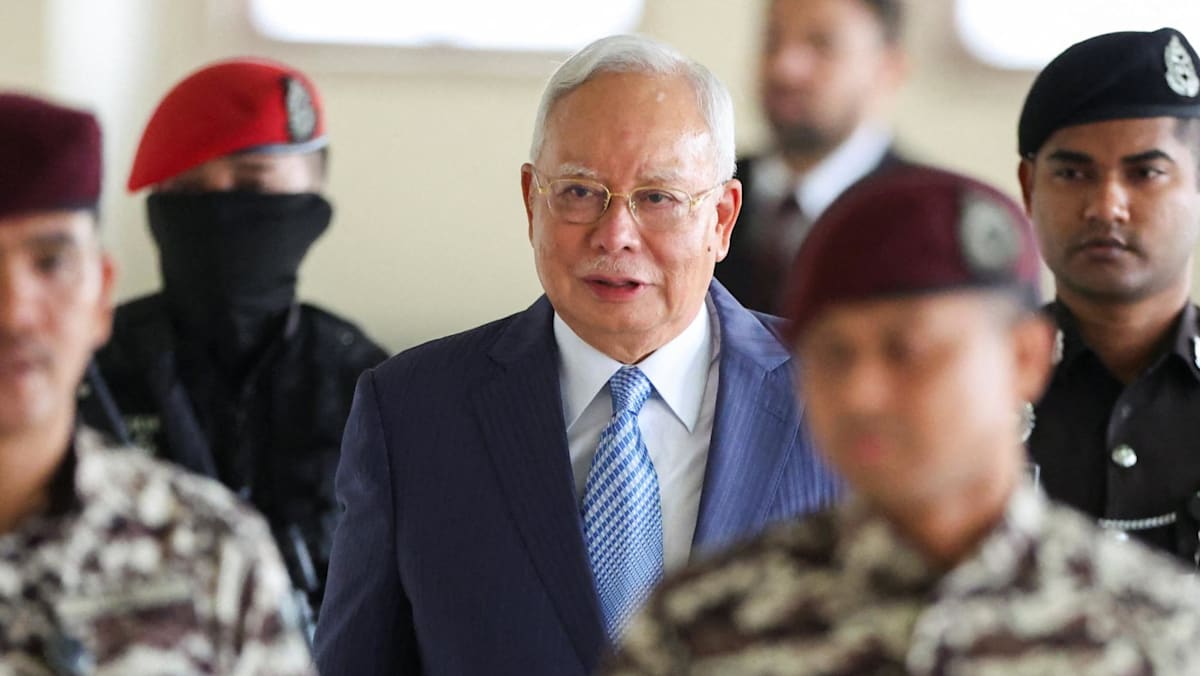
Commentary With two upcoming state elections, conventional wisdom held that neither coalition would want the former prime minister and his corruption convictions as a live campaign topic, says Asian studies professor James Chin. Malaysia's former Prime Minister Najib Razak arrives at the Kuala Lumpur High Court for a hearing on his bid to stay the execution of a 15-year jail sentence imposed in a case linked to the 1MDB corruption scandal on Oct 14, 2026. (Photo: Reuters/Hasnoor Hussain) New: You can now listen to articles. This audio is generated by an AI tool. HOBART, Australia: The departure of former Malaysian prime minister Najib Razak from Kajang Prison on Friday (Nov 6) afternoon caught many observers like myself off guard – by how quickly it happened and how it came earlier than anticipated.The expectation was that any transfer would only happen after the Melaka state election on Nov 14 and the Sarawak election on Dec 12. Conventional wisdom held that both the Pakatan Harapan (PH) coalition and Najib’s party, the United Malays National Organisation (UMNO), would prefer to keep the issue of Najib’s status and his corruption convictions from becoming a live campaign topic. Under the terms of a conditional pardon granted by the king Sultan Ibrahim Sultan Iskandar in September, Najib was permitted to serve the remainder of his reduced sentence in the SRC International corruption case under house arrest until Aug 23, 2028, provided a fine of RM50 million (US$12.3 million) was paid. That payment, raised through a UMNO-led solidarity fund, was completed on Friday morning. Shortly after the release, the Attorney-General’s Chambers called for a temporary suspension of the house arrest arrangement, for legal clarifications about the pardon and its implications on his separate 15-year 1MDB corruption-related sentence. Najib was brought back to prison hours later following the attorney-general’s intervention. The king later stated that the conditional pardon was unambiguous and unrelated to any other cases. But these are procedural issues that will certainly be resolved. It is just a matter of time that Najib goes home to serve out his sentence. CLEARING POLITICAL CALENDAR BEFORE GE16The timing of it all is best understood through the lens of electoral calculus. Najib’s early release means UMNO removes the issue from the campaign calendar. In Melaka, the UMNO-led Barisan Nasional (BN) coalition faces little risk of defeat. In the previous state election, BN secured 21 of 28 seats and a two-thirds majority. This time it has formalised cooperation with religious conservative Parti Islam Se-Malaysia (PAS) and its Perikatan Nasional coalition, producing a joint manifesto and an agreement not to clash over contested seats. I project that the UMNO–PAS combo, what I called the “Malay Tsunami”, will win at least 24 to 28 seats. With such a comfortable margin, the political cost of Najib’s release is negligible in the state. Sarawak presents an even clearer case for early action. UMNO has no presence in the East Malaysian state; it is not on the ballot paper. Gabungan Parti Sarawak (GPS) dominates local politics, and the Najib case has no traction. So UMNO’s eyes are on the next general election (GE16), due by early 2028. It is counting on public attention having moved on by then. Malaysian voters have repeatedly demonstrated short political memories once an event leaves the daily news cycle. NAJIB REMAINS AN INSIDERThe irony is that public frustration has often been directed at Prime Minister Anwar Ibrahim for not keeping Najib behind bars. The decisive interventions, however, have come from the monarchy. The possibility of some form of royal clemency has been public knowledge for roughly two years, following the 2024 reduction of Najib’s original 12-year sentence and RM210 million fine to six years and RM50 million. The pardon system in Malaysia relies on the absolute prerogative of the king. Najib received the reduction in sentence from the previous king, who is the Sultan of Pahang, and a conditional house-arrest arrangement from the present king. Najib himself is deeply embedded in the Malay political establishment and has longstanding ties to the Pahang royal house. He long held the federal parliamentary seat of Pekan, and was Pahang’s chief minister between 1982 and 1986, both positions also previously held by his father. The Razak family holds the peerage title of Orang Kaya Indera Shahbandar, one of the positions in the Orang Besar Berempat (The Four Major Chiefs), making it the fourth-highest-ranking noble title directly below the Sultan of Pahang. This reality is reinforced by the continued political standing of Najib’s children. His eldest son, Mohamad Nizar, serves as a Pahang state executive councillor and assemblyman. Another son, Mohd Nazifuddin, is UMNO division chief in Langkawi. His daughter Nooryana Najwa holds leadership positions in Puteri UMNO, its young women’s wing. These roles keep the family inside the party’s organisational and patronage networks. A supporter of jailed former Malaysian Prime Minister Najib Razak holds a button featuring his portrait outside Najib's residence after a court issued an order allowing his transfer to house arrest, in Kuala Lumpur, Malaysia, November 6, 2026. REUTERS/Najjua Zulkefli Najib has never been an outsider who could be fully detached from the protective instincts of the traditional Malay elite that has dominated the system even before independence. The system, in short, has not allowed one of its own to suffer the full weight of ordinary criminal consequences.THE CORE OF MALAYSIA’S POLITICAL SYSTEMNajib’s transfer to house arrest is therefore less an exception than a reaffirmation of existing rules. As long as politics is structured along racial and religious lines, power still flows through elite bargains within the Malay establishment. The episode will fade from headlines, the state elections will proceed on their own local dynamics, and the longer-term pattern of limited elite accountability will remain intact. The latest episode in Najib’s saga is a reminder that the historic change of government in 2018 has not reformed the core of Malaysia’s political system. James Chin is Professor of Asian Studies, University of Tasmania, and Senior Research Associate, Tun Tan Cheng Lock Institute of Social Studies, Malaysia.
Commentary: What the timing of Najib’s house arrest says about Malaysian politics
Full Article
Original Source
Read the full article at Channelnewsasia →KhanList aggregates and links to publicly available news content. We do not host full articles from third-party sources. Always verify important information with original sources.