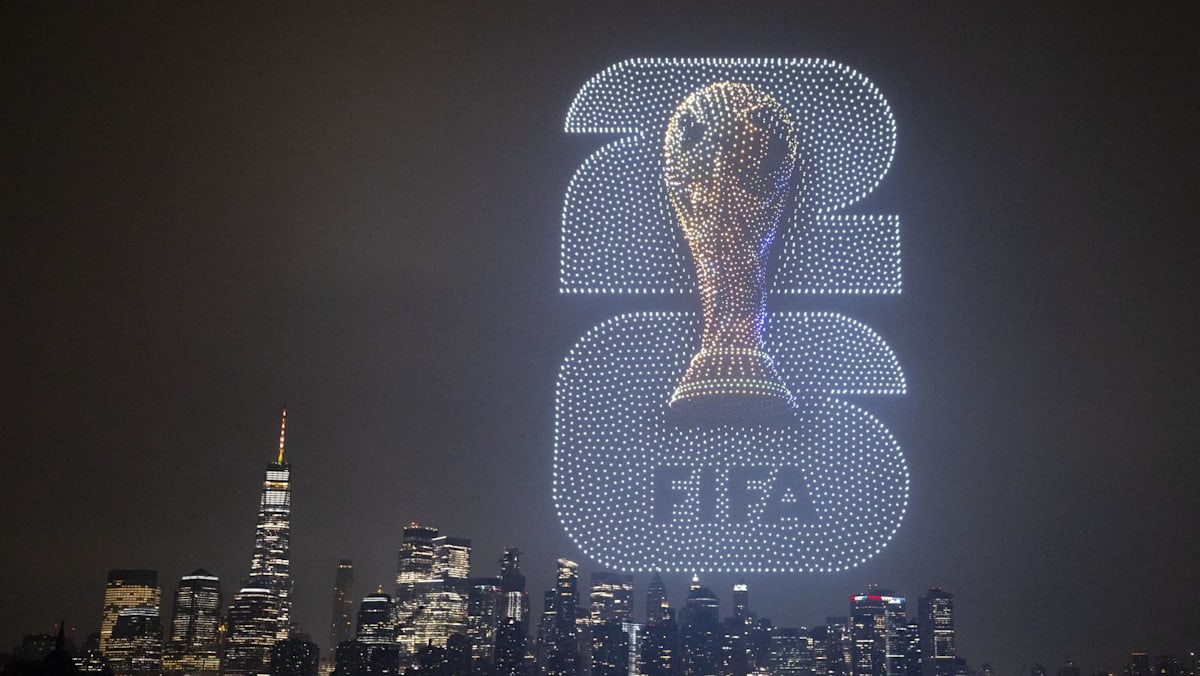
Commentary By allowing fans to see what others are saying about football in their own words, AI has removed the language barrier and democratised the conversation, says Gearoid Reidy for Bloomberg Opinion. A FIFA World Cup Trophy visual is displayed against the Manhattan skyline during the FIFA Drone show in New York/New Jersey at Liberty State Park on Jul 15, 2026 in Jersey City, New Jersey. (Photo: AFP/David Ramos/Getty Images) TOKYO: Following Argentina’s controversial come-from-behind World Cup victory against Egypt, a match the losing team said was “fixed”, one wit on social media summed up the mood.“Not even the British Museum stole so much from Egypt as FIFA did,” said user Intrapiernoso in a tweet seen by over 6 million people. It was arguably the best zinger of a tournament that has had dozens of them.Except the original was not in English. What they actually wrote was, “Ni el Museo Britanico le robo tanto a Egipto, como la FIFA”. I don’t speak Spanish and while it doesn’t take a genius to work out what “el Museo Brianico” means, the act of puzzling over the unfamiliar grammar robs the remark of its wit.But now, thanks to the automated, LLM-generated translations and algorithmic boosts of social media, I can read it in my native language. It’s also been shared by users speaking Persian, Arabic and Korean, for whom el Museo Britanico might be harder to grasp. The World Cup happens once every four years, and each time it’s a stark demonstration of how technology has changed. During the 2006 tournament, I got into podcasts; in 2022, I watched the games anywhere on my iPad, free of my TV. This is the first time I get to see what people in other cultures are saying about football, in their own words, removing the language barrier and democratising the conversation - and revealing the wit of multiple cultures, from French swipes at Argentina to the Brazilian narrative that blames their side’s recent underperformance on the decline of Catholicism. It also shows how much we have in common: The most bitter rivalries are everywhere due to historical grudges with our closest neighbors, while Simpsons football memes seem to transcend national borders. There’s also a serious side: French star Kylian Mbappe’s riposte to a Paraguayan senator who attacked him in racist tweets was written in French, but still one of the most-seen remarks of the entire tournament, with some 90 million views.SOLVING THE PROBLEM OF LANGUAGEIt’s not unreasonable to be wary of where artificial intelligence is taking us. But it is also humbling to think that we are close to solving the problem of language, an issue that has divided humanity for as long as our species has existed.The creation myth in the Book of Genesis says that after the flood, “the whole earth was of one language, and of one speech”. The united human race, goes the tale, sought to build a tower in Babel that would reach all the way to heaven. For this hubris, God punished them, “confounding” their tongues and scattering humanity across the face of the earth. It’s an origin tale to explain why members of the same race should find themselves unable to communicate with one another.But now we can understand each other at scale almost instantly, without committing to decades of language learning. Far beyond tweets, this technology will allow information to be free, removing gatekeepers and allowing ordinary people to access the latest academic papers, and weaken Anglophone domination of global discourse. Similar leaps are coming for voice, humanity’s primary form of communication. In the coming years, technology like Apple’s AirPods live translation will combine with tech like the latest voice mode of ChatGPT, which can speak in a manner that feels like a human being, to provide something close to Star Trek’s universal translator. Of course, it’s far from an unequivocal good. Like any muscle, speaking a second language is a skill that atrophies if it’s not used (for now, X gives you the options to say which languages it should not interpret, but as this technology proliferates such technology will likely default to your native tongue more and more). And LLMs can be far from perfect, particularly in cultures like Japanese where the subject or object of a sentence is frequently dropped and assumed from context. X’s Grok, for now, confidently translates regardless, while a human might express some uncertainty.COMMON UNDERSTANDING?Just because we comprehend each other’s words, it doesn’t automatically follow that we share a common understanding. Translation of text cannot always explain irony, taboo, banter or trolling. There is no better time to recognise that than during the World Cup, as Americans and British, “two nations divided by a common language” as the line often attributed to George Bernard Shaw has it, talk past one another over the same sport. No amount of linguistic proficiency can change the fact that lots of Americans seemingly believe that if LeBron James or Tom Brady just took up football instead, they’d win the tournament.Perhaps the biggest worry is this: Some modern scholars argue that the scattering of humanity in the Tower of Babel story was not a punishment but a blessing, bestowing on us cultural diversity and dispersing a monolithic empire. As the internet has proliferated, the world has become smaller, squashed into a monoculture. That might happen with our wit, too, as local differences, particularly smaller ones, give way to the largest languages and the references that travel most easily.AI translation may blur some of that. But still, after thousands of years of failing to understand one another, getting the joke at all still feels something close to miraculous.
Commentary: These World Cup tweets show how AI will unite us all
Full Article
📰 Original Source
Read full article at Channelnewsasia →KhanList aggregates and links to publicly available news content. We do not host full articles from third-party sources. Always verify important information with original sources.