
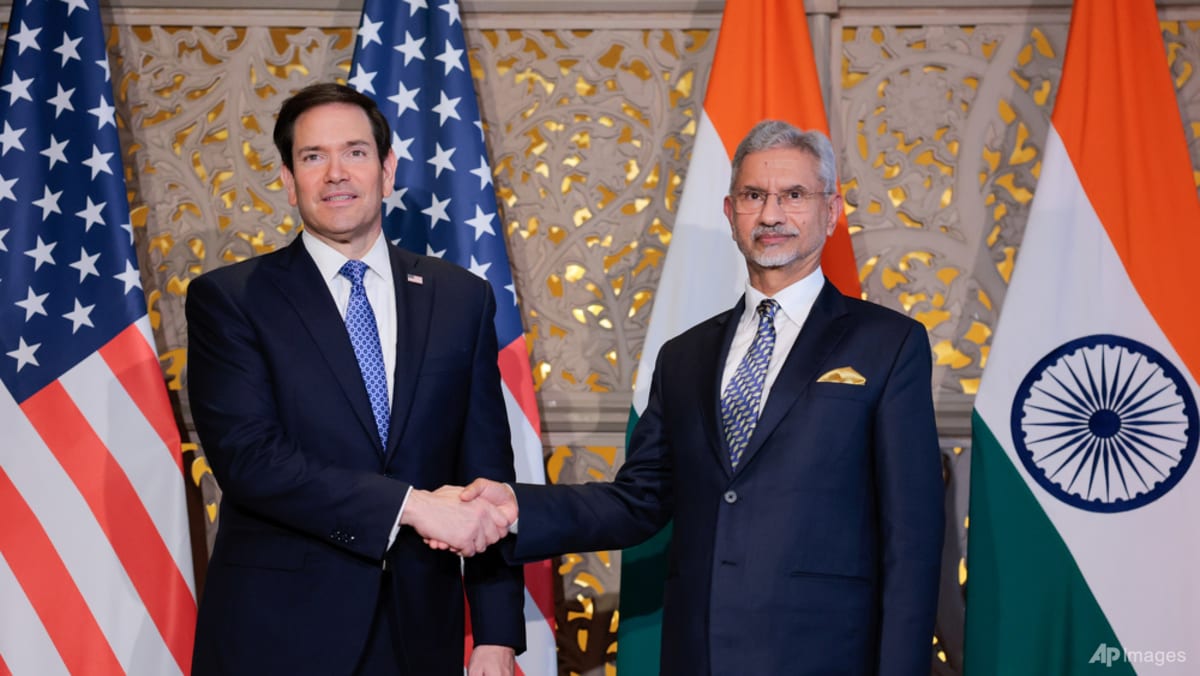
Commentary Structural ties endure, but US President Donald Trump’s flip-flopping on energy policy has done lasting damage to Washington’s relationship with New Delhi, says Chietigj Bajpaee from the Chatham House think tank. US Secretary of State Marco Rubio, left, shakes hands with India's Foreign Minister Subrahmanyam Jaishankar, right, before their meeting in Mumbai, India, Tuesday, Oct. 20, 2026. (Kylie Cooper/Pool Photo via AP) LONDON: United States Secretary of State Marco Rubio’s visit to India last week triggered two opposing narratives: one that the India-US relationship remains in chronic decline, and another that it continues to move from strength to strength. As with most things, the reality is somewhere in the middle.The naysayers point to Rubio visiting Mumbai and Jamnagar but not New Delhi. This overlooks the fact that many other foreign leaders have bypassed the Indian capital: Chinese President Xi Jinping visited the southern state of Tamil Nadu in 2019, as part of their informal summit diplomacy; United Kingdom Prime Minister Keir Starmer visited Mumbai last October after India and the UK signed a free trade agreement; and German Chancellor Friedrich Merz visited India’s IT hubs Ahmedabad and Bengaluru in January.TALK IS CHEAPAs argued in earlier analysis, the India-US relationship remains “sticky”. Despite the war of words between New Delhi and Washington over the last year – fuelled by tariffs, sanctions, and tightening visa rules – structural engagement remains strong. Bilateral trade in goods and services grew to around US$240 billion in 2025. India continues to conduct more joint military exercises with the US than any other country. Technology cooperation remains robust, with the launch of a joint satellite in 2025, and US tech companies pledging massive AI investments in India.Rubio’s latest visit sought to double down on this economic engagement. The trip to Jamnagar – home to the world’s largest refinery, owned by Reliance Industries – came amid continued oil price pressures triggered by the US-Israel war with Iran. Rubio’s visit was rooted in India becoming the second-largest buyer of Venezuelan heavy crude – most of which is processed in Jamnagar – after the US captured Nicolas Maduro in January. It also followed Trump’s March announcement that Reliance will invest in a major refinery in Brownsville, Texas.And yet, those who buy into the Trump administration’s rhetoric – from Rubio claiming that India is a “refining superpower” to Trump calling Narendra Modi “one of my greatest friends” and US Ambassador to India Sergio Gor referring to Kashmir as an “important part” of India during his visit to the disputed territory in August – miss the point that there has been lasting damage to the India-US relationship. Talk is cheap, particularly under the Trump administration’s fickle foreign policy. FLIP-FLOPPING POLICIESNowhere is this more apparent than in energy policy, where the US flip-flopping on India’s purchase of Russian crude has been nothing short of staggering. India initially came under heavy scrutiny following the Russian invasion of Ukraine, before Western countries came around to understanding India’s strategic compulsions as a price-sensitive developing country that was playing a stabilising role in global energy markets. New Delhi assumed things would only get better under Trump, given his proclivity to engage Moscow, but instead his administration slapped 50 per cent tariffs on India and threatened secondary sanctions. White House trade adviser Peter Navarro infamously labelled India a “laundromat for the Kremlin”.In February, the US reduced tariffs on India as the framework for a US-India interim trade deal was reached in exchange for New Delhi suspending Russian oil purchases. But this was partially reversed when the US allowed India to buy Russian oil stranded at sea following disruptions in the Strait of Hormuz triggered by the US-Israel attack on Iran in the same month. Then, in September, the Lindsey O Graham Sanctioning Russia and Iran Act of 2026, authorised tariffs up to 100 per cent on the five largest buyers of Russian oil and gas, including India. But with the US now buying Russian diesel itself, Trump waived those penalties in October, with Rubio indicating a 60-day review to follow. WEAKENING PILLARSThe fundamental problem with the Trump administration’s approach to India is that it prioritises short-term interests (in this case quelling inflationary pressures ahead of the upcoming US midterm elections) over long-term strategic considerations. Two key pillars of the India-US relationship have weakened under Trump: the countries’ shared democratic values and India’s role as a counterbalance to China. The values debate is non-existent in Trump’s might-is-right, hemispheric worldview, and the “China factor” has lost salience, as each country is independently seeking to reset relations with Beijing. Earlier this year, Deputy Secretary of State Christopher Landau said the US would not repeat the “mistake” it had made with China by allowing India to emerge as an economic competitor to the US. This was a far cry from the stance of previous US administrations, which helped to facilitate India’s rise.Looking ahead, a long-delayed bilateral trade agreement and a Quad leaders’ summit are key watchpoints for a structural shift in the bilateral relationship. Both face obstacles: India’s finance minister says trade talks have hit a “plateau”, and no Quad leaders’ summit has taken place in over two years. Nonetheless, recent claims that a deal is near and plans for a Quad leaders’ summit in Manila in November are cause for some hope.Rubio’s visits to India’s financial and energy capitals help to strengthen India’s strategic indispensability to the US. However, a lasting reset in the bilateral relationship needs to go beyond episodic achievements. Rather than platitudes or dealmaking, the strategic rationale of the India-US relationship needs to be rediscovered and revived.Dr Chietigj Bajpaee is senior research fellow for South Asia in the Asia-Pacific Programme at Chatham House. This commentary first appeared on Lowy Institute’s blog, The Interpreter.
Commentary: Rubio’s visits are not enough to reset India-US relations
Full Article
Original Source
Read the full article at Channelnewsasia →KhanList aggregates and links to publicly available news content. We do not host full articles from third-party sources. Always verify important information with original sources.