
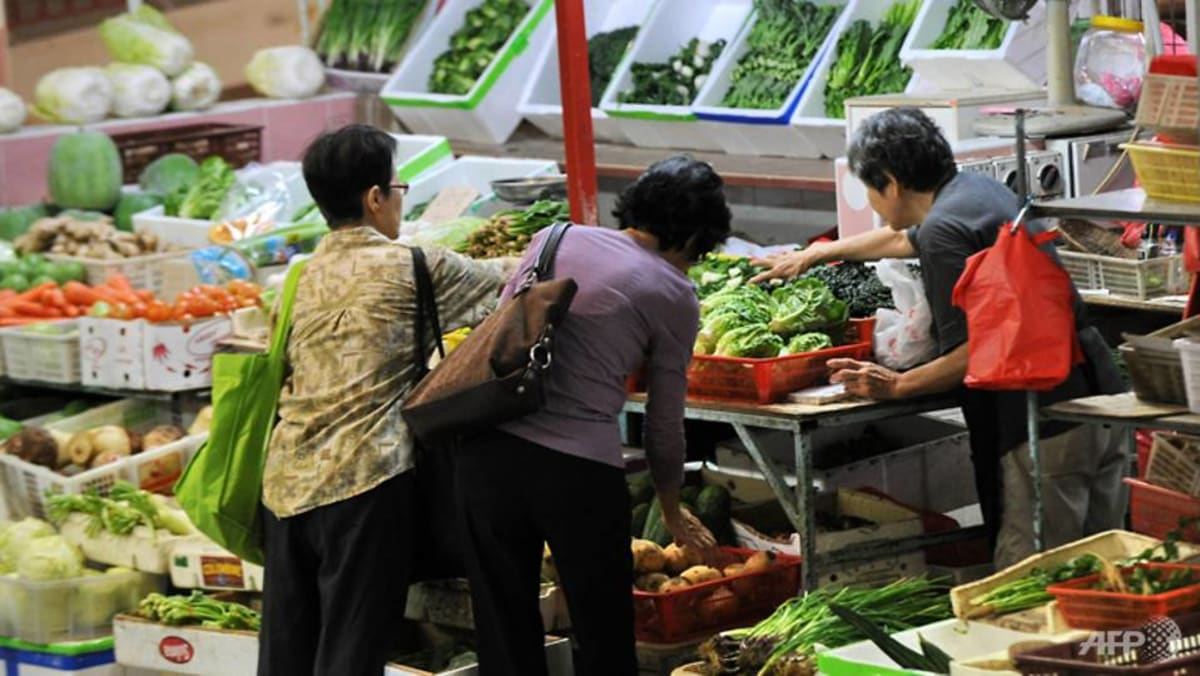
Commentary Singapore cannot close itself off to global food trade, so it must anticipate and detect risks before they arrive, says Paul Teng of ISEAS-Yusof Ishak Institute. Three women pick out vegetables at a wet market in Singapore. (Photo: AFP/Roslan Rahman) New: You can now listen to articles. This audio is generated by an AI tool. SINGAPORE: A food safety scandal thousands of kilometres away can quickly become a concern for Singapore.That was demonstrated recently when reports emerged that traders in Hebei, China, had illegally treated cabbages with formalin, a solution of formaldehyde, to extend their shelf life. Formalin is a chemical commonly used as a disinfectant or preservative, and it is a known carcinogen.Singapore responded by stepping up surveillance and testing. The Singapore Food Agency (SFA) on Sep 4 said it found no evidence of formalin contamination in the cabbages and other vegetables from China that it tested.But the episode raises a larger question. In a country that imports more than 90 per cent of its food, how vulnerable are Singapore consumers to food safety failures occurring overseas, and what can we do about them? THE PRICE OF FOOD RESILIENCESingapore’s food resilience depends on sourcing food from more than 180 countries and regions worldwide.Geographic source diversification is one of our great strengths to deal with threats like plant and animal diseases, extreme weather, war or export restrictions. If supplies from one country are disrupted, importers can turn elsewhere.But diversification creates the challenge of assuring the safety of food originating from sources that have different farming systems, climates, regulations and food-safety cultures.A vegetable may pass from farm to collector, packing house, wholesaler, transporter, exporter, importer and retailer before reaching our kitchens. At every stage of the supply chain, something can go wrong.The risks include bacteria such as salmonella and E. coli, viruses and parasites, pesticide residues, undeclared allergens, toxins and deliberate adulteration. The World Health Organization estimates that annually, around 866 million people worldwide become ill from contaminated food, with about 1.52 million deaths.Even countries with sophisticated food-control systems are not exempt. In the United States this year, authorities have investigated E. coli associated with frozen blueberries and raw cheddar cheese, salmonella associated with eggs and jalapeno peppers, and cyclospora associated with iceberg lettuce.Food safety failures are therefore not simply a problem of poorer countries or weak regulatory systems. They are an unavoidable risk of modern food systems. This is an important underpinning principle. HOW DOES SINGAPORE PROTECT ITSELF?Singapore's protection starts before some foods even leave their country of origin. Potentially higher-risk foods such as meat and eggs are subject to source accreditation to avoid contamination.In 2025, for example, SFA approved new overseas sources for eggs, poultry, pork and beef subject to its regulatory framework.Surveillance for contamination continues even after food enters Singapore. SFA adopts a “farm-to-fork” approach, regulating imports, primary production, local manufacturing and food retail. It assesses risks based on food safety incidents, reports of non-compliance and test results, then takes steps to mitigate such risks.Between April 2024 and March 2025, SFA tested more than 6,000 food samples from retail outlets under its Market Monitoring Programme. The programme looks not only for conventional safety hazards but also problems such as undeclared allergens.The effectiveness of SFA’s measures is encouraging. SFA reports that major foodborne illness cases associated with outbreaks involving at least 15 people fell from 22.8 per 100,000 population in 2024 to 16.8 in 2025. ANTICIPATING THE NEXT THREATHowever, food safety breaches that originate abroad raise a harder question: Can we detect what we don’t suspect?Singapore intensified testing after reports emerged of the formalin-treated cabbages in China. But what happens when there is no such report?It is impossible to test every shipment for every conceivable hazard. A modern food-safety system must therefore do more than react to known threats. It must become increasingly good at anticipating where the next threat may come from.That means combining conventional inspections with international intelligence-sharing, rapid exchange of outbreak information, better traceability and increasingly sophisticated data analytics. All this depends too on building networks with relevant national and international bodies.Artificial intelligence could eventually help regulators detect unusual patterns across information on suppliers, previous violations, disease outbreaks, weather, laboratory results and international food alerts.New laboratory capabilities are equally important, and Singapore is fortunate that it can afford sophisticated and often expensive diagnostics. VIGILANCE, NOT ALARMConsumers should therefore take overseas food scares seriously – but not panic whenever one appears.Singapore's reliance on imports makes zero risk impossible. Indeed, no country can guarantee completely risk-free food.What matters is having multiple layers of protection: reliable overseas suppliers, surveillance and laboratory testing, international information exchange, and responsible food handling by retailers and consumers.Our best defence is therefore not to close ourselves off from global food trade, which we cannot do, but to become better at anticipating and detecting risks before they reach us. Early warning is far better than damage control.In the end, Singapore's biggest vulnerability is not unsafe imports we know about, but emerging hazards we do not yet know to test for.Paul Teng is Visiting Senior Fellow of the Climate Change in Southeast Asia Programme at ISEAS-Yusof Ishak Institute.
Commentary: How concerned should Singapore be about food safety lapses abroad?
Full Article
Original Source
Read the full article at Channelnewsasia →KhanList aggregates and links to publicly available news content. We do not host full articles from third-party sources. Always verify important information with original sources.