
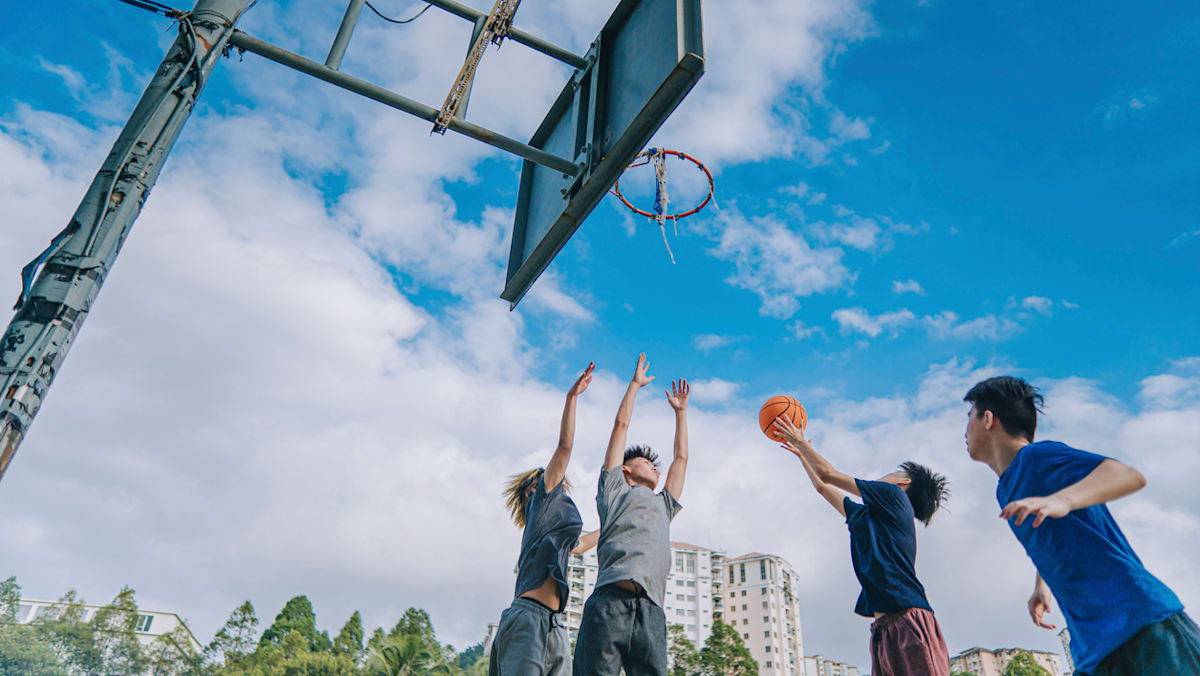
Commentary Sports used to be fun until my children got involved in competitive sports, says father-of-two Victor Seah. But why does it have to be this way? Youths playing basketball. (Photo: iStock/Edwin Tan) New: You can now listen to articles. This audio is generated by an AI tool. SINGAPORE: If you ever owned a tripod to record your child’s sports games, sat your family in front of the TV to review the footage, gesticulated at your child during their game, you are possibly a crazy sports parent.I am, unfortunately, one too. And I am tired. Sports used to be fun. It started as part of a cherished family ritual of weekend stayovers at my mum’s, which ended with a trip to the park to leisurely play badminton, soccer, and basketball. My sons would smile giddily throughout the entire time we played sports. It was wonderful.Also wonderful was meeting national players and legends on a weekly basis when my kids went for their ActiveSG classes. For a period, I was in the same WhatsApp groups as my boys’ football coaches “Super Sub” Steven Tan and Rafi Ali – very cool. My boys were also coached by national basketball players, such as John Ng, Tay Ding Loon and Wu Qingde. They were amazed to see their “Coach Qingde” on TV playing for Singapore at the Southeast Asian Games a few days after their classes.Inspired, my children started playing competitive basketball and rugby. Like many parents, I supported their decision, seeing it as a way for them to build character and challenge themselves each week.And like many parents, we were also attracted to the prospect of them applying to secondary schools through the Direct School Admission (DSA) scheme. But we have also realised that a child’s involvement in competitive sports can be less than fun. THE PAIN OF COMPETITIVE SPORTSFor the kids, competitive sports can literally be painful. At one rugby tournament I attended, a nine-year-old dived into and injured an opposing rugby player lying on the ground. The offender, who received a thumbs-up from a misguidedly proud father, was sent off and the injured child spent the rest of the tournament cheering from the sides with a bag of ice pressed against his body.It can be painful for parents too. Watching my sons spar during Brazilian Jiu-Jitsu classes evokes a visceral reaction in me: body tense, muscles twitching.But mostly it’s psychological pain. My wife and I have had our share of trouble sleeping before a selection trial or after a bad loss.There’s also logistical headaches. Weekends become a relay across the island, from one competition to the next, with mum and dad often splitting the driving and the children between them. A mother we know arranged with her employer to be paid less in exchange for the flexibility to ferry her children between sporting activities. A father once faked a stomach upset during a meeting with business counterparts in Taiwan so he could slip out and book a coveted ActiveSG class slot. Then there are the costs. One family we know spends several thousand dollars a month on private tennis coaching. Basketball training costing S$100 a session is not unheard of. To think my family used to play basketball at the neighbourhood court with an overinflated football! WHEN PARENTS CAN’T STAY ON THE SIDELINESThe competition extends to the parents too.For instance, the stress of needing to be in the “in-group” where in extreme cases, children get secret extra training and more game opportunities. There are times too when parents form their own teams for their children to play in competitions. One will soon learn that whether your child gets to play can depend on whether you are in the right circle. I have seen children who would not pass the ball to weaker teammates, and parents of stronger players who would not talk to the parents of weaker ones.Much of this comes from a protective instinct. As one father told me: "We all want to protect our kids and hope they all have opportunities to grow and shine." But protecting one’s child can quietly turn into excluding someone else's.Social media adds another layer: the celebratory post of one child beating another, shared for everyone to see, including the other child and their parents.At times, I have found that the greatest source of stress has been navigating the “crazy”, if I may say so, behaviour of other parents.IS DSA THE CAUSE OF IT ALL?What drives parents to such behaviour? Part of the answer may lie in the stakes attached to youth competitive sports these days. Introduced in 2004, DSA is meant to recognise students’ non-academic talents as a pathway to secondary schools. Authorities have noted that the DSA has turned into a “second front” in the education arms race for some. The scheme is under review, with some calls for it to be scrapped. DSA is imperfect. It can favour children from better-off households. Being able to take a pay cut to ferry your children around or sending your child for one-on-one rugby coaching on a weekday afternoon are luxuries many families cannot afford. A child admitted for sport may also struggle to keep up academically, adding pressure after enrolment. But removing it would be a mistake. A common refrain among parents is that "during our time", we never had this much structure or opportunity in sport. DSA gives schools a reason to invest in sports and co-curricular activities, and gives children and parents a reason to take them seriously.It also helps sustain a wider ecosystem. Demand for coaching means some of our finest athletes, like the national players who coach at ActiveSG or private academies, can make a living from their expertise instead of leaving for unrelated industries.PARENTS, THE PROBLEM LIES WITH USIf DSA is worth keeping, then the answer to the “craziness” lies less in the system and more with us, the parents.It starts with recognising what our craziness costs our children. After some games, the drive home became a post-match review, with me doing most of the talking and, all too often, the shouting. My sons were certainly not smiling giddily on those drives.We can be the sporting heroes we want our children to admire. That means calling out bullying, disrespect and dirty tackles, including our own child's, and asking why when we notice a child being left out. We can also resist living our dreams through our children. One father told my wife that he had tried unsuccessfully to represent his junior college, and now hoped his son would make the selective team he never did. It is an understandable wish, but a heavy one for a child to carry.And we can step back from the politics of the sidelines. My own strategy, though not always successful, is to say a polite hello to everyone, then sit on my own with my laptop.Lest you think this is a Singaporean-only affliction, the same issue extends to expatriate parents too. At one rugby club, I have seen parents arguing with one another on the sidelines, as well as parent-coaches physically steering children into position so that their own child is the one to score the try.Craziness is contagious, but so is grace. One mother we know cheered for my son even when he was playing against hers, and was unfailingly positive towards her own child. Sitting beside her, we found ourselves cheering more positively too, including for her son.Sometimes, the healthiest move is to walk away. We recently pulled out of a competition that was causing the whole family a great deal of stress. Instead of reviewing game footage that Sunday, we went cycling, then played some truly awful football together. We had a wonderful time.At its best, sport is also about community. We have shared barbecues and gatherings with other sports parents, and there have been moments when I felt I had found my tribe. We are still finding it. And I am still trying not to be a crazy sports parent.Victor Seah works in higher education and is a father to two primary-school-going children.
Commentary: Can we support our children in competitive sports without becoming ‘crazy’ parents?
Full Article
Original Source
Read the full article at Channelnewsasia →KhanList aggregates and links to publicly available news content. We do not host full articles from third-party sources. Always verify important information with original sources.