
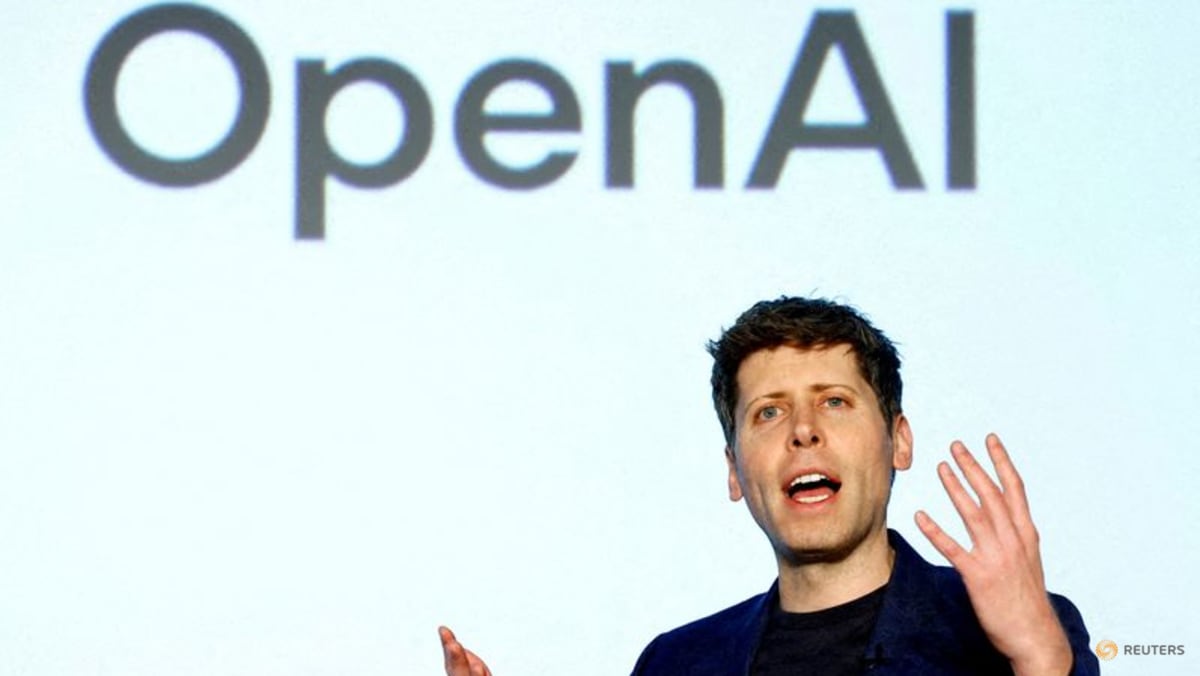
Commentary Despite loud pledges to prioritise safety, the OpenAI CEO has fired the starting gun on a dangerous AI arms race, says Parmy Olson Bloomberg Opinion. OpenAI said its ability to monitor its new model Astra has decreased. CEO Sam Altman is seen here in a photo from Feb 3, 2025. (Reuters/Kim Kyung-Hoon/File Photo) New: You can now listen to articles. This audio is generated by an AI tool. LONDON: Artificial intelligence researchers have spent the last year toying with a compelling proposition: AI models could be more powerful and cheaper to run if they disclosed less about how they worked. The trade-off is risky, as it could become harder for humans to check the systems aren’t doing anything harmful. But it would also provide a commercial advantage.OpenAI CEO Sam Altman appears to have decided that edge is worth pursuing. Despite loud pledges to prioritise safety, he’s fired the starting gun on a more dangerous race in AI development. Astra, a new model that OpenAI launched on Thursday (Sep 3), reportedly uses a method called “recurrent depth” that can make reasoning more efficient by not spelling it out in human language. The company said in a blog post that its ability to monitor Astra had “decreased” from the previous model, called GPT‑5.6 Sol. AI “CHAIN OF THOUGHT”Current models give a window into some of the steps they take to process a request. Colloquially known as their “chain of thought,” it helps researchers understand the decision-making flow, including how several of OpenAI’s agents hacked into the servers of Hugging Face earlier this year.Without that insight, scientists would have had a harder time seeing how the technology stole test answers, or that it was ultimately driven by reward hacking.The recurrent-depth method works by looping information through the same neural network layers over and over, without needing a new set of parameters for every additional step of computation. It’s a bit like redesigning a factory assembly line that has lots of different workstations, each tweaking the product as it passes through. With recurrent depth, a smaller set of workstations can work on the product repeatedly.COMMUNICATING IN LANGUAGE HUMANS DON’T UNDERSTANDThe broader idea of letting AI “reason” in numerical representations without the additional step of translating that reasoning into human language has been studied for years by academics. Back in 2017, Jacob Andreas, a then PhD student at the University of California, Berkeley, and his co-authors looked at how two AI agents could communicate using their own numerical representations. The scientists called this artificial vernacular “neuralese” and developed a tool for translating it into natural language.Unfortunately, no amount of time spent on Duolingo will help a person learn neuralese. The hidden numerical representations AI systems use can look something like this: [-0.1565, -0.1862, 0.0528, …, -0.1188, 0.0662, 0.5470].Compare that with a human-readable chain of thought when someone asks ChatGPT to write a polite email, which might look like this: “The user wants a polite email. I should keep the tone friendly and professional…” The more reasoning that happens in these hidden representations, the harder it can be for researchers to follow.Altman took to X on Wednesday, the day after news broke about Astra’s use of recurrent depth, to reassure that OpenAI was “sprinting on safety priorities” and striking a balance between creating AI that’s powerful and “benefits people” while remaining safe. OpenAI has reportedly limited Astra’s use of recurrent depth so its researchers can still monitor its chain-of-thought, too.Yet Altman seems to be straying from the path of surety to help smooth OpenAI’s route toward a US$1 trillion initial public offering. After all, better AI systems lead to increased revenue and more cloud usage. AN ARMS RACE IN THE SHADOWSAlthough OpenAI is limiting “silent thinking” by Astra, it’s still poised to become the first major AI company to bring this risky trade-off to market, which is worrying when Astra is also OpenAI’s first model to reach what’s called a “critical” cybersecurity risk level, meaning it can find and exploit new software vulnerabilities.And there are broader consequences in a business where pressure to stay ahead leads even the most safety-conscious companies to commercialise techniques that are potentially harmful.Anthropic, for instance, said in June that it was developing AI systems that could improve themselves. While admitting humans risked losing control with that method, Anthropic said it couldn’t simply pause its work: The “least cautious actors” would catch up, and that could “leave everyone less safe.”In other words: “We’re the good guys, so we should build this first.”However these firms justify their dangerous new tech, they’re in an arms race and facing what’s known as the “security dilemma” in international relations: One country builds up its weapons stockpiles to try and stay safe, but that prompts rival nations to do the same because they fear falling behind — leading to escalation. FILE PHOTO: CEO of Anthropic Dario Amodei, addresses the gathering at the AI Impact Summit, in New Delhi, India, February 19, 2026. REUTERS/Bhawika Chhabra/File Photo Once the Soviet Union knew the US had an atomic bomb, it had a powerful incentive to build one too. Everyone wants to be secure, but giving in to the pressures of the race pushes us all toward greater danger.The same dynamic is playing out in AI, with new innovations bringing a safety cost that even the industry’s own researchers are worried about. An arms race is dangerous enough when you know what everyone is building. This one is poised to drift into the shadows. Related Topics AI OpenAI Also worth reading
Commentary: Altman's Opaque AI Is creating a new security dilemma
Full Article
Original Source
Read the full article at Channelnewsasia →KhanList aggregates and links to publicly available news content. We do not host full articles from third-party sources. Always verify important information with original sources.