
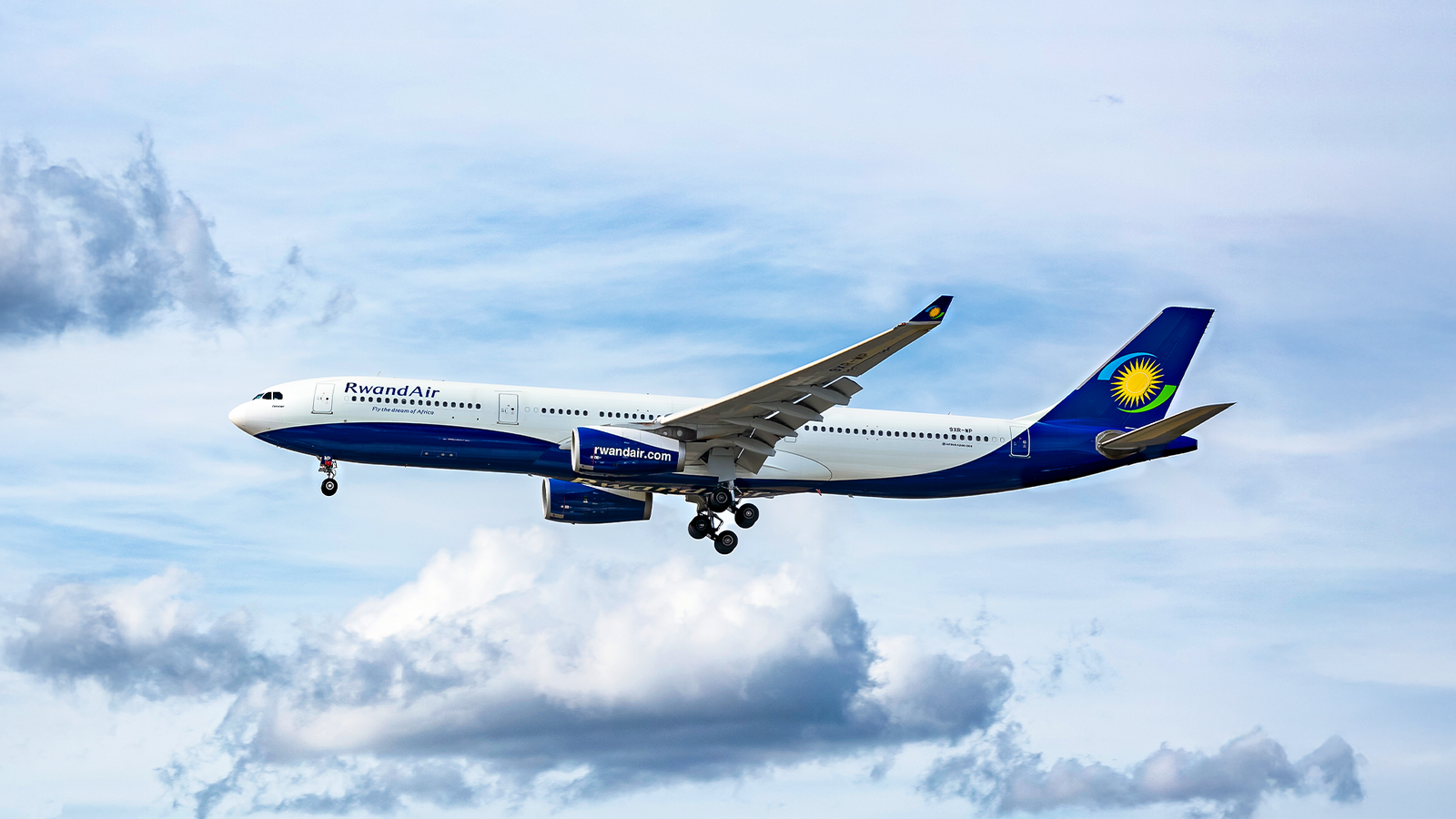
A large portion of the global commercial aviation sector fixates on multi-billion-dollar backlogs for next-generation, re-engined aircraft types, all while a quieter and more pragmatic fleet strategy is unfolding in East Africa. RwandAir has initiated an aggressive widebody expansion program, welcoming a new Airbus A330-200 to its Kigali hub as the first of five classic widebodies slated to join its operations. In an industry where newer invariably commands the media spotlight, choosing established, non-neo aircraft is rarely seen today. RwandAir's fleet growth sets the stage for a massive commercial push for the airline, touching on everything from high-yield regional connectivity to untapped intercontinental demand. Speaking with Simple Flying's Sumit Singh exclusively at the World Travel Market (WTM) in London, Reuben Mbonye, Acting Chief Commercial Officer of RwandAir, outlined how matching aircraft economics with passenger comfort is what is leading the airline's trajectory. But how does passing on the latest technological iterations position a growing mid-sized carrier to outmaneuver cost pressures while scaling its global coverage? Opting For A Proven Path The decision to scale widebody operations with five additional A330-200 airframes, leased to distribute capital exposure, with the initial delivery touching down on August 24, 2026, and subsequent arrivals scheduled within the current financial year, rests firmly on immediate availability and capital discipline. It is no secret that next-generation neo variants promise marginal fuel burn improvements, but their exorbitant acquisition costs, manufacturing delays, and lengthy order backlogs make them a difficult proposition for a carrier seeking rapid, scalable network expansion. RwandAir has therefore opted for proven, readily available A330 units, which allows the airline to avoid the entry-into-service issues plaguing modern original equipment manufacturers. This acquisition strategy is deeply rooted in existing operational ecosystems, as noted by Mbonye during his exclusive discussions with Simple Flying. RwandAir already has an established widebody fleet of Airbus aircraft, so introducing additional A330s maximizes economies of scale across maintenance, spare parts provisioning, and flight crew currency. Training pilots on a familiar type rating takes away the steep financial overhead and scheduling friction associated with introducing a completely new aircraft family, so that the new assets transition smoothly from delivery to revenue-generating service. The classic A330 platform offers a balanced payload-range capability tailored precisely to medium and long-haul trunk routes connecting Africa with Europe and the Middle East, without the excessive capital depreciation tied to brand-new airframes. According to reports from The New Times and ch-aviation data, the structured leasing model gives the airline the ability to expand capacity incrementally and shield its balance sheet from volatile market price spikes at the same time. Despite this, tying a major international growth phase to older aircraft frames makes challenging global network carriers difficult. Maintaining a passenger product that can fiercely compete against rivals flying state-of-the-art hardware is where the airline is seeking to put a lot of its focus. Better Seat Pitch Than Its Rivals? For RwandAir, the way to truly compete with rivals is prioritizing stability rather than reinvention. Initiating disruptive and financially burdensome mid-cycle cabin retrofits on its incoming widebody batch is not the best way forward in this scenario, so the carrier has firmly committed to maintaining its tried-and-tested multi-class product configurations across both Business and Economy cabins. Take Air India's 787-8 retrofits as an example; as detailed by Avi-Go, the first retrofitted aircraft fell 2 years behind schedule, which for a small fleet like RwandAir's would be catastrophic. This philosophy of product consistency was underscored by Reuben Mbonye during his discussions at WTM London. Mbonye explained the decision to preserve the existing hardware across the expanded widebody fleet. "At this point in time, we are looking at maintaining the existing products, which is the business class and economy class cabins. In terms of whether we'll be considering other products that would be, I wouldn't say anytime soon because it all depends on the demand. So right now, I can say the product in business class has been so far so good. The same applies to economy, so we will maintain that." — Reuben Mbonye, Acting Chief Commercial Officer of RwandAir Elaborating on what makes these cabins resonate with international travelers, Mbonye highlighted the unique blend of comfort and personalized service, "The service stands out, of course. We have the Rwandan hospitality touch to it, so I think this is what most people really enjoy: the fact that we're able to give the client that satisfaction based on you know the experience they'll have all through. And considering that, of course, most of our when you look at the wide bodies, we have the live flat beds, for instance. So that's one good feature that they take. Plus the in-flight entertainment that comes along very well for most of our customers." The commitment to passenger experience extends directly into the economy cabin, where Mbonye pointed out that fleet-wide metrics compiled alongside data from ch-aviation confirm "when you look at the seat pitch, it's when you compare it with other carriers. I think you find our seat pitch is much, much better." The New Global Challenger Moving from the economic rationale of fleet commonality to practical network application, the arrival of five additional widebodies massively changes how RwandAir deploys capacity across its international trunk routes. Instead of adding speculative frequencies to saturated regional corridors, the carrier is placing its trust in the incremental gauge of its A330-200 fleet to scale traffic between its hub at Kigali International Airport (KGL) and high-demand markets across Europe, Africa, and the East Asia. Ultimately, the deployment puts the airline in a new era of operations, going from constrained point-to-point flying toward a more robust hub-and-spoke consolidation model. The strategic deployment of these widebodies is guided by comprehensive market studies and not pure guesswork, ensuring each airframe captures optimal yield. Detailing the airline's network focus during discussions at WTM London, Reuben Mbonye emphasized, "We are mostly focused. It's a global thing. If you look at it, beat Europe, beat Africa. We're trying to expand as much as possible. As you know, right now the demand is there. It's quite high, and so we are trying to focus on destinations that will bring in others. So, so far there are a lot of studies going on to see where exactly we get the best value." Such an analytical approach supports ongoing evaluations for potential network additions, alongside planned evaluations for returning to historical high-yield gateways like Mumbai Chhatrapati Shivaji Maharaj International Airport (BOM) and Guangzhou Baiyun International Airport (CAN), as reported by IGIHE News. Route Market Operational Status & Equipment Strategic Focus & Target Yield Kigali – Paris / Brussels Active service (A330-200, 226 seats) Core European trunk lines capturing corporate and leisure traffic Kigali – Frankfurt Under active evaluation Deepening Central European commercial integration Kigali – Mumbai / Guangzhou Candidates for service restoration Re-establishing high-demand economic corridors to Asia Embarking on a widebody-driven network expansion across multiple continents does bring some very immediate operational hurdles. Channeling increased passenger flows through a single East African hub means looking beyond flight schedules to examine the broader macroeconomic and structural barriers shaping African aviation today. The Rise Of Aviation In Africa Beneath the immediate calculus of lease rates and seat pitch is a much larger, structural narrative, with the profound under-penetration of commercial aviation across the African continent. Established aviation markets in North America and Europe face maturity and capacity constraints, whereas Africa is a massive demographic frontier where commercial flight is still, for the most part, an untapped luxury for the vast majority of the population. The structural imbalance here forms the macroeconomic foundation of RwandAir’s widebody expansion, changing what might otherwise be viewed as regional risk to a calculated long-term demographic play supported by independent market analyses from the World Bank and the African Airlines Association (AFRAA). Industry data compiled by the International Air Transport Association (IATA) consistently highlights that despite harboring immense economic potential, African carriers experience substantial operating friction from regulatory fragmentation, inflated jet fuel prices, and high intra-continental taxes. Simultaneously, these very barriers create an extraordinary vacuum for well-capitalized carriers capable of connecting regional gaps with reliable widebody capacity. Emphasizing this immense untapped runway during his WTM London briefings, Reuben Mbonye noted the stark contrast defining the continent's aviation landscape, pointing out that Africa accounts for "almost fifth of the world's population, but out of that, only 2% account for air travel," adding that "generally in Africa it remains underserved." To convert this demographic promise into sustainable revenue, carriers need to work within complex liberalization frameworks such as the Single African Air Transport Market (SAATM), designed to remove fifth-freedom traffic restrictions across participating states. As regional connectivity matures and regulatory hurdles gradually recede, airlines with standardized, highly efficient widebody fleets will be uniquely positioned to capture high-yield connecting traffic before foreign mega-carriers dominate fifth-freedom corridors. Local Investment Is Equally Ambitious Transitioning from macro-level growth projections to real-world results, taking in five additional widebodies into a single-hub network places immediate, rigorous demands on ground infrastructure and operational turnaround times. Operating out of Kigali International Airport (KGL), RwandAir’s technical dispatchers, flight crews, and ground handlers will need to manage increased rotations in a way that does not compromise schedule reliability. Using a structured leasing model for the A330-200 fleet, as highlighted in reports by ch-aviation and Business Insider Africa, allows the airline to match capacity scaling directly to facility readiness. The operational scaling aligns directly with national infrastructure milestones, most notably Rwanda's multi-billion-dollar development of Bugesera International Airport. Designed to handle an initial capacity of seven million passengers annually, Bugesera is the perfect base to support RwandAir's ambition of doubling its overall fleet size over the next five years. In reality, scaling a widebody fleet successfully depends as much on apron space, maintenance hangars, and cargo logistics at the main hub as it does on passenger demand across intercontinental corridors. Operational Parameter Baseline & Infrastructure Target Strategic Impact On Hub Operations Hub Capacity Kigali International Airport (KGL) and upcoming Bugesera development (7 million capacity) Accommodating expanded widebody rotations and surging cargo volume Fleet Structure 5 leased Airbus A330-200 airframes (226 seats) Controlled capital expenditure and streamlined maintenance commonality Commercial Metric Two-way passenger flow (Europe, Africa, Asia) Ensuring high load factors across newly expanded trunk routes Ultimately, the success of this widebody expansion is going to be measured with two-way traffic generation, balancing incoming European and Asian visitors with outbound African connectivity. Coupling disciplined lease financing with long-term infrastructure upgrades, RwandAir is on a mission to show that mid-sized African carriers can scale effectively on their own terms. With these four remaining A330 airframes joining the fleet before the financial year closes in June, the airline's operational resilience in Kigali is about to set the scene for a very bright future ahead. A Clear And Exciting Growth Strategy In an aviation climate obsessed with multi-decade order backlogs and carbon-neutral pipe dreams, RwandAir's widebody playbook is a masterclass in aggressive pragmatism. Placing its trust in leased A330-200 platforms to champion its international ambitions rather than waiting on delayed next-generation hardware, the airline has chosen balance-sheet velocity over speculative hype. Now is really the time to keep a close eye on Kigali and long-range corridors to Frankfurt, Mumbai, and Guangzhou. RwandAir has a very clear strategy for how it sees its ability to grow in the global market, not just in the regional African market. The next few years will be pivotal for the airline in its quest to take on global markets, but what is certain is that RwandAir is on a very exciting path forward.
Comfort, Capacity & Lower Costs: Why This Airline Is Expanding Its Airbus A330 Fleet
Full Article
Original Source
Read the full article at Simpleflying →KhanList aggregates and links to publicly available news content. We do not host full articles from third-party sources. Always verify important information with original sources.