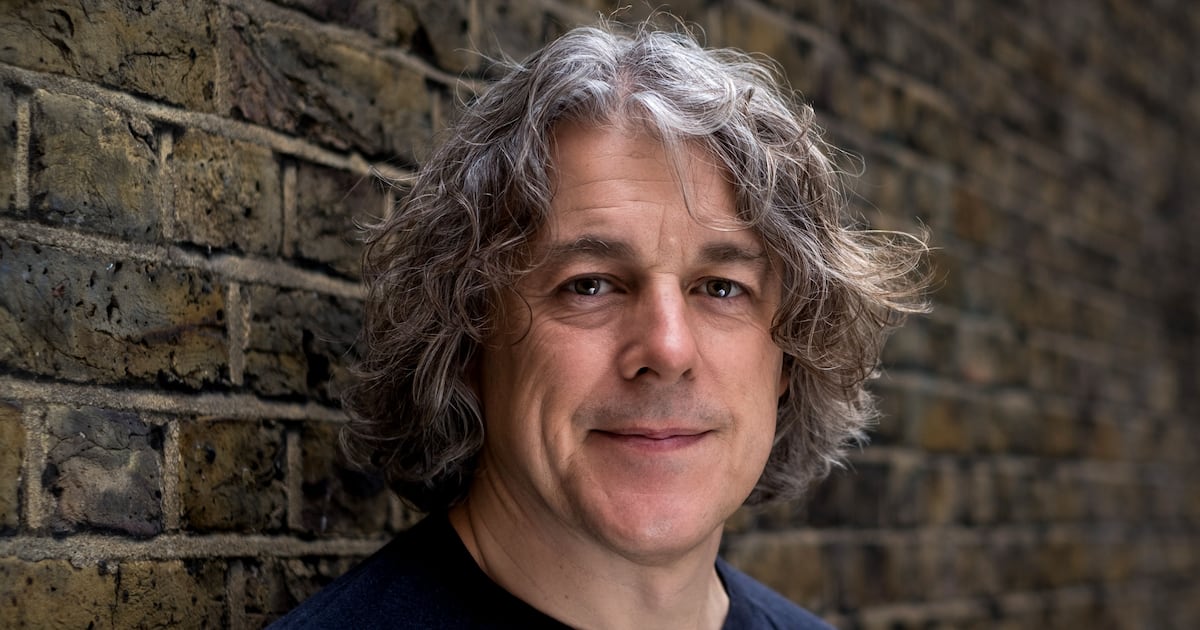
Alan Davies is “funnier than ever”. It’s on the blurb for Think Ahead, his first stand-up show in a decade, and it’s true, he says. “I feel like I’ve presented a show that, if it was a cake, it’s the whole cake, with all the ingredients. And I think it’s a similarly nice cake. Better than the last cake.”In the show he talks about the travails of turning 60 and the “relentless eye-rolls” he receives from his kids, but he also goes to “certain places”, having decided he was ready to “talk about what my father did, and how I ended up having him arrested”. He laughs gently as he notes that this might not sound like a comedy show. “But it is.”In 2020, Davies revealed that he had been sexually abused by his father from the age of about eight until 13. He wrote about it in Just Ignore Him, a devastating memoir about the loss of his mother to leukaemia when he was six and his subsequent manipulation by a self-serving, predatory father who came into his bedroom to molest him.In last year’s follow-up, White Male Stand-Up, he went on to re-evaluate how his life and career as a comedian and actor unfolded while he was “carrying all of this stuff, secretly – this secret shame”. It made him an “angry boy”, which he didn’t want to be.READ MOREThink Ahead delves into this, although he stresses there’s still “a fair amount of frivolity” in his stand-up.“I absolutely begin the show by trying to whip up as much comedic euphoria as I can. I like to get going quickly; I like to get laughs,” he says from his north London home. He’s softly spoken and reflective and can do several interviews like this in a day, but there was a time when he didn’t want to; nor did he imagine he would ever address on stage the reality of his childhood.“I really thought it was just for a book,” he says. “There is that feeling with a book or an audiobook of it being between you and the reader. They can take their time with it and go where they want with it.”When Just Ignore Him came out, mid-pandemic, interviewers asked him about the abuse. “I said, ‘No, you don’t understand. I don’t want to talk about it. I’ve written about it.’”Someone who has had a terrible experience as a child is not obliged to talk about it to anyone, he says. “They will tell their story in their own time, in a way that suits them, to the person they want to tell it to.”Alan Davies. Photograph: Tony Briggs So he told the journalists that the answers to their questions were in the book. But the Covid years were grim for live comedy, and he was soon keen to tour again. He started to think that maybe audiences would listen to his story, and that he could tell it. Doubts about being able to “keep the level of laughs up” subsided.[ Sean Lock: 8 Out of 10 Cats comedian dies aged 58Opens in new window ]“As I get older and I become more experienced as a comedian, and see more of life, I realise that all around us are people with these stories, and all throughout the audience there are people who’ve had difficult experiences in their lives,” he says.“No grown-up wants to just have frivolity and superficial nonsense, at least not from someone who’s standing in front of them for about 80 minutes. It would be different if you were doing an eight-minute spot on a telly show. You could talk about your dog, get a few laughs, go home. I’ve done that myself a few times.”When he first performed Think Ahead, at Edinburgh Festival Fringe last August, the reception was assuring.“The audience were ready for this kind of storytelling. They want this sort of storytelling. They laugh their heads off, then they go totally silent and listen. They are engaged. “And it’s really gratifying in a period when you think all people want to do is stare at their phones. Do they want to gather in a room and hear stories? They do, because this is human nature. Stories are what we have, and humour is our superpower.”Alan Davies on stage in 2015. Photograph: Matthew Baker/WireImage After Edinburgh he toured the UK, then took the show to Australia. Now he’s back on the road in New Zealand, which will be followed by a string of dates in Britain and Ireland.He likes the welcome he receives in Australia and New Zealand. “If I’ve ever had a negative media story, if there’s ever been a bad tabloid story or something, it doesn’t seem to get there. And if it does, they don’t care.”Irish audiences are likewise prepared to enjoy themselves, he finds. “They’re able to decide that this is the time that they’re going to have a good time. They come for that; they want that. So I very much look forward to doing the show.”He is used to performing Think Ahead now, but the memory of his abuse sometimes causes shortness of breath – a “mild” iteration of post-traumatic stress disorder, he says. “It can still catch me when I’m talking about stuff.”At book signings, people occasionally approach him to share their own stories. “They like to come quietly and speak quietly and say, ‘Something like that happened to me, by the way,’ and that happens quite a lot, and it’s sad that it’s so commonplace. But one of the reasons why abuse of children is commonplace, I think, is because the child is shamed into silence.”Davies doesn’t question why people come to his shows – “I’m just delighted that they do” – and doesn’t know whether some of his audience now seeks him out specifically because they read Just Ignore Him.‘I’m not good with forgiveness. Occasionally I meet someone who talks to me about the value of forgiveness, which I am yet to be convinced of’— Alan Davies“It’s hard to imagine somebody coming across me for the first time. When you get to 60 and you’ve been doing it for 35-years-plus, you think surely people are more likely to think, ‘Oh my God, not this bloke again.’ “But I like the idea that someone might have picked up my book expecting one thing and then thought, ‘Oh wow, that’s not what I expected. I’ll go and see his stand-up: maybe there’s more to him than I thought. Maybe he’s a different sort of comedian than I thought he was.’ You’re always slightly pushing back against the public perception of you.”Davies started out in stand-up in the late 1980s. He believes his pursuit of laughs from strangers was a quest to find the love and attention he had been missing since his mother died, although this self-analysis came later, as did the realisation that, with a dysfunctional family behind him, he was seeking surrogate families everywhere he went.His fame soared in 1997, when he was cast as the duffel-coated title character in Jonathan Creek, David Renwick’s comedy-mystery drama about a magician’s assistant who solves crimes through his understanding of illusions. It was watched by millions – more than 11 million, at one point – on BBC One.He remains a regular presence on television courtesy of QI, the BBC Two comedy panel show on which it is better to be quite interesting than correct. Davies, the only permanent panellist, plays the daft foil to the knowledge-armed hosts of the show (Stephen Fry, then Sandi Toksvig), which has run for 23 seasons and counting.Alan Davies with his Jonathan Creek costar Caroline Quentin in 1996. Photograph: Larry Ellis Collection/Getty During his hiatus from stand-up, he went “away from everything” to do a two-year master’s degree in creative writing at Goldsmiths, University of London, which included a life-writing component led by the author Blake Morrison.“It was a given on the course that you didn’t talk about other people’s work, certainly not on social media or anything like that, and what was talked about in workshops was private,” he says.A Goldsmiths graduate came in one week to discuss the novel she had written about her own rape. “You realised that all around you there were people trying to find a way to create a piece of art or something worthwhile from the darkest, bleakest thing.”The course taught Davies how to write about his childhood in 1970s Essex, but he already knew he had to do it. “It was getting in the way of everything else that I wanted to write. If I wanted to write a script or something, I just couldn’t get away from it. It was the first thing in my head all the time.”There was another catalyst. In 2017, his stepmother told him that his father had amassed a collection of images of naked boys, some labelled “teens”. Davies reported him to the police, telling them what happened to him. The UK’s Crown Prosecution Service found his evidence “credible and compelling”, but declined to prosecute. By this point his father had Alzheimer’s, and he died in 2023.Davies is “very proud” of Just Ignore Him, which is darkly humorous but mostly heartbreaking. It begins with the loss of his mother, who was not told she was dying, denying her the opportunity to say goodbye. His memories of her are finite but potent. After she died, his father directed terrifying “surges of flat-handed rage” at him. When the “special cuddles” began, he initially reasoned that it was an improvement on being hit.White Male Stand-Up, “kind of the part two”, covers entertaining showbiz ground but is still threaded with pain, with Davies fearing he has become a “drunken adult incarnation” of the fight-prone, misbehaving boy he was in his lonely, confused school years. Something needed to change, for his own sake and that of his wife, the children’s author Katie Maskell, and their growing family.“When my daughter was born, I really didn’t want to be like my father, so if – or when, rather – I shouted at her for some misdemeanour, I would always find her and apologise. I remember going to her one day and saying, ‘I’m sorry I shouted at you,’ and she said, ‘Oh, Daddy, you always say that.’ It made me laugh, but I thought, ‘That’s okay. That’s still better.’”Abandoning the burden of secrecy has been beneficial, he says.“I feel like I’ve never really understood or particularly believed in the term closure. When people talk about closure it’s a bit of an Americanism. But I think this, in some sense, did give me some closure, because I’ve told that story now. All the details are there.”It would be going too far, however, to say the process was cathartic.“I’m not good with forgiveness. Occasionally I meet someone who talks to me about the value of forgiveness, which I am yet to be convinced of. It feels like you’re being asked to do something else now. ‘And now you have to do this.’ No, I’m not doing anything any more.”Alan Davies with Zoe Lyons, Sandi Toksvig, Chris McCausland and Ed Byrne on QI. Photograph: Freemantle/BBC He talks about his daughter, now 16, and his sons, aged 15 and 10, in his live show “a fair bit”. They haven’t seen his stand-up, but they know this is what he does.“They once saw me on TV talking about taking my daughter to soft play. I really hurt myself and was wondering if I was ever going to be able to get out of the soft play without cutting the roof off the place, because I kind of got stuck in a mangle thing. They realised I was earning money from telling stories about them – and they felt they had a right to ask for more toys,” he says, laughing.In the show he recalls a trip to Back to the Future: The Musical with his youngest, who detected a resemblance between him and Doc Brown, the mad scientist. Davies discovered he was much older than Christopher Lloyd was when he played him in the film. Suddenly he was at an age when he was spending more time in the pharmacy than in the gym.In his set, he doesn’t dwell on a recent cancer scare – he had an operation to remove a tumour from his bladder in 2024 – but failing body parts do feature.[ Comedian Davies puts foot in it and angers Anfield faithfulOpens in new window ]One night an audience member’s phone went off mid-show.“I know that’s very annoying if you’re in the middle of a play and you’re in character, but for comedians sometimes it’s a gift. You just want them to answer the phone and tell you who it is. So I said, ‘Is that to remind you to take your medication?’ And she said yes. That was one of those laughs where it was completely out of the blue and unexpected, and it wasn’t even me who got the laugh. It was the woman in the third row.”He loves it when laughs mingle with surprise like this. “I’ve never really been a set-up-and-punchline sort of writer, someone like Frank Skinner or Jimmy Carr, amongst my peers. I’m more of a rambly storyteller. I quite liked Billy Connolly when I was younger. But if you can find a moment that they don’t see coming, then you get a real thunderclap of laughs, and there’s a massive sort of exhalation of breath from everyone. That’s really fun.”Davies has spoken before about having a “deeply ingrained eagerness to please”. He thinks it will always be a part of him.“At the Hay Festival I was being interviewed by Mel Giedroyc about my book. As soon as you go out on stage and you see people – and I’m sure Mel feels the same – there’s an instinct to try and get laughs going. “It’s very, very deep-rooted. For a long time, actually, I couldn’t go in the post office without trying to get a smile from the person selling me a stamp. It’s quite an affliction.”But he worries less now about trying to please everyone through stand-up. He tries to find as many laughs as he can, but he also wants to illuminate the complete picture, the stuff of life. “It’s not such a skin-deep, superficial thing these days.”Help is available if you have been sexually abused, including from One in Four (01-6624070, oneinfour.ie), Cari (0818-924567, cari.ie) and Dublin Rape Crisis Centre (1800-778888, drcc.ie). You can report child sexual abuse confidentially to the Garda on 1800-555222Alan Davies: Think Ahead is at Cork Opera House on Monday, October 12th; Ulster Hall, Belfast, on Tuesday, October 13th; and 3Olympia Theatre, Dublin, on Wednesday, October 14th; Just Ignore Him and White Male Stand-Up are published by Abacus and Monoray
Comedian Alan Davies: ‘I talk about what my father did, and how I had him arrested’
Full Article
Original Source
Read the full article at Irishtimes →KhanList aggregates and links to publicly available news content. We do not host full articles from third-party sources. Always verify important information with original sources.