
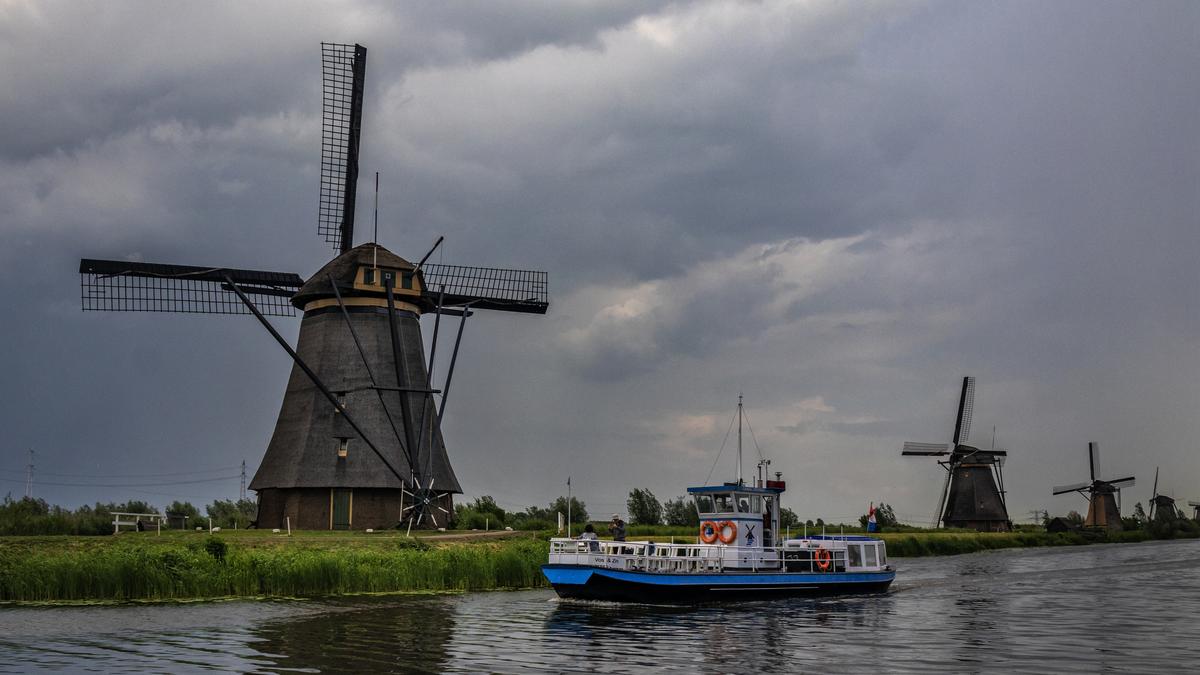
I’m writing this piece on a train hurtling through the Netherlands on my way to Copenhagen. We started in Amsterdam, where I’ve spent the past few months. A city of canals, with a water system so complex that understanding it makes you realise the country’s very existence is a sheer feat of engineering.About 26% of the country lies below sea level. An integrated ‘water defence’ system — which includes dikes, sand dunes, storm surge sluices, and the famous Dutch windmills built to pump excess water out — is what keeps the country afloat. On the one hand, it can be seen as an act of genius, but on the other, a gross example of human narcissism forcing control over its environment and nature.In his excellent novella, The Living Mountain, Amitav Ghosh exposes the politics of land and environmental colonialism, emphasising the role of European colonialism in the violent transformation of land, including the practice of land reclamation. He argues that this historical context is crucial to understanding the current climate crisis in the Global South. Colonial powers treated nature as an inert resource, exploiting it without regard for ecological balance or the rights of indigenous peoples.One only has to look at Bombay, once the pride of the British East India Company, to see the effects of this narcissism. Almost immediately after acquiring it in 1662, King Charles II of England started the process of land reclamation, creating a peninsula out of what was an archipelago of seven islands. Since there are decidedly no canals in the city, I personally blame the British for the flooding Mumbaikars face every monsoon — inevitable when one is living on what was once an ocean. A waterlogged road near Andheri subway | Photo Credit: PTI Ground water deficitIn India, we are lucky to not have to rely completely on groundwater, owing to the Himalayas and the glacial water they provide. Still, over 50% of the country’s water for agriculture comes from groundwater. And unlike the Dutch, who replenish their underground aquifers (60% of its freshwater supply comes from groundwater) by filtering wastewater and putting it back into the ground, a large part of our wastewater ends up in the ocean — lost to salt.Groundwater levels in India today are critically low, with many regions experiencing severe depletion. As of 2026, the average state of groundwater extraction stands at 60.4%, where extraction is taking place faster than replenishment. In fact, bad urban planning (hello, Bengaluru) has cities expanding so fast that aquifers that are used to replenish groundwater are being cemented over to build housing.India saw its first ‘water protests’ in Indore this year, where citizens blocked roads and demanded the Indore Municipal Board (IMC) provide water because borewells and tubewells had run dry. The IMC, in turn, began seizing illegal pumps, taking over private hydrants, and penalising buildings without functioning rainwater harvesting systems, in a desperate bid to fix the ‘problem’. The AI data centres in the city, however, remain out of their jurisdiction. Congress leader Umang Singhar and party MLAs stage a protest over Indore's water contamination deaths | Photo Credit: PTI The good newsWhat if we thought of soil not simply as a medium for growing crops, but as a vast, living water filter? Nutrient rich soil is one of the best water filters we have on our planet: it purifies through physical, chemical, and biological processes, breaking down and removing contaminants such as pesticides and heavy metals.In my more rebellious youth, I have been known to crack city pavements and other concretised areas just to let rainwater through, in a small bid to end flooding and help water’s natural cycle to reach full circle. Allowing water to soak into the soil and recharge aquifers is an achingly simple solution to the profound problem facing India today, a country that actually has a rich history of managing water by working with the landscape. From Rajasthan’s johads to traditional tanks, communities have long developed ways to capture rain, slow its movement and help water remain available through dry periods. It is almost always cheaper to build a rainwater harvesting tank than it is to dig a borewell. The historic Chand Baori stepwell in Abhaneri village of western Rajasthan | Photo Credit: AFP Another way to introduce water back into the soil is to create wastewater filtration systems that separate grey and black water (the latter contains faecal matter). A lot of my work today is creating carbon-based filtration systems to re-use grey wastewater by running water from showers, sinks and washing machines into gardens. From dried leaves to charcoal or activated carbon granules, your filtration system can be as sophisticated as you would like it to be.Lessons from The JellyfishThese thoughts were running through my head when my partner and fellow water nerd suggested we go for a walk by the dunes in Castricum, a seaside town in North Holland. I had long heard stories of ‘De Kwal’ (Dutch for ‘The Jellyfish’), the water filtration site that provides the area with clean water.At De Kwal, the walking trail, the dunes, and the reeds together make up the water filtration plant. Per year, about 25 billion litres of contaminated water are pumped to Castricum, where it seeps into the soil below the dunes, getting naturally cleaned of bacteria and viruses. After 21 days, the now clean water is pumped up and passed through the large parkland of reed beds that further cleans and oxygenates it.De Kwal’s water filtration | Video Credit: Simrit Malhi The dunes are also covered in extensive oak forests, their undergrowth filled with honeysuckle and hawthorn. This is what makes the water feel ‘alive’: by running it under the soil, through woods and over roots.Reed beds in De Kwal | Video Credit: Simrit Malhi For some reason, we trust our water to machines and pipes more than air, soil and plants. Perhaps the most sophisticated water filter we could invest in is not one we manufacture, but the living soil beneath our feet.A series written through the lens of someone who works the land. Let’s make thinking about the ecology feel like Second Nature.
Column | Why do we trust pipes more than soil?
Full Article
Original Source
Read the full article at Thehindu →KhanList aggregates and links to publicly available news content. We do not host full articles from third-party sources. Always verify important information with original sources.