
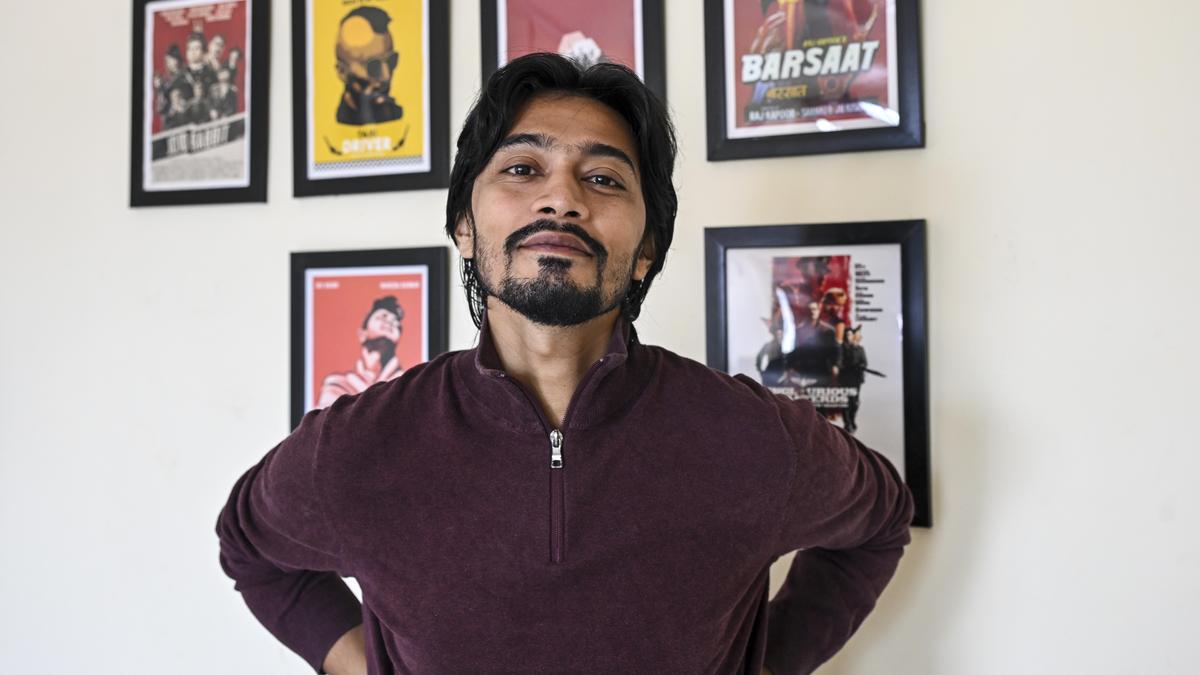
In 2019, Aamir Aziz’s song ‘Achhe Din Blues’, which riffed on Prime Minister Narendra Modi’s 2014 election slogan, was taken down by YouTube. | Photo Credit: Emmanual Yogini Aamir Aziz says he doesn’t want to die in penury like fellow poet Premchand. “Poverty refuses to leave me,” says the 36-year-old actor and poet. “I don’t understand why.”Aziz, whose blistering protest poems can make you weep or fill you with rage/ despair — Pink Floyd’s Roger Waters was inspired to recite a translation of ‘Sab Yaad Rakha Jayega’ (‘Everything Will be Remembered’) in 2020 — says he’s tried everything to earn a living in Mumbai, from acting to songwriting. “I’m not idealistic like the older poets. I’ve even performed in pubs and done whatever it takes,” he says. But money eludes him. The impact of his published work outweighs its quantity (about half a dozen songs). YouTube removed his 2019 hit ‘Achhe Din Blues’ — which riffed on Prime Minister Narendra Modi’s slogan during the 2014 election — for violating its terms of service. His latest, ‘Dopeher Blues’, is a hat tip to that hit.“It’s the sequel to my very first song which sang of morning and evening, but there was no afternoon story,” says Aziz. He writes continuously in Roman Hindi on his phone. “There are a few fine days when I sit at a table and write in Urdu with a pen on paper,” he adds sheepishly. Aamir Aziz in a still from ‘Dopeher Blues’. Worries remainThe dramatic video of Aziz’s new hip-hop style single, shot in a concrete space with a Brutalist feel (don’t miss the cement tape recorder), depicts a dozen or so people in factory worker uniforms and intricate balloon helmets that envelop their heads. As they play musical chairs with the Indian experience, this country devours them one by one.Now I sing in vain for strangers’ funerals, a line in the song goes. It was written a few years ago but its themes are even more relevant today: honour killings; farmer suicides; Palestine; Kashmir; foot soldiers blinded by rage and orphaned of any beliefs; death and dead dreams; the teflon bubble of privileged folks who look away from suffering. Like Aziz, we have mourned many strangers in recent years. Aziz’s new release comes after a six-year hiatus on his YouTube channel, a time largely spent trying to make it as an actor in the Hindi film industry. He managed character appearances in two films by Anurag Kashyap and one by Vishal Bhardwaj, among others, but success hasn’t been forthcoming. “Work in general is hard,” he says. “Maybe it’s difficult for people to see me as an actor.” He recently discovered Charles Bukowski and says his newer work is funnier courtesy the German-American poet and novelist. If it weren’t for his worry about his family in Bihar, he might even have dabbled in political standup comedy. Now, Aziz plans to focus on releasing some of his unpublished songs.Resisting helplessnessNear the end of ‘Dopeher Blues’, the poet urges his ‘daughter’ to sing the stories that are yet unknown to him. It is a message to children to carry on the work of being witnesses to the times. Aziz is unmarried but he uses ‘daughter’ because of his five nieces.The youngest of four siblings, Aziz grew up in a rural area of Patna district. His father was a Unani doctor in the health department where salaries were irregular. His mother would often say, “paisa band hai” (there’s no money). “My parents invested everything in our studies, that’s probably how I escaped to Delhi,” he says. “If I hadn’t come to Jamia Millia Islamia university, I wouldn’t do what I do now. The journey from my birthplace to Jamia is usually a very long journey that takes decades.”At Jamia, as he studied to become a civil engineer, he was introduced to the guitar and Bob Dylan and he embraced both. He switched his playlist to country music that centred lyrics from Hindi songs such as the Sonu Nigam hit ‘Yeh Dhokhe Pyaar Ke Dhokhe’ from Bewafa Sanam (1995). Urdu poets such as Mirza Ghalib have always been a part of Aziz’s life — he says he knew their famous lines without having any memory of ever reading them. But Dylan triggered a new dream. “For the first time, I thought that I could write a song.” Later, he even did a Bhojpuri version of Dylan’s ‘Knockin’ on Heaven’s Door’. Working as an engineer on construction sites opened Aziz’s eyes to what he describes as one of the most exploitative workplaces. “It broke my heart,” he says. “I thought, ‘let’s quit this job first’.” In 2017, he moved to Mumbai and began life as a struggling actor.Aziz’s own blues come from a sense of feeling suffocated, or the more evocative Hindi equivalent ghutan. “Pain is alright until we are able to do something about it but not being able to do anything about your pain, only because of the broader atmosphere, is suffocating,” he says. “It’s almost a new culture, a state of learning how to feel helpless, and the constant fight is to resist this culture of forced helplessness.” One way to do it is to sing the blues.The writer is a Bengaluru-based journalist and the co-founder of India Love Project on Instagram. Published - September 04, 2026 01:49 pm IST
Column | Why Aamir Aziz is singing the blues again
Full Article
Original Source
Read the full article at Thehindu →KhanList aggregates and links to publicly available news content. We do not host full articles from third-party sources. Always verify important information with original sources.