
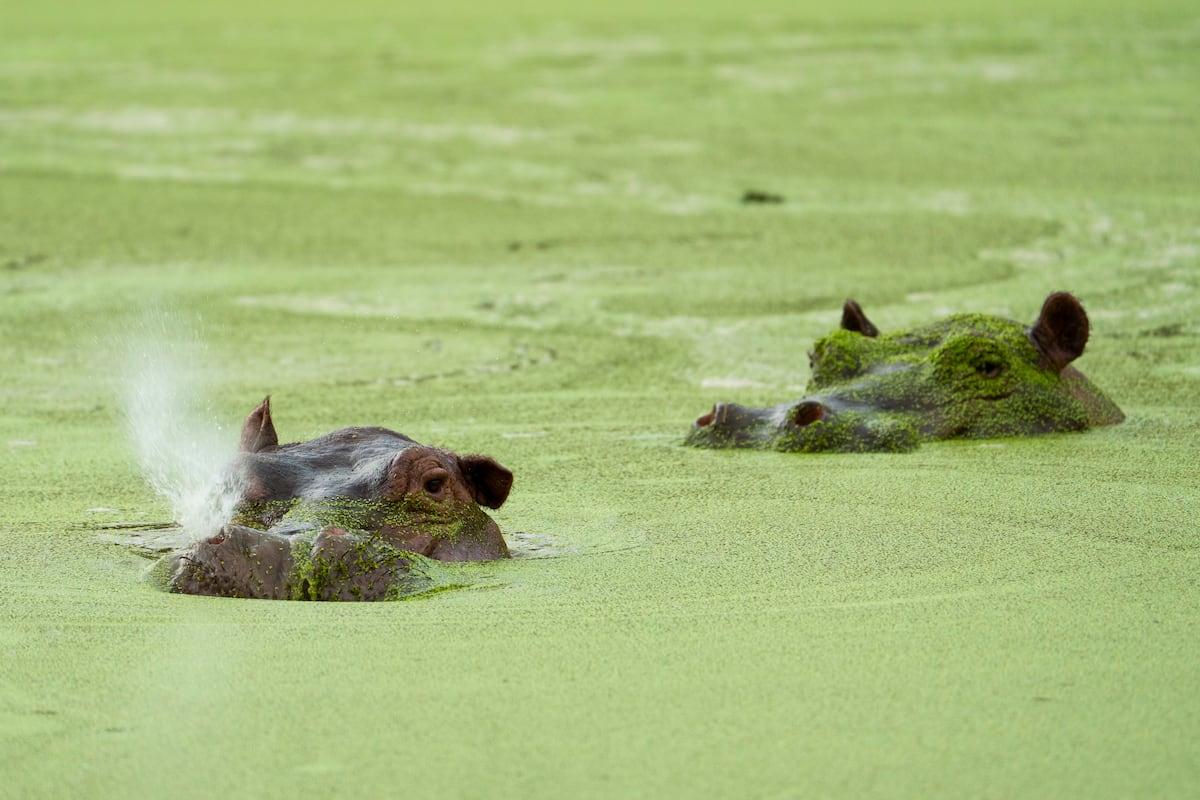
Colombia’s hippo saga has gained a new chapter. On Wednesday, the Colombian Ministry of Environment and several regional environmental authorities announced that they will implement a management protocol that includes the chemical euthanasia of 10 hippos in the department of Antioquia over the next four months. The animals are located near populated areas and are considered a risk to local communities.The announcement marks the first setback for Environment Minister Fabio Arjona, who upon taking office promised to create a sanctuary for the invasive species “similar to Jurassic Park.” “It’s cheaper to keep them than to kill them,” he told EL PAÍS at the time.David Echeverri, head of biodiversity management at Cornare (the Regional Autonomous Corporation of the Negro and Nare River Basins), welcomed the decision despite the controversy surrounding the issue in Colombia. “Ethically and environmentally, it is the best measure. And it had to be taken sooner or later. Better now than to be forced into it after someone dies from an attack,” he said by phone. So far, at least three people have been injured in the Magdalena Medio area. One is now in a wheelchair. The other victims are fishermen who were attacked while working.Colombia’s National Plan for the Prevention, Control and Management of the Common Hippopotamus (Hippopotamus amphibius) is built around four areas of action: population monitoring and research; control and management interventions; community engagement and institutional coordination; and environmental education.The intervention measures include sterilization, relocation, confinement and chemical euthanasia. Although authorities carried out the controlled hunting of a hippo known as Pepe in 2009, this would be the first use of chemical euthanasia in four decades. Ever since Pablo Escobar brought four hippos to Colombia, three males and one female, for his Hacienda Nápoles estate, responsibility for managing the invasive population has been passed from one government to the next like a hot potato.The operation will begin with a pilot phase costing about 500 million pesos ($150,000). A broader rollout over the following four months would require more than 8 billion pesos ($2.4 million), although funding for that phase has not yet been secured.For Katherin Corrales Bravo, a biologist specializing in invasive-species management at Corpoboyacá, the announcement is excellent news, though she is not ready to celebrate just yet. “What is promised and what is done are two different things,” she said by phone. “We have heard governments say for many years that they will take charge. We’ll have to see... What I do know is that Cornare’s team is perfectly prepared to carry it out.”This regional environmental authority has been managing the species for 15 years. Since 2009, it has conducted population monitoring and tracking, confinement trials, 35 surgical procedures, and ongoing environmental education programs with local communities. These efforts have also included the sterilization of 58 hippos and the relocation of several individuals to zoos across Colombia.The Ministry of Environment said it is also working with experts from the South African government to strengthen local capacities through training and knowledge transfer, “particularly in procedures for capturing and handling hippos in the water.”Among the animals slated for euthanasia is the hippo at the center of a legal action filed in September by mothers in Puerto Nare, Antioquia. The animal appeared in late July in the river used daily by 23 students on their journey to a rural school, posing a risk to the children as well as to local fishermen and residents. For the community, the river is the main route to hospitals, funeral homes, markets and recreational areas.The lawsuit was recently dismissed, according to Juber Martínez, the attorney representing the plaintiffs. He said the judge’s reasoning was that “we are not qualified to bring this legal action.”News of the planned euthanasia of the 10 hippos was met in Puerto Nare with a mixture of relief and sorrow. “I know many residents are opposed to this measure, but there is a school, there are children... We have to act,” said the scientist, adding that it was a very difficult situation.Also slated for euthanasia are the hippos that recently appeared in a viral video on social media. A week ago, footage showed four hippos narrowly avoiding being struck by a tractor-trailer on a highway at night in the municipality of Puerto Triunfo. Environmental authorities launched a search for the herd and urged motorists to reduce their speed. But residents affected by the growing hippo population are frustrated that the only measures taken so far have amounted to recommendations on how to coexist with an animal that kills an estimated 500 people a year in Africa.Echeverri added that there are two other clusters of hippos high on the detailed priority list compiled jointly by his agency and the ministry.Quickly and painlesslyThe procedure is complex and painstaking. First, a multidisciplinary team will travel to the areas where the hippos are located to identify them, sedate them and then administer the lethal drug. “What we want is for it to happen as quickly as possible and without pain,” said Echeverri.The hippo’s carcass, which would likely remain floating in the river, would then be removed with a crane and buried to prevent scavengers from being contaminated by the powerful drugs used in the procedure.The biologist insists, however, that this is only the first phase of a long-term plan. “We will be able to say the problem is over when the sterilized hippos die of old age and the problematic ones are gone,” he said. “That will take years.” Neither Echeverri nor the ministry rule out relocating other hippos to Vantara, a wildlife rescue center in Gujarat, India, as had been considered by the previous government.Euthanasia has long been advocated by environmentalists in Colombia, who have spent decades studying the negative impact of these animals, which can weigh up to three tons, on ecosystems along the Magdalena River, the country’s main waterway. They point to effects ranging from the displacement of native species and soil compaction to the contamination of waterways with hippo waste.“The decision to approve euthanasia is essential for conserving our ecosystems,” biologist Nataly Castelblanco of Biodiversos Colombia said several months ago.Colombia’s hippos are currently reproducing at a rate around 4% higher than in their native range. The population is estimated at about 250 animals spread across roughly 770 square miles, an area larger than the city of Bogotá. A hippo was recently spotted in Barrancabermeja, more than 300 kilometers (186 miles) from Hacienda Nápoles. The Alexander von Humboldt Biological Resources Research Institute has warned that, without proper controls, the population could reach 1,000 animals by 2035.Sign up for our weekly newsletter to get more English-language news coverage from EL PAÍS USA Edition
Colombia to put down 10 of Pablo Escobar’s hippos under new control plan
Full Article
Original Source
Read the full article at English →KhanList aggregates and links to publicly available news content. We do not host full articles from third-party sources. Always verify important information with original sources.