
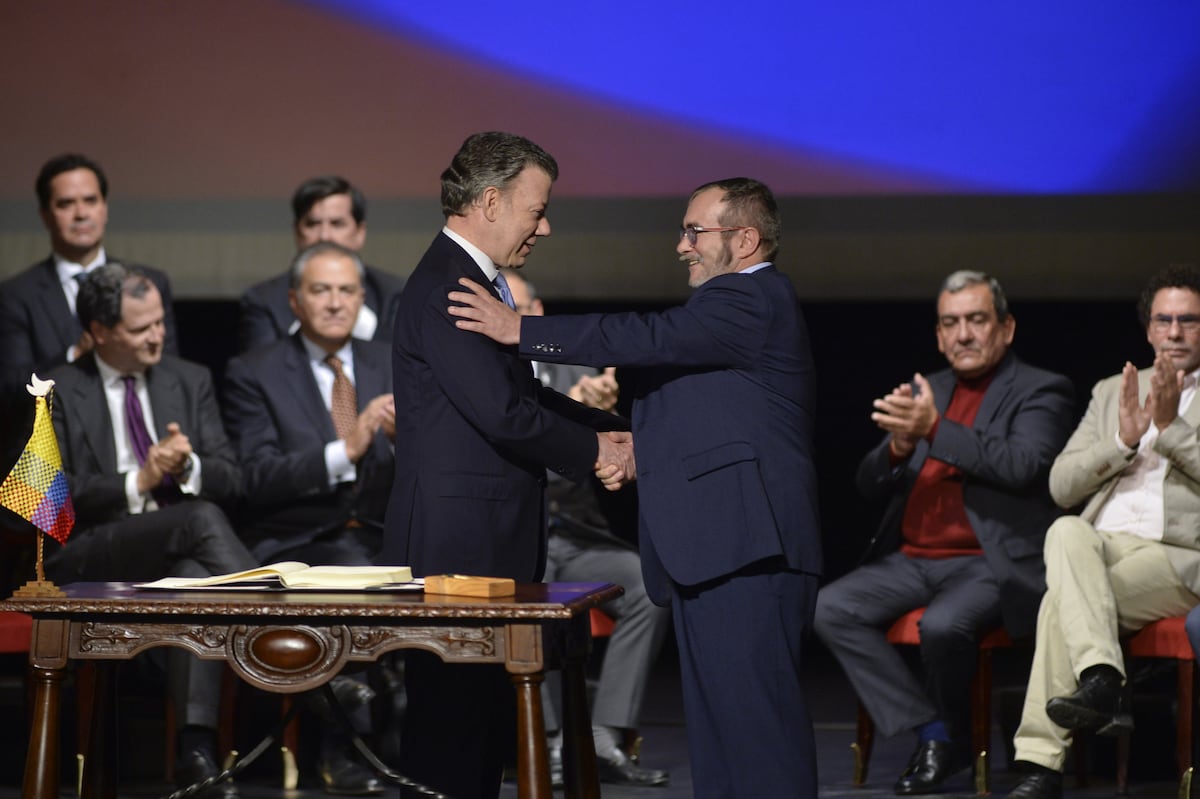
In an Indigenous community in the Urabá region of Antioquia, on Colombia’s Caribbean coast, Liris Borja Domicó learned to write her name at the age of 52. Until then, her national ID card bore a fingerprint and the words “unable to sign.” In a place where land, crops and food are shared by everyone, she says, that document was the only thing she truly felt belonged to her. “Now I’m a community leader,” she says. The literacy program that made this possible also helped her understand her rights, express herself more confidently in Spanish and take the step toward leading her community. For several years, these classes have been a form of reparation for hundreds of women like her, survivors of sexual violence during decades of armed conflict. But it is now November, and this year’s course has yet to begin. The program has been suspended. No one knows why or when it will resume.This is one of the quiet losses of the 2016 peace agreement signed by the Revolutionary Armed Forces of Colombia (FARC) guerrilla group and the government of Juan Manuel Santos, which marks its tenth anniversary on Tuesday. A decade after the FARC laid down its arms, the smaller, everyday aspects of peace — projects for victims of the war — are beginning to encounter even greater difficulties.Three governments later, just 36% of the commitments in the peace agreement have been fulfilled, according to the Kroc Institute. Under Iván Duque’s administration, the first stages of the former guerrillas’ reintegration into civilian and political life moved forward: the former rebel group became the Comunes party, which secured representation in Congress. But the right-wing president had been elected on an anti-agreement platform and devoted much of his efforts to challenging the creation of the Special Jurisdiction for Peace (JEP), the tribunal responsible for trying former guerrillas and military personnel and providing reparations to victims. The agreement’s first pillar — a rural reform to benefit the country’s poorest farmers — was never among his priorities.Under Gustavo Petro, who was elected on a platform of peace and rural reform, progress was also slow and limited, particularly on the plan to replace coca crops with legal alternatives and efforts to protect the lives of former guerrillas. More than 500 have been killed since they chose to return to civilian life.The anniversary of the signing of the peace agreement, which brought more than half a century of armed conflict to an end, comes as President Abelardo de la Espriella seeks to erase that chapter from Colombia’s history. In just three months, he has begun making good on his promise to scrap the JEP “with the stroke of a pen,” significantly cutting its budget and ruling out any further negotiations. “False peace has come at a very high cost to Colombia!” he said on the eve of the anniversary, dismissing the agreement as a “piece of garbage.” His main adversary on this issue is Juan Manuel Santos, the former president who signed the agreement and received the Nobel Peace Prize for his efforts. On November 10, Santos warned: “Ten years later, we are watching a president walk among corpses.” The following day, he made a direct appeal: “Mr. President, don’t miss this opportunity.”On November 24, 2016, at the Teatro Colón in Bogotá, the Colombian state and the FARC, the country’s largest guerrilla group, signed an agreement formally ending a war that has left more than 10 million people officially recognized by the state as victims. Nearly two months earlier, Colombians had narrowly rejected the first version of the agreement in a referendum, forcing Santos to renegotiate it. More than 13,600 combatants laid down their arms, and in 2017 the country recorded its lowest homicide rate in more than three decades. Between 2012 and 2019, kidnappings fell by 70%.But the state never moved in to fill the vacuum left by the FARC. Other armed groups took over the areas the guerrillas had abandoned. The ELN, dissident factions that rejected the peace deal or took up arms again and the Clan del Golfo, Colombia’s largest criminal organization, have kept the conflict alive. They are no longer fighting to seize power, but competing for control of cocaine trafficking routes, gold mines and border crossings. They spread terror through extortion, the recruitment of minors, forced confinement and the murder of social leaders. They also took advantage of Gustavo Petro’s push for dialogue to expand their ranks. The latest count by the armed forces puts their combined membership at around 29,000, spread across 165 groups, up from nearly 13,000 in 2022.For former president Santos, the problem was never the peace agreement itself, but the failure to implement it. “The lack of implementation is what has caused many of the problems,” he said. The former combatants interviewed by EL PAÍS last February at a coffee farm overlooking Lake Calima, in Valle del Cauca, tell much the same story, albeit in different words.Freddy Dimaté, one of them, remembers bending down to lay his rifle on a tree stump when a landmine attached to it exploded upward. His group, 36 FARC guerrillas, had spent weeks fleeing a military offensive in the mountains of southern Cauca. They had gone 46 days eating just a teaspoon a day of flour, powdered milk and sugar. When he looked down at his foot, it was gone. “As if you had literally torn off a banana.” A piece of his heel was left dangling from a tendon. It was the kind of weapon his own guerrilla group had planted across the country. Along with the ELN, the FARC have been the main perpetrators of landmine attacks in Colombia. Since 1990, landmines have killed or maimed more than 12,600 people in the country, nearly six in 10 of them soldiers or police officers.No one dared to move because they were in the middle of a minefield. They tossed him painkillers in a bag tied to a rock, and he injected himself through his clothes. Hours later, the comrade acting as a medic sat down beside him and burst into tears because he couldn’t bring himself to make the cut. Dimaté asked him for the scalpel. He heated it, sterilized it and handed it over. “I cut a tendon. I thought, ‘No, we’re doing fine.’” He finished the operation in half an hour. His comrades then carried him for 15 days through mountains and across rivers until they reached safety.Two decades later, Dimaté, now 45, makes a living from the coffee grown and sold by some former combatants. He proudly recalls having served a cup to a president and a queen. When the peace agreement was signed, he was “convinced the peace process wasn’t going to happen.” But today he says that without it, “I’d be hiding somewhere deep in the jungle,” with a tragic end looming over him.But in return, the former guerrilla fighter had expected the state to arrive “with public institutions, electricity, power, a decent life,” and for former combatants to work alongside local communities to build schools, water systems and roads. “And that never happened.” On the contrary, “all the areas we left behind were left to fend for themselves; the army pulled out, and then chaos set in.” Dimaté argues that, had the agreement been fully implemented, it would have been “the most successful peace process in the world” and that in many places “people wouldn’t have to make a living from coca.”Osvaldo Mendoza, known by his nom de guerre, Pacho Pinto, organized the disarmament process in La Elvira, a village in northern Cauca. He recalls that the first few years amounted to “a simulation of implementation.” After listing the commitments that were never fulfilled, he warns: “We didn’t sign a peace agreement to die because of it.” According to the Ombudsman’s Office, 521 people who signed the agreement have been killed over the past 10 years.The latest report from the U.N. Verification Mission — the international observers monitoring implementation of the agreement on the ground — reads like an inventory of uncertainties. The De la Espriella government had yet to define its approach to implementing the agreement or secure the necessary funding. It had also broken off talks with armed groups, branded them all terrorists and stepped up its military offensive.Those who signed the agreement continue to pay the price. By the end of September, the mission had verified 13 killings of former combatants in 2026, while attempted killings had risen from five in all of 2025 to 15. The U.N. renewed the mission’s mandate for another year, but at the government’s request, it will no longer monitor rural reform — the agreement’s first and least-implemented pillar.The promised rural reform lies at the heart of the conflict: land redistribution was the FARC’s original rallying cry. In a country where, according to Oxfam, 1% of farms account for 81% of the land, the peace deal pledged to distribute three million hectares free of charge to landless farmers over 12 years. The land was not to come from expropriating large landowners, but primarily from properties acquired illegally and public lands occupied unlawfully. At the current pace, Colombia’s comptroller general estimates, distributing all that land would take nearly 400 years.Foreign Minister Omar Bula excluded this rural reform from the list of issues to be monitored by state institutions when he addressed the U.N. Security Council. The United States welcomed the decision to limit the mission’s mandate to the reintegration of former combatants and their security. Without international observers, the promise of land redistribution is left in the hands of a government intent on turning the page on the peace agreement.Meanwhile, hanging from a coat rack in an office in Bogotá is a backpack with a pencil case designed especially for Indigenous women, a beautiful box painted with jungle motifs. Inside are two pencils, a notebook, a ruler and an eraser. But it is still unclear whether that box will ever make it onto the desks of Indigenous women. Liris is still waiting for classes to begin, while trying to temper the expectations of the women in her community. At 52, the future governor of Huapa Alto knows how much an opportunity like this can change — but also what it means when it disappears.Sign up for our weekly newsletter to get more English-language news coverage from EL PAÍS USA Edition
Colombia marks 10 years since FARC peace deal as De la Espriella threatens its future
Full Article
Original Source
Read the full article at English →KhanList aggregates and links to publicly available news content. We do not host full articles from third-party sources. Always verify important information with original sources.