
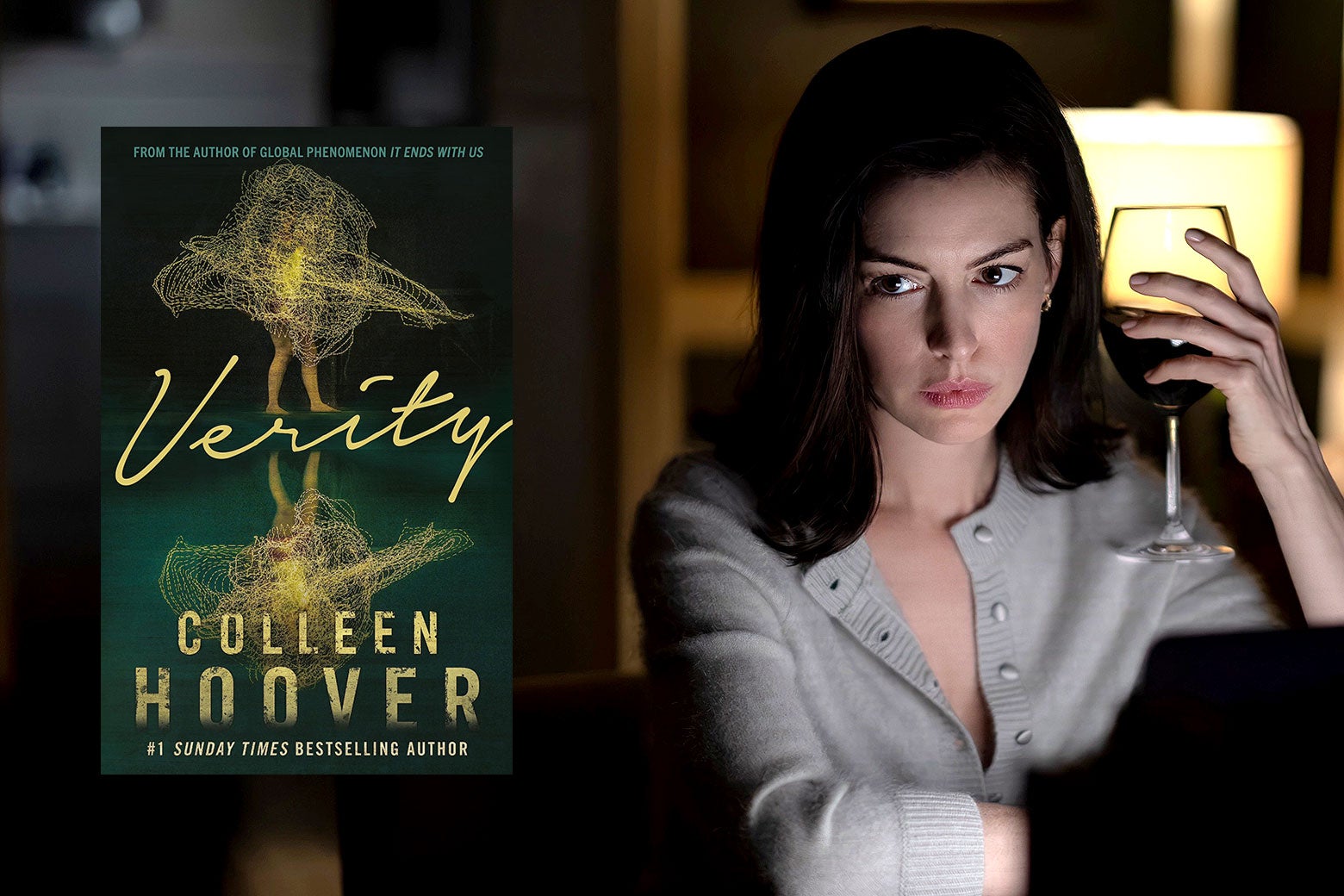
Movies Verity Has the Juice By Enter your email to receive alerts for this author. Sign in or create an account to better manage your email preferences. Unsubscribe from email alerts Are you sure you want to unsubscribe from email alerts for Rebecca Onion? Oct 02, 20263:47 PM Photo illustration by Slate. Images via Amazon MGM Studios and Grand Central Publishing. Sign up for the Slatest to get the most insightful analysis, criticism, and advice out there, delivered to your inbox daily. This article contains spoilers for Verity. “What’s it like to provide such a beautiful life for the people you love so much?” Gayle King, in one of several talk-show-host cameos in the new Colleen Hoover adaptation Verity, asks the successful writer Verity Crawford, played by Anne Hathaway. The Michael Showalter–directed thriller is about Verity; her handsome husband, Jeremy (Josh Hartnett); and the younger and less successful author Lowen (Dakota Johnson), who’s hired to help finish Verity’s book series after the author is in a bad car accident. This Hoover movie is the latest in a flurry of releases that began with a bang with the lawsuit-generating hit It Ends With Us, before going on to sag with the mid Regretting You and the even more forgettable Reminders of Him. Long-suffering fans of the bestselling novelist may finally have reason to feel hopeful stirrings this weekend: Verity, based on a book that’s widely considered to be the most bonkers of Hoover’s oeuvre, boasts recognizable movie stars and a capable director. Yes, CoHo hive, Verity has the juice. To start with, the movie overdelivers on the first obligation of a thriller about rich people: real-estate voyeurism. The Crawfords’ life is, like Gayle King says, absolutely beautiful. The midcentury house where this movie was shot, a landmark in modernism that in real life is now a wellness retreat in upstate New York, has a distinctive series of impractical-looking triangular peaks on its roof. For scenes set inside the home, set designers incorporated boulders into the interior design—absurd touches that are really fun to look at and that telegraph both wealth and a serious taste for drama. Compared with the forgettable locales of the first three Hoover movies, this production’s choice of house immediately makes a statement: The people who made Verity are trying to absorb you into this impossible tale. The contrast between this beautiful home and the tragedies in the Crawford family—the author’s car wreck was preceded by a canoe accident that took the life of a child—is nicely foreboding, with the people in the house isolated further by winter. This story is chock-full of impossible twists: When Lowen arrives at the house to process the papers in Verity’s office, we find out that Verity’s in a worse state than her publisher has revealed and is unable to do more than eat and blink. Hathaway stares into the distance, her lips chapped and her face blank and white, while her remaining child, a little boy named Crew, plays on his iPad by her side. At first, Lowen feels sorry for Verity—when her hospital bed self-adjusts in the night, emitting a truly unbelievable cacophony of upsetting noises, she worries Jeremy may be raping his catatonic wife and rushes to defend her. But then, after discovering a hidden thumb drive in Verity’s (incredible, huge, gorgeous) study, Lowen believes she’s discovered Verity’s secret: Verity has secretly written an autobiography, and in it she reveals that she’s a sex-obsessed narcissist who hates her children because they dilute Jeremy’s focus on her, and she killed her own daughter hoping to regain his attention. Here, Showalter blends overlaid images of Hathaway’s and Johnson’s faces with lines of text and images of remembered sex scenes between Jeremy and this newly revealed bad version of Verity, as the sound of violins playing in the background builds anxiety and dark anticipation. Is this diary the revelation at the heart of Verity’s story? Lowen, a writer whose brain is bent by the same genre as Verity, imagines she’s cracked the case. She turns against the author she’d admired, lecturing the immobile Verity that she’ll be taking her husband, her book series, and her beautiful life away. “You deserve to rot in your sad little robot bed, you selfish Machiavellian cunt!” she yells at the climax of this scene, in a line invented for the film that I’m sure people will laugh at in theaters. This is about as forceful as Dakota Johnson gets in the movie, and if you’re not a fan of the actress’ withholding affect, Verity may be hard to enjoy, even though there are some lines that self-consciously acknowledge Lowen’s lack of heat. (“I have resting bored face,” she tells Jeremy at one point.) In the novel, Lowen has more reasons to be so damp (bad mother, anxiety); in the movie, we have to make them up for ourselves. It turns out Lowen is wrong: In the next twist, Verity reveals herself to have been faking paralysis (impossibly, for a wealthy woman who’s had the best brain scans science can offer). But don’t rest yet! Jeremy and Lowen, each scandalized by the revelations in Verity’s autobiography, collaborate to kill her and disguise her death as an accident. Seven months later, we see the new couple, with Crew, packing up the lake house, which they have decided to leave behind for a new chapter. Then, in the story’s third and final twist, Lowen discovers a letter under a floorboard, written by Verity, during the time she was pretending to be incapacitated. It reveals that the Bad Verity manuscript was just a writing exercise all along, but Jeremy read it after their child died and believed every word. Mad with grief, he set up the car accident, drugging his wife and tying a block to the gas pedal of her car. Afterward, Verity pretended to be paralyzed as a matter of self-defense against her husband. We’re meant to be shocked by this turn: Lowen, five or six months pregnant by now, is bound to this man, and her financial life depends on him endorsing her to continue Verity’s book series. But in both the book and the movie, I find this twist to be surprising but not very horrifying, and have always wondered if that was the author’s intent. Jeremy is one of Hoover’s most interesting villains because it’s not clear if he is even meant to be one. After all, he isn’t the scheming, abusive Andrew Winchester, Brandon Sklenar’s character from last year’s extremely successful thriller adaptation The Housemaid, another story in which an ingenue who looks a lot like the wife moves into a rich couple’s house where creepy stuff turns out to be happening. Jeremy is just a bad husband who feels overshadowed by his wife. (When this idea comes together, you see why Josh Hartnett, with his slightly gone-to-seed handsomeness, was the perfect actor for this somewhat slight role.) Earlier in the movie, Jeremy says he’s only ever read one of Verity’s books and wonders aloud to Lowen why Verity would need his validation, when she has everyone else’s. He doesn’t pay attention to his wife’s editor at a business lunch where the editor suggests Verity try antagonistic journaling (“writer talk always bored” him). This is the technique that unlocks her ability to write from the villain’s point of view, and that resulted in her fake autobiography. And then, after finding it, Jeremy believes the journal is real because he doesn’t trust Verity and doesn’t bother to verify what’s in her manuscript before he hops right to murder. He married a woman who got too successful, was too weak to accept it, and lost the plot. Verity: CoHo’s feminist triumph! The movie dispenses with many, many of the over-the-top flourishes of Hoover’s novel, including a moment when the fictional Bad Verity tries to abort her twins with a coat hanger, leaving a scar on one of their faces; Bad Verity’s choice not to breastfeed those twins because it would “ruin her breasts” (news for Bad Verity: That’s not how it works); Lowen’s classic-of-the-genre sleepwalking habit, which leads Jeremy to lock her in her room at night (consensually!); and the existence of a third Crawford child, Chastin, who also dies—in her case, of anaphylaxis brought on by a triggered peanut allergy. In the novel, these elements build up the drama of the final twist, but Showalter and his screenwriter Nick Antosca were right to omit them. The end result is an adaptation that bests the source material, slimming down the book’s near-compulsive proliferation of details so you can focus on Hoover’s try at landing the psychological-thriller equivalent of a plot quadruple axel. Late last year, I heard everyone gasp their lungs out at The Housemaid. Viewers of Verity, get ready to bite your headboards. Books Movies Thrillers
Colleen Hoover’s Most Bonkers Book Is Now an Even Wilder Movie Starring Anne Hathaway. It’s Quite the Ride.
Full Article
Original Source
Read the full article at Slate →KhanList aggregates and links to publicly available news content. We do not host full articles from third-party sources. Always verify important information with original sources.