
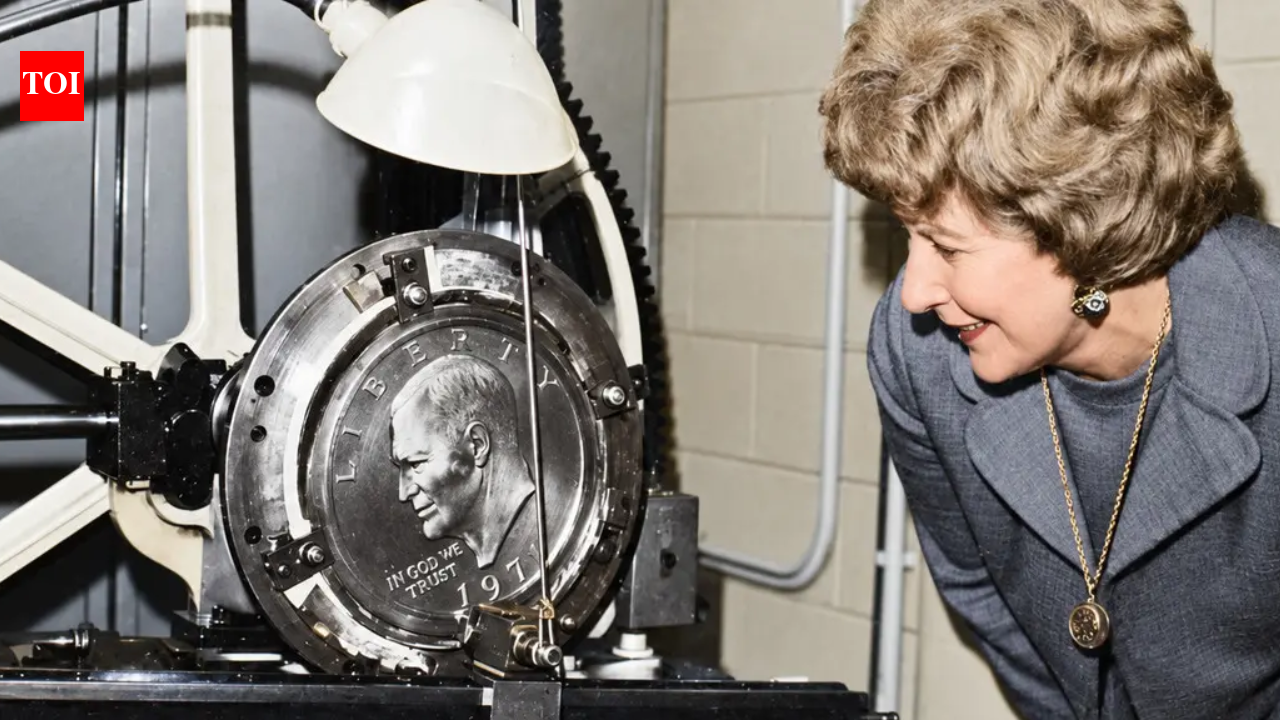
US Mint Director Mary Brooks observes obverse galvano being mechanically reduced to create the master hub for the Eisenhower Dollar.An experimental 1971 Eisenhower dollar that spent decades hidden inside a tube of ordinary coins before selling for $264,000 (£199,000) has returned to the auction block. The coin is one of only three known surviving prototypes of the United States Mint’s first space-themed dollar, according to a report published by CoinWeek. Catalogued as Judd-2147, the coin is scheduled to be sold by online auction house GreatCollections, with bidding set to close on October 18, 2026. Graded SP67 by the Professional Coin Grading Service (PCGS) and carrying a green Certified Acceptance Corporation (CAC) sticker, the coin is considered one of the most remarkable modern discoveries in American numismatics.Spotted inside a coin tubeThe discovery took place on February 15, 2008, at the Long Beach Coin Expo in California. Collector Lee C. Lydston was attending the show with his wife, Denise, when she noticed a dealer selling tubes containing 40 per cent silver Eisenhower dollars. While examining one of the tubes, Lydston pulled out a 1971-S dollar that looked very different from normal uncirculated coins and standard proof issues. Its surface had an unusual texture, the strike was extremely sharp, and the details of the Moon on the reverse did not match regular production coins. Realising that the coin did not fit known examples, Lydston bought it and sent it to specialists at the Ike Group for scientific testing.Clues on the MoonResearchers compared the coin with archival material and discovered that its reverse matched an early 1970 galvano held at the Dwight D. Eisenhower Presidential Library and Museum in Abilene, Kansas. The biggest difference can be seen on the Moon on the reverse. Chief Engraver Frank Gasparro had added detailed craters to the lunar surface during the early design process. However, many of those details were changed or removed before regular production began. The coin also shows heavy die-polishing lines, rough edges around some of the lettering, slight doubling of some design elements and an unusually strong strike. Later metallurgical testing by PCGS confirmed that the coin contains the standard 40 per cent silver and 60 per cent copper mix used for collector coins of the period.Press demonstrations and a minting challengeThe United States Mint faced major technical challenges while preparing the Eisenhower dollar for release in 1971. The coin marked the return of the dollar denomination after a 36-year break following the Peace dollar series in 1935. Gasparro's design showed General Eisenhower on the front and an adapted Apollo 11 mission patch on the back. The reverse featured an eagle carrying an olive branch above the Moon. Because the coin measured 38.5 millimetres across, Mint workers had difficulty producing the high-relief details without damaging the dies or minting equipment. According to historical records cited by CoinWeek, Mint Director Mary T. Brooks invited journalists to the Philadelphia Mint on January 25, 1971, to watch experimental trial strikes. Official documents said technicians prepared several prototype dies and 40 per cent silver blanks to test die shapes, planchet preparation and striking pressure. Mint rules required all trial coins made during the Philadelphia demonstration to be destroyed by the Director’s Trial Strike Committee.The mystery of the San Francisco markDespite those orders, three prototype dollars survived. All three known coins carry the "S" mintmark for the San Francisco Mint. Because of this, researchers at Heritage Auctions have suggested that the Mint may have sent prototype dies to San Francisco to test equipment intended for producing 40 per cent silver collector coins. However, it is still unknown exactly how the experimental coins left official Mint control and ended up in the public market, packaged inside standard Mint pliofilm wrappers known to collectors as "Blue Packs." For 37 years, the Lydston prototype remained completely unnoticed.Two more chance discoveriesTwo more examples were found in later years, confirming that the prototype series used two different die pairings. In 2010, collector Charles Chatham bought a second prototype inside an original Blue Pack at an Alabama pawn shop for just $10. It had the same prototype reverse die as Lydston's coin but used a different obverse die. The difference could be seen in variations in the lettering of the word "LIBERTY." A third prototype was found on eBay in 2013 by an alert collector. That coin used the exact same die pairing as Lydston's discovery and was later graded PCGS SP66.A quarter-million-dollar milestoneThe extreme rarity of the three prototypes is striking when compared with the number of regular coins produced. The San Francisco Mint struck more than 6.8 million uncirculated silver dollars and more than 4 million silver proof dollars in 1971 alone. Lydston's discovery was later acquired by collector David Frohman. In January 2022, Heritage Auctions sold the PCGS SP67 example for $264,000, setting an auction record for the Judd-2147 designation. The coin now being offered by GreatCollections, under certification number 55926571, remains the only one of the three known prototypes to receive CAC approval. It is also the highest-graded example known.
Collector found rare Eisenhower dollar in coin tube; it later sold for $264,000
Full Article
Original Source
Read the full article at Timesofindia →KhanList aggregates and links to publicly available news content. We do not host full articles from third-party sources. Always verify important information with original sources.