
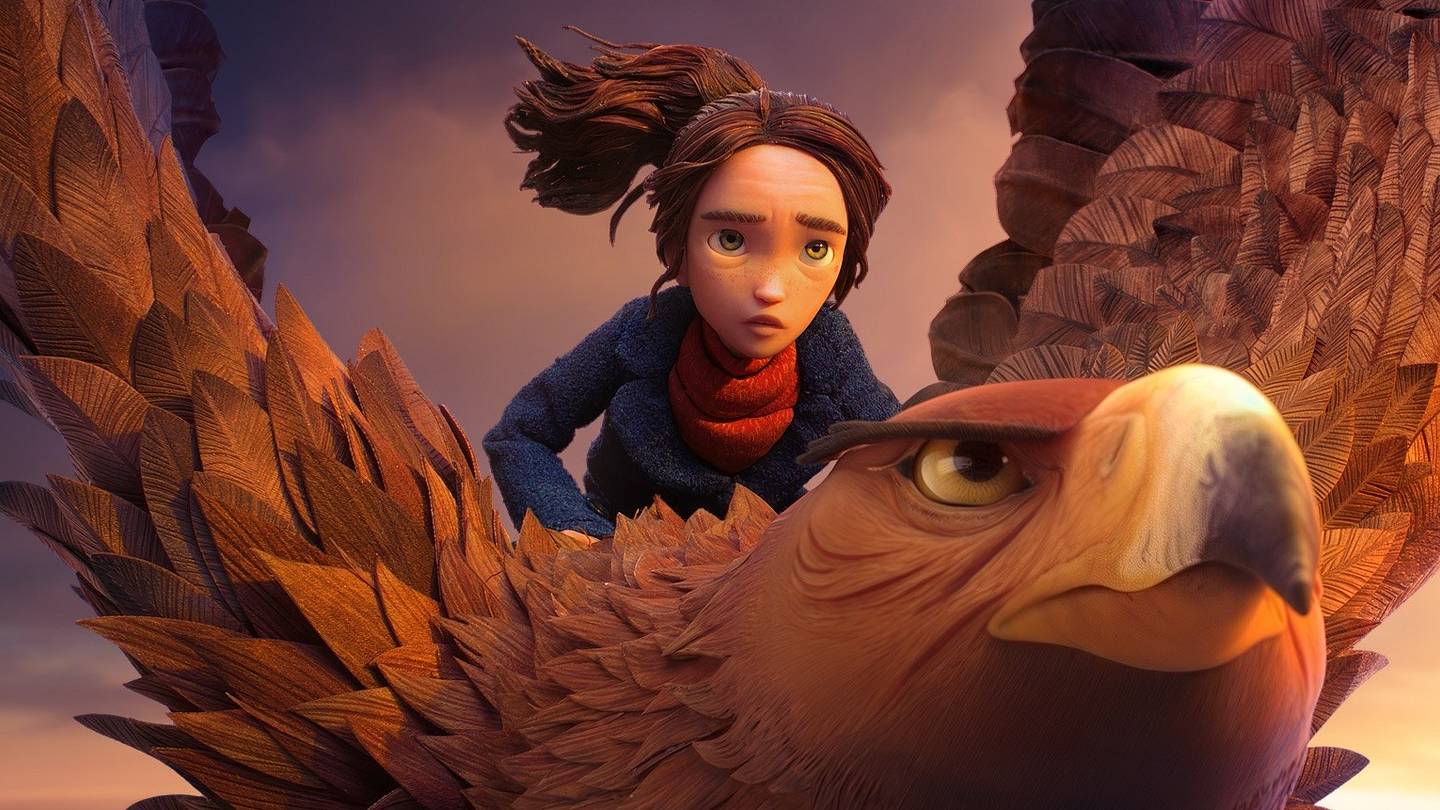
(Spoilers ahead for Wildwood.)It began with a walk in the woods.That’s how many a folk and fairy tale has started since humans began telling stories around campfires long ago. That’s also how Colin Meloy and Carson Ellis came up with the idea for their book Wildwood, now a film from Laika Studios. On their strolls through the jewel-green tapestry of Portland’s Forest Park, they began to imagine another world—one of child-stealing birds, prescient trees, and long-kept secrets. Those, too, are elements of many old stories that Meloy and Ellis wanted to make a part of their new one.They also transposed unique details onto the tale, shaping it around the geography and local characters of Forest Park and the flavor and charm of their home of Portland, Oregon. And they added a dysfunctional and corrupt government, a violent leader, and more elements that may spark some recognition for anyone who has ever paid attention to history or the news. The evolution of WildwoodThe first thing Meloy and Ellis did for Wildwood, they explained during a talk at the 2026 Portland Book Festival, was create a new map of Forest Park and the city that borders it. They kept some familiar landmarks, such as the stately Pittock Mansion, but transformed others. The Bird Alliance—home to an extremely regal Great Horned Owl named Julio—became the Avian Principality, a kingdom led by the noble Owl Rex. Other animals received slightly less favorable transformations; a coyote had recently killed their cat, and so coyotes became Wildwood’s lesser villains. At the center of the story is Prue, who enters the so-called Impassable Wilderness after a murder of crows steals her baby brother. Along for the ride is the hapless Curtis, who, Meloy admitted, was in many ways a stand-in for his younger self.Meloy, who is also the frontman of the band The Decemberists, wrote the story, and Ellis added her trademark whimsical illustrations. Before the book was published, animation studios began expressing interest. But Meloy and Ellers were leery of studios that would cannibalize their as-yet unborn tale. Then Laika, the studio then best known for Coraline, reached out. The company was Portland-based and wanted to do stop-motion, and so Meloy and Ellis agreed. 16 years, thousands of artists, and countless numbers of carefully detailed leaves and facial expressions later, the film hit theaters on October 23, 2026. It entered the world at a remarkably different time from when Meloy and Ellis had written the story. But in this modern age, the Wildwood film’s painstakingly handmade nature has resonated with audiences who see it as a resoundingly anti-AI, pro-human-art project. In a time of deeply fractured politics and simmering resentment against government ineffectuality and corruption, among other things, some viewers have also read its message as an anti-colonial one, and a warning sign of what happens when leaders attempt to impose their own bottomless emptiness on nature and the people who steward it. Speaking to Mental Floss, Meloy confirms that this isn't just fan interpretation. At the same time, the story is a retelling of one of the most timeless tales of all: that of children venturing into dark woods, and being forever transformed by what they find there.Below is a transcript of the conversation, which was conducted on November 2, 2026 and has been edited for clarity. Colin Meloy on WildwoodCarson Ellis, Colin Meloy - Vanity Fair And LAIKA Celebrate The Launch Of "Wildwood: The Exhibition" | Dave Benett/GettyImagesMental Floss: I'm curious about the process of seeing a book and characters you worked on for so long coming to the screen, especially over so many years. How has it been to see all of it transform from in your head to this huge visual universe?Colin Meloy: It's been kind of surreal, but it's been so long in coming that I feel like I've adjusted to the idea over time. We have been going up and visiting Laika every couple of years over the last 16 years. We’ve toured the place and seen puppets and sets from their other productions, and were shown concept art along the way. So it did not come out of nowhere. It's come together over a very, very prolonged period of time.I'd love to hear about some of the legends, stories, and myths that inspired the story. You’ve mentioned some references to Irish folklore. I'm curious if there are any fairy tales or mythical creatures that came to mind when you were creating the story. We had a general sense of the world in which the story would take place, and that was a reimagined Forest Park, this park that exists just inside the city limits of Portland. It's a 5,000-acre park, a wooded park, a wilderness.Then there was the question of drawing the story out of it. Carson and I had been working on a story prior to this one, going back to 2000 or 2001. We ended up cannibalizing a little bit of it for Wildwood. But we also really wanted it to be steeped in fairy tale and folk tale elements and archetypes.Something that has always interested me, and that has found its way into songwriting and into Carson's work, is universal stories, and paying homage to fairy tales, folk tales, and the stories that are in the collective unconscious. The crows, for example, are based on an Irish folk tale. The sluagh were spirits sometimes known to take the form of crows or other birds that would steal children or babies from their cribs. That's a classic storytelling trope. Sometimes they’re goblins. There's a great Maurice Sendak book called Outside Over There, where a baby is stolen by goblins. I think it speaks to infant mortality over time, [and to times when] a child could be stolen away from a family at any point. We've maybe lost touch with that a little bit, with modern medicine and infant mortality in this day and age. But it's been this ever-present danger for parents for thousands of years.Even the idea of going into the woods—of crossing over that threshold between reality and myth—is a really important story that humans have been telling for thousands of years in all different cultures. In some ways, it symbolizes everyday people's experiences going beyond their own comfort zones and putting themselves at risk in order to learn and to evolve, but especially children’s.It finds its way into so many fairy tales and folk tales: the dangerous, dark woods just outside the front door that you're not to ever enter. It’s a classic trope because in some ways, it symbolizes the dividing line between childhood and adulthood. What Prue and Curtis are both experiencing, in very different ways, is essentially puberty. If you want to get really clinical about it, you can think of Bruno Bettelheim, a psychologist who wrote a lot about fairy tales. He talks a lot about these old fairy tales, like Hansel and Gretel and Little Red Riding Hood, and how so much of the crossing-over of that liminal space, that threshold, is all about moving from childhood to adulthood.If you live in Portland, and if you go walking in Forest Park, it can often feel very strange—like one moment you're in a city neighborhood, and the next moment, you're just in the middle of the woods. So it already has the crazy transitional, proximal feeling of a wilderness right up against this populated part of town. That perfectly overlapped with my own interest in that idea of the scary woods as being a place of transformation.I wanted to ask a little bit more about Portland and its connection to the novel. I know you're based there, and also the Laika team is based there. I know Forest Park was a big influence. What other locations helped craft the book? Why did Portland feel like the place to set the story?As a kid, I was an avid reader, and I loved books that took existing places and then mapped imaginary worlds onto them. I feel like that's a really powerful tradition, not only in books that I was reading but in my own experience. I grew up in Montana, and there were woods and mountains right outside my back door and my friends' back doors. We would spend the weekends going out into the woods, or we would go out into the mountains and play and reimagine these places as fantastical kingdoms. So that wasn't a big stretch for me. This was also in the books that I loved reading, and in so much of classic children's literature. The Hundred Acre Wood from Winnie the Pooh is based on the 500-acre wood in England. Watership Down, which is an important influence on Wildwood, is based on a real area of England near London. Even Thomas Hardy was doing this.I call them mythogeographies—taking existing places and reimagining worlds onto them. Hardy did a sort of reimagined version of England as Wessex. I like to say that in some ways, Thomas Hardy was writing fantasy and speculative fiction with books like Tess of the d’Urbervilles and Jude the Obscure. That always interested me. Of course, Portland's my backyard—what a great thing. Not only were we walking around it and living it and loving it, but also, in some ways, it felt like this was a cool gift to hand to young readers in Portland. This is sort of weirdly myopic, but I was imagining that kids reading this book could look out their windows and see Forest Park as the Impassable Wilderness, and maybe even would use the map from the book and navigate themselves around the woods that way. So that excited me.Then, when we were going around the country and doing the book tours, we were sort of inviting kids to look at the wild areas that are around them, and to maybe value them more and see them as these places that need protecting and developing. Photo from the Wildwood Trail in Forest Park in Portland, Oregon | Eden Gordon / Mental FlossI definitely felt that ecological theme running through the story, and that was such a big part of the movie, with Prue learning that plants are listening and meeting the Council Tree. I'm curious if you can talk about what inspired that, and if there were any specific trees—either in Forest Park or elsewhere—that influenced that key part of the story? We were living in Forest Park at the time I was writing Wildwood. We were up in this neighborhood right above the St. Johns Bridge, and we had immediate access to the park and were doing a lot of walking there. We included places like Pittock Mansion in the book to give modern-day readers and kids the experience of navigating the woods and seeing it there.When you go to Pittock Mansion, it's such an extraordinary building right in the middle of the woods, especially if you walk to it on the Wildwood Trail. It just kind of comes out of nowhere. Why shouldn't that be part of this magical kingdom? We also populated it with things that we discovered while we were living in the woods. There was this huge gorge right next to our house, but when we tried to blaze a neighborhood trail into the park, it totally stopped us. So that became the Long Gap, which doesn't show up in the movie, but it's there. Also, the English ivy in Portland and in Forest Park is kind of a scourge. It's really bad stuff. There are whole teams of volunteers going out and trying to cut out the ivy because, left to its own devices, it will just swallow that whole forest without some pretty concerted efforts on the part of volunteers and conservators. So the ivy seemed like a good villain. Then there were the coyotes. We had two different cats that we think were killed by coyotes while we lived up in the park. We were just angry at the coyotes. So what better way to get back at them than to make them an evil army? I also really appreciated, especially in the book but also in the movie, that there's a lot of this charmingly archaic language, with names like the Dowager Governess and the like. I'm curious if you drew on anything from history or any real historical battles. I've also read analyses that say the movie is a metaphor for colonization or the destruction of Indigenous people and places. Did any of that history shape the story at all?I think these are universal stories. They mean very different things now than they did in 2010 when I was initially writing them. That's all part of it. At the end of the day, I feel like Wildwood—I can't speak for Travis [Knight], but I think it is essentially an anti-fascist book. In fact, all three in the cycle are very anti-fascist. In that sense, they are anti-colonial. There's maybe more of a political message in the book. I think, just for efficiency's sake, they probably couldn't dwell on some of the political nature of it in the movie, particularly the Southwood governance and how it's been corrupted since Alexandra left. It does become this kind of fascist bureaucracy, and that maybe is not as clear in the movie. But I do think that you see Alexandra and the coyote army as being forces of vengeance and ego and personal pride, which I think anybody even remotely paying any attention to the state of politics in the U.S. should resonate with. I think it is a condemnation of that kind of tactic. It's interesting that the movie has kind of become the center of this rallying cry for human-made art, with this anti-AI theme. Did that surprise you? Was that part of your intention with going with Laika? It wouldn't have been back then. There was no AI. We had sold it to Laika before it was even finished. We were sort of already freaked out about this story even being a book. Carson and I had been working on some aspects of it since 2001. It felt like this very personal story to us. So we really wanted it to be a book before it was anything else.We had seen other people's books adapted for screen, particularly animated family films. We’d seen how far off the mark they can be and how changed they can become to meet that market, and we were really uncomfortable with that idea.The story I tell is that when studios started asking around about rights for the book, we said that we would only agree to it if it was done in the hand-drawn cell animation of 1978's Watership Down or, barring that, stop-motion animation. In some ways I think we wanted just to put a full stop on anybody asking around about movie rights, and that was our cheeky way of doing it.But also, I think we wanted to know that whoever was going to make a movie of this book was going to do it laboriously, and would have to really care about the book and the story in order to even make it. We didn't want to give it to a DreamWorks or a Pixar or Warner Brothers who would make it in LA and maybe not have that connection to Portland and to Forest Park, and would maybe not get it and instead turn it into some kind of tentpole summer blockbuster fantasy spectacle. We wanted to try to get in the way of that.I think it just makes sense, the AI thing. It almost feels inevitable, the way things were going, trying to make things faster, easier, cheaper, and more appealing to a broader and broader audience. That's sort of what all AI is built to do.It does seem like it came at the perfect time after all those years. In terms of watching the process of the creation, which was just so detailed, I've read incredible stories about the artists who worked on everything. Were there any particular scenes or any particular characters or artworks that really amazed you, or that you felt really fit with the vision for the book, that you want to mention? When I was getting initial drafts of the screenplay, I was surprised at how intact they left the story. I was under the assumption that a book of that length would inevitably have to be changed or transformed to fit the parameters of a movie. But they were pretty faithful to it. There's so much in it that I'm happy survived. I mean, certainly, the battle scene and the scope of the battle at the end is beyond anything I could have imagined them doing. Seeing that on screen is extraordinary. I'd written it as this sort of epic battle, but that exists in your brain as you're reading it, so see it on the screen there and to share it with an audience is a really wild experience. I feel like they did such a good job with the cages that Curtis and the bandits are imprisoned in, and the Warren. I remember writing that and having to explain it to Carson as she was doing illustrations, and hoping that it made sense and that it worked. To see them so faithfully put it on the screen—that is so cool.You also write songs, and I'm curious about the process of writing a book versus writing songs. Do they feel connected to you, like they come from the same place, or are they super different in your mind? How's that relationship? Even though I feel like they probably come from the same place—from the same impulse, the same desire—they feel so different. Sometimes you can write a song in the time that it takes to sing it. Sometimes they just come out, and songwriting can be very generous in that way. It allows you a lot of leeway. You don't have to worry about developing a character or a voice or an arc or a throughline. It can just be whatever, and there's so much other information in there to give it its tone and its vibe and its story. It works on other dimensions. But writing is this laborious process where sometimes you're only getting a page, maybe, done a day. It’s like stacking firewood; it just takes time. So in that sense, they could not be more different. Yet I feel like they must come from the same place. I have a drive and a desire to do both of them equally. So I don't know. It's hard to say.Last question. If someone is going to Portland to experience Wildwood and the magic of the story, do you have any tips or suggestions for the itinerary?You should definitely go through Forest Park and go on Wildwood Trail. And particularly, if you want to do the Wildwood experience, you could start on Leif Erikson at the Wildwood connection there, and then loop around to Pittock Mansion and down to the Bird Alliance, which was the Audubon Society—that was the Avian Principality—and then come back around into town. I think you would get the full experience. That’s what I would recommend.Also, if you’re going up to St. Johns, you can walk around Prue’s neighborhood and see the St. Johns Bridge, which they so lovingly put into the movie.St. Johns Bridge in Portland, Oregon | George Rose/GettyImages
Colin Meloy on the Folklore, Forests, and Political Message of 'Wildwood'
Full Article
Original Source
Read the full article at Mentalfloss →KhanList aggregates and links to publicly available news content. We do not host full articles from third-party sources. Always verify important information with original sources.