
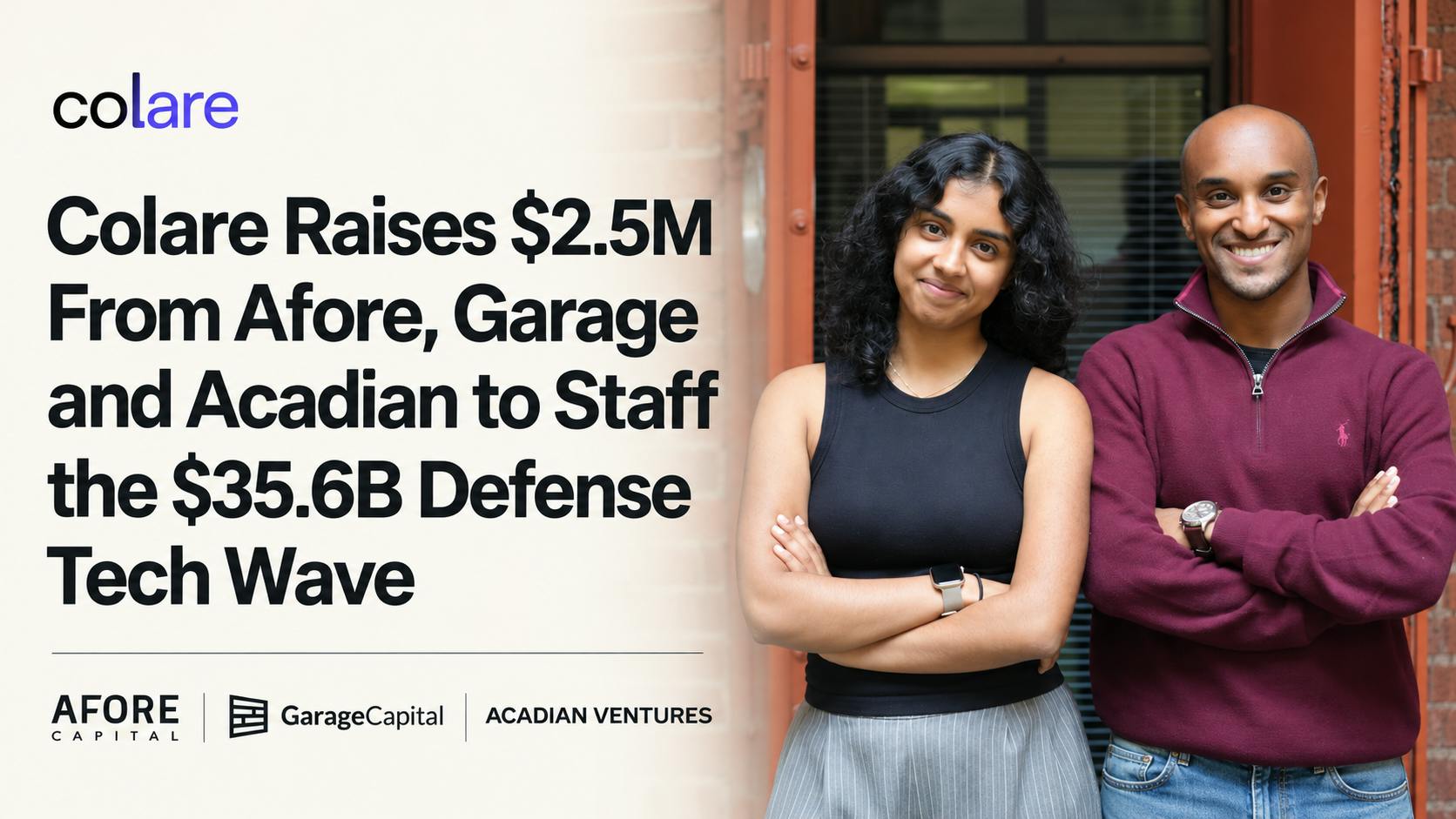
Hiring one mechanical, electrical or embedded engineer takes roughly 40 hours of senior engineering time across phone screens, take-home reviews and onsite interviews, according to Colare, the San Francisco startup that raised a $2.5 million pre-seed round from Afore Capital, Garage Capital and Acadian Ventures . The company launched publicly the same day with simulation-based assessments in which candidates solve realistic engineering problems in the tools they would use on the job before anyone books an interview. About half of its clients are in aerospace and defense. The Hardtech Market Colare Serves The industries that hire hardware engineers are growing quickly. The global space economy reached a record $686 billion in 2025, up 12% from 2024, with commercial activity making up $544.3 billion or 79% of the total, according to the Space Foundation's annual report as summarized by Payload. Its five-year compound growth rate is close to 10%. Government space budgets added about $141 billion, which gives launch companies, satellite makers and the factories behind them a large and steady base of demand for the engineers who design and build their products. Global space economy, commercial and government, in billions of dollars. Source: Space Foundation, State of the Global Space Economy (July 2026). Venture capital has followed the demand. PitchBook data reported by Defense News puts defense tech venture deal value at $27.2 billion in 2024 and a record $49.1 billion in 2025. Tectonic reports that defense and defense-adjacent startups, a group that includes space, advanced manufacturing and energy companies, raised $35.6 billion in the first half of 2026 alone, which is about 73% of all of 2025 by our arithmetic. Manufacturing-focused defense tech investment reached $4.7 billion across 39 deals in 2025, up from $2.6 billion across 24 deals the year before, so every funded company in this group now has hiring plans that have to be met.Defense tech venture deal value, in billions of dollars. The 73% figure is our arithmetic. Source: PitchBook via Defense News and Tectonic.The Engineering Talent Bottleneck The people who judge candidates are the same senior engineers the companies need building products. Attrition across aerospace and defense ran at about 15% in 2024 according to the AIA and McKinsey workforce study cited by AMTEC. An AIA and PwC study found that more than 29% of the workforce was aged 55 or older. The Bureau of Labor Statistics projects about 3,800 aerospace engineer openings a year on average through 2035, mostly from people leaving the occupation, in a field of about 68,700 engineers that is expected to grow 8% to about 74,400 with a median salary of $134,960.Aerospace and defense workforce indicators. The under-7.5% figure is our reading of 'more than double'. Source: AIA/McKinsey and AIA/PwC via AMTEC; BLS. The demand extends well beyond aerospace. Deloitte and the Manufacturing Institute estimated that US manufacturers could need as many as 3.8 million new employees between 2024 and 2033 and that about 1.9 million of those skilled positions could go unfilled if the skills and applicant gaps are not addressed, while 65% of respondents to a National Association of Manufacturers outlook named attracting and retaining talent as their primary business challenge. Every one of those hires needs some way to confirm that the person can do the work, which puts the quality of the screening step at the center of the whole hiring pipeline.US manufacturing jobs needed and at risk of going unfilled next to US aerospace engineer employment. Source: Deloitte and the Manufacturing InstituteThe Cost of Screening Hardware Engineers Colare says the rounds that actually test a hardware engineer's skills, such as multi-hour onsite interviews, come last and can only be run by other engineers, so every candidate who should have been filtered earlier uses scarce senior time. At the company's figure of 40 senior engineering hours per hire, a space customer adding up to 50 open roles a month would spend up to 2,000 hours on hiring if every role took the full process, which is our arithmetic. AI adds pressure from the other side, since the Greenhouse 2026 AI in Hiring Report, based on 1,200 job seekers, 219 recruiters and 446 hiring managers, describes AI-enabled fraud and misrepresentation as a changing problem for recruiters who already handle large application volumes. Senior engineering hours spent on hiring at 40 hours per hire. This is our arithmetic from the stated 40 hours, not a reported total. How Colare's Simulation-Based Assessments Work Companies give Colare a job description. The platform maps the role to engineering assessments across disciplines that include CAD, PCB design, thermal analysis, FEA and systems problem solving. The simulations recreate decisions engineers face on the job, Colare evaluates both the process and the final output. It returns a detailed debrief with candidate rankings while handling scheduling and industry-specific hiring workflows. Hardware engineering rarely has a single correct answer, since engineers trade off performance, cost, manufacturability, reliability and physical constraints, so Colare builds its rubrics with senior engineers who have shipped hardware and aims to turn the intuition an experienced engineer uses to spot strong talent into a signal that scales across hundreds of candidates. The company's site says assessments connect to a customer's applicant tracking system, cover mechanical, electrical, firmware, embedded, controls, thermal, test and reliability roles and can be shared through job postings or email. Founder Thesis Esther Thomas, Co-Founder and Co-CEO of Colare, says that for any ambitious hardware product success comes down to the team. One wrong hire can mean a failed launch, a delayed mission or a lost contract. She argues that because the risk is so high engineers stop building to interview. Colare exists to turn the intuition engineers use to screen their hires into assessments that scale across the whole candidate pool. She adds that AI is weakening the usual signals, since résumés can be inflated, interview answers can be assisted and polished profiles reveal less about how someone will perform, which raises hiring demand and lowers confidence in the old screening process at the same moment. Co-Founder and Co-CEO Nain Abdi met the problem firsthand as an electrical engineer at Ford, where his team had stopped trusting résumés because candidates who looked strong on paper often struggled in technical interviews. The company took shape in fall 2024 through the Velocity Cornerstone program at the University of Waterloo, where Abdi and Thomas refined the concept, won the program's pitch competition and later ran a pilot with companies. Abdi says hardware engineering is the application of knowledge to the constraints of building in the physical world, so Colare grounds its assessments in first principles and tests hundreds of candidates against the same bar.Investor Thesis Dr Thomas Otter, General Partner at Acadian Ventures, describes the problem as how to give electrical, mechanical, structural and mechatronic engineers the opportunity to show their skills. He points to the rapid growth of robotics and the emergence of physical AI as reasons the demand to assess engineering skills fairly and rigorously is vast. He says the Colare team has what it takes to help companies evaluate and identify great engineers. The thesis fits the capital flowing into the sector, since each funded hardware company has to hire engineers faster than its own staff can screen them. The Round The $2.5 million pre-seed round includes Afore Capital, Garage Capital and Acadian Ventures and will fund the expansion of Colare's simulation-based hiring platform. Afore is a pre-seed specialist that closed a $185 million fourth fund in early 2025, up from $150 million in 2022. It says it has backed about 200 companies with a combined valuation above $13.5 billion, so the firm is used to funding founders before the rest of the market has a category for what they build. Afore Capital fund sizes in millions of dollars.The company has moved from a two-week program to a public launch in about two years. Abdi joined Velocity Cornerstone in fall 2024 when his startup was heading in a different direction. The pivot into Colare took shape there before an enterprise co-op program helped the founders win companies over for a pilot that validated the approach. The launch on 26 October 2026 gives that work its first institutional capital and a customer list that now ranges from newly funded startups to multi-billion-dollar aerospace manufacturers.Customers and Traction About half of Colare's clients operate in aerospace and defense. One space customer is adding up to 50 open roles a month. For a two-person chemical manufacturing startup hiring its first electrical engineer, Colare became the technical evaluation layer the founders did not have in-house. At a subsidiary of a public manufacturer it flagged major engineering gaps in a candidate who had cleared the initial screen and was headed to the CEO round, which caught the problem before it reached senior leadership. John Slack, CEO of Rhoic, says that neither he nor his co-founder is an electrical engineer and so they do not know what a good answer looks like. Colare lets them see much earlier how candidates approach the work they would actually be doing, which spares senior engineers from finding out basic capability late in the process. What Comes Next Colare plans to turn its assessment data into a broader picture of what engineers can do, including how they may perform on problems they have never been explicitly tested on. The company's long-term view is that as employers get better at measuring ability directly, skill will replace pedigree as the hiring credential, which would open aerospace, manufacturing and energy roles to engineers whose work is strong even when their résumés are modest. With the space economy at a record, defense tech startups at $35.6 billion raised in the first half of 2026 and Colare now live with customers across the sector, the next test is how quickly hardware teams adopt screening that shows candidates working before the first interview is booked. Don’t forget to like and share the story!
Colare Raises $2.5M to Staff the $35.6B Defense Tech Wave
Full Article
Original Source
Read the full article at Hackernoon →KhanList aggregates and links to publicly available news content. We do not host full articles from third-party sources. Always verify important information with original sources.