
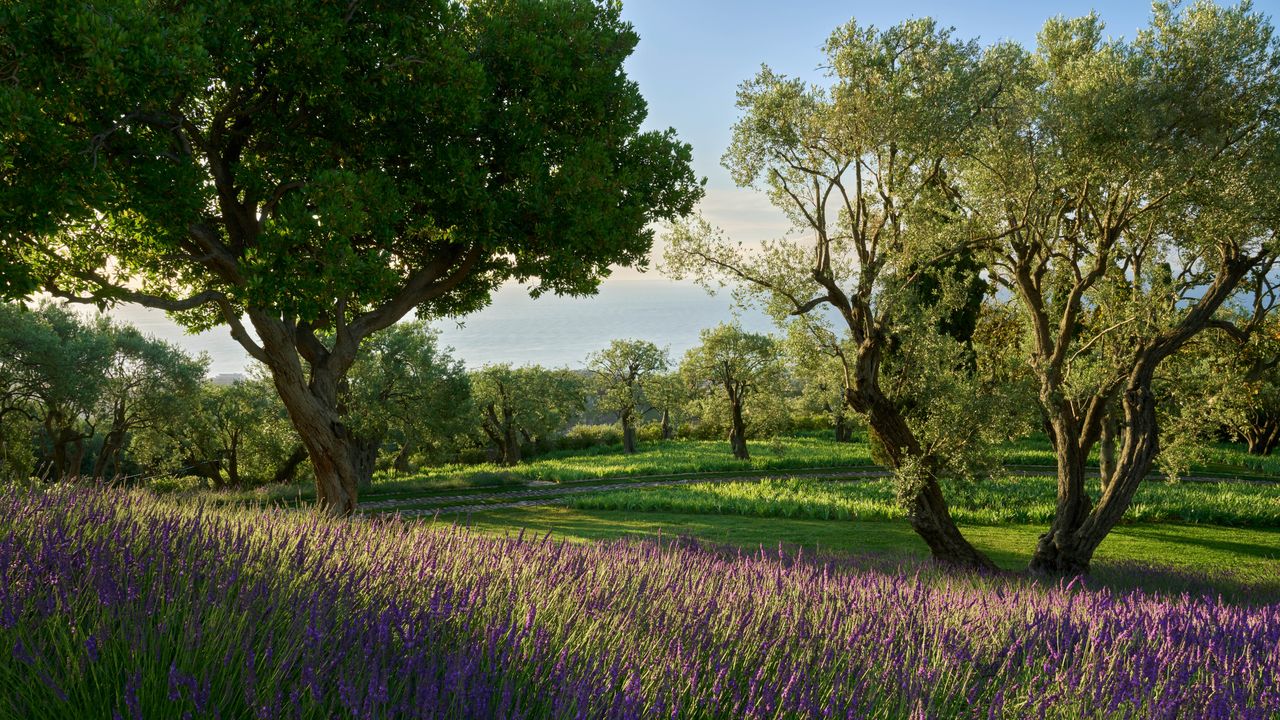
Architect Peter Marino returns the legendary designer's beloved Mediterranean getaway to its 1930s glory—flooding the hillsides with lavender and iris and giving the centuries-old olive trees a moonlit glowFields of lavender are one of the defining features of the landscape at La Pausa, the getaway Gabrielle “Coco” Chanel built on the French Riviera in the late 1920s. A stone-paved alleyway makes its way through the property, and the gardens are punctuated with 250 ancient olive trees.The first thing you encounter in the late spring as you cross the gates of Chanel’s La Pausa estate in Roquebrune-Cap-Martin and wind your way up the cobblestone drive is a cloud of fragrant jasmine wafting from the tangle of vines along the stone walls. Next is the soft fragrance of iris floating from a field of blooms to the right. And finally, as you approach the top, the woozy aroma of lavender that blankets hills and beds surrounding the house.That two of these three—jasmine and iris—are ingredients of Chanel No. 5 is not by chance: Gabrielle “Coco” Chanel bought the nearly 10-acre property overlooking the Mediterranean in 1928 with profits from the wildly popular perfume, introduced seven years earlier, and her revolutionary couture. Upon the hillside perch, Chanel and architect Robert Streitz built a sober, sturdy house partly inspired by the austere Aubazine convent where she had been raised. She named it La Pausa, or the pause, likely after a 15th-century chapel that abuts the land; according to local lore, Mary Magdalene rested in the shade of Roquebrune’s olive trees during her journey to Marseille after Jesus’s crucifixion. La Pausa served as Chanel’s Riviera retreat until she sold it to publisher Emery Reves in 1953—shortly before Chanel reopened her couture house, after a nearly 15-year sabbatical that began with the onset of World War II.The Cloister, which opens onto the South Terrace, functions as the heart of the house, and the great hall, living room, and dining room open off of it. Plants are displayed in an array of simple clay flowerpots of the type Chanel had when she lived there. Chanel and friends on the olive tree in the Cloister, 1938 ARCHIVAL PHOTOS: Roger Schall © Schall CollectionChanel amid lavender at La Pausa, 1938 ARCHIVAL PHOTO: Roger Schall © Schall CollectionLa Pausa, 1929 ARCHIVAL PHOTOS: Roger Schall © Schall CollectionIn 2015, the house of Chanel bought La Pausa from the Reves heirs. American architect Peter Marino, who has designed Chanel boutiques and offices for the past four decades, was enlisted to restore the house and grounds to their original 1930s splendor. Chanel envisioned the estate as a private home, an artistic residency, and a place for creative inspiration.With the assistance of Chanel’s Heritage team, Marino pored through La Pausa’s archives and chose 1935 as his landscape reference point, because that’s when the grounds had really taken form as Chanel intended. “We wanted this ambience of the ’30s, which, as you know, was the Depression,” Marino explained. “People weren’t spending lavishly, so it had to be somewhat demure.”The East façade; the shutters are painted a custom shade of blue matched to the original color during Chanel’s time at the house. A suite of wrought-iron furniture with custom upholstery stands under a wisteria-laden pergola on the West Terrace. During construction of La Pausa in 1928 and 1929, Chanel instructed Streitz to work around two centenary olive trees—one that he left in the middle of the entrance walkway (“She didn’t dream of moving it,” Marino said), and a second that became the centerpiece of a cloister-like courtyard. “She built the house around it,” Marino said. “That says a lot to me.”For the rest of the gardens, she kept everything as natural as possible. She loved the scruffiness of the garrigue, or scrubland, with its wild lavender and irises, cacti, Holm oaks, and olive trees. “In Paris, she was always into camellias—flowers that moved,” Marino said. “Here, it was more about sculptural forms and plants that thrived on heat and dryness.”The only nonindigenous plantings Chanel added were a Magnolia grandiflora tree, which, Marino pointed out, has dark, shiny green leaves like her beloved camellia but withstands hot climates, and desert species, such as agave in the garden and pots of cacti and succulents in the house and on the terraces. “In the South of France, you have to respect a garden’s native feeling,” Marino said.Architect Peter Marino in a bed of agapanthus A mown grass pathway curves between beds of iris and olive trees. Another view of the West Terrace The Cloister was designed around an ancient olive tree. To return to Chanel’s spare, modernist ideal, Marino removed later decorative additions and took out more recent plantings such as palms and other “non-native trees that had just grown up and were kind of weedy,” he said. In doing so, he opened up views of the coastal enclaves of Menton to the east and Monaco to the west.From there, Marino moved some of the existing 250 olive trees to more ideal spots, including returning one to the entrance walkway. “It is my guardian,” Chanel said of the one that originally stood there. Many of La Pausa’s oliviers have stood for centuries—the most ancient is thought to be 800 years old. To light them, he ran wires from the ground and affixed small LED spotlights to the branches, facing downward, so the trees appear moonlit. “Even if it’s cloudy, you feel like the moonlight is getting through, and it creates wonderful patterns on the ground,” he explained.La Pausa on its hillside perch Marino grasps a stem of blooming agapanthus. Marino, in a field of lavender, looks toward the nearby town of Menton and the Mediterranean beyond. Another view of the West TerraceOnce the earth had settled, Marino planted swaths of lavender and irises, color-blocking the land “like my favorite painter, Kandinsky,” he said. On the front slope, the lavender cascades down to the drive, a style of planting known in French as a “coulée,” or flood. He left lawns to grow wild, the grass mixing with clover and whatever else sprouts. “I tried to make the garden feel somewhat textured,” like Chanel’s signature tweed suits, Marino said. “The garden very, very, very strongly reflects her fashion sensibilities.”Marino holding a Cosmos The wrought-iron swing chairs on the South Terrace were re-created based on archival images from chanel’s years in residence. So much so, in fact, that Chanel’s creative director Matthieu Blazy chose to shoot the ad campaign for his first ready-to-wear collection, which debuted last spring, at La Pausa, with models climbing the courtyard olive tree like Mademoiselle did nearly a century ago. La Pausa will remain private, hosting company events from time to time, such as the high-jewelry presentation this past May, and artist residencies. The first, held in the autumn of 2025, was for writers; the second, next summer, will be for composers. For that, there will be a concert, the music drifting across the gardens, much as it did when Chanel’s friends Erik Satie, Georges Auric, and Misia Sert played at La Pausa. “You’re not worried about something else when you’re here,” Marino said, as he looked across the lavender to the sea. “I don’t know too many places on earth you could say that.”This story appears in the September issue. Never miss a story when you subscribe to AD.Not a subscriber? Join AD for print and digital access now.Sign up for our daily newsletter to get the best of design in your inbox.
Coco Chanel's Riviera Gardens Were Restored With Her Iconic Tweed Suits In Mind
Full Article
Original Source
Read the full article at Architecturaldigest →KhanList aggregates and links to publicly available news content. We do not host full articles from third-party sources. Always verify important information with original sources.