
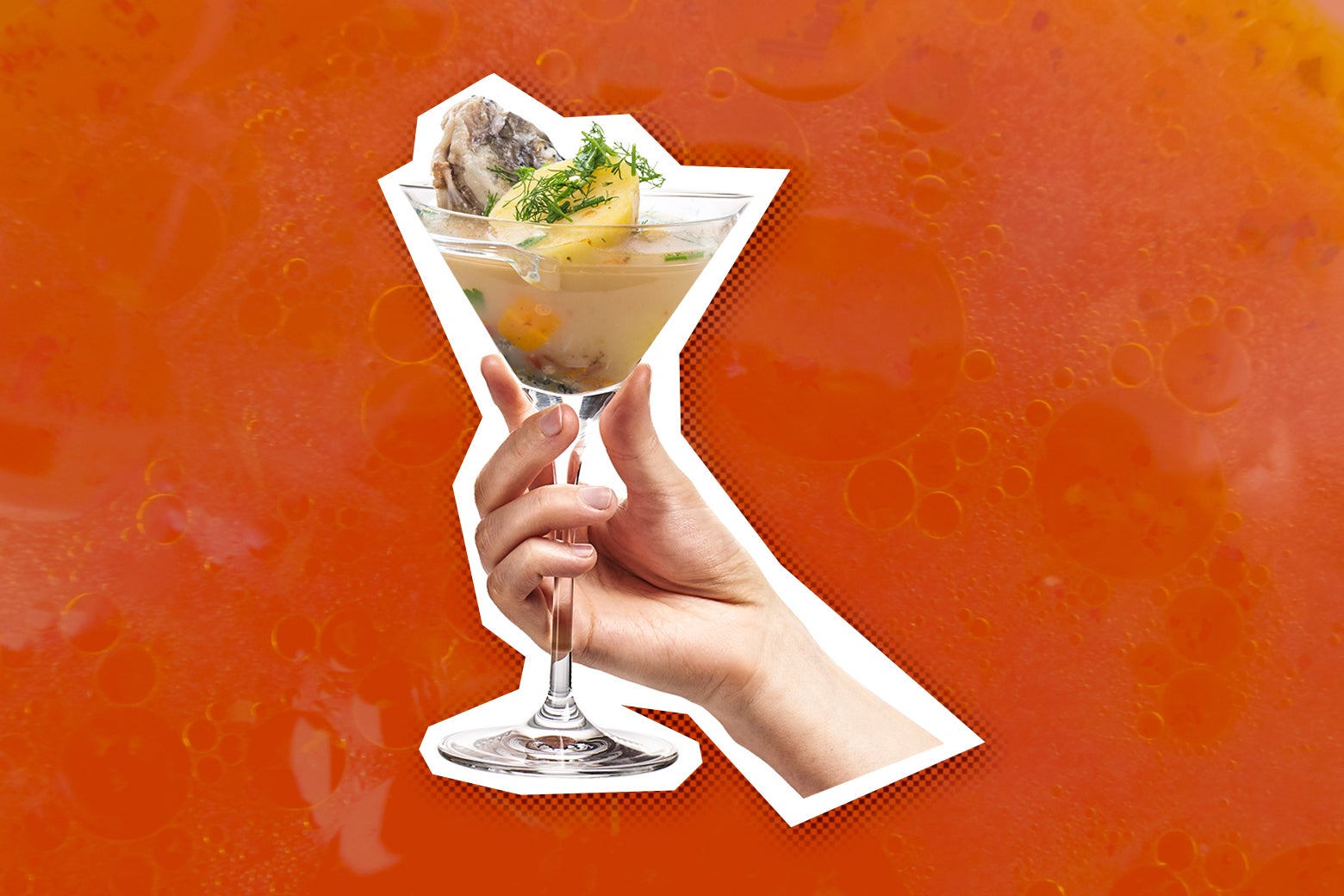
Drink Are Soupy Cocktails the Next Big Thing? Believe it or not, your new favorite drink might be a little … meaty. Photo illustration by Slate. Photos by Getty Images Plus. Sign up for the Slatest to get the most insightful analysis, criticism, and advice out there, delivered to your inbox daily. There’s a little bit of magic in that bracing, ice-cold martini you sip at the bar to kick off your night before dinner. But if you’re short on time and at one of the many establishments currently mixing up savory cocktails that incorporate soup, you could always just combine that drink and that dinner—vodka and pho, anyone? To the average cocktail drinker, a concoction made with broth may sound like one of the stunt combos punishing consumers a few years ago—mac-and-cheese ice cream, french fry–flavored vodka, RanchNog. Indeed, in that stretch from roughly 2021 to 2023, Campbell’s joined in on the craze with its “brothtails” campaign, releasing cocktail recipes to be made with four different broths. That elicited the horror you might expect. So it may come as a surprise that one of the latest trending cocktail ingredients is, in fact, soup. The Japanese stock dashi appears in the Umami Mary at New York’s Bar Goto; in the Dashi Papi at Superbueno, also in New York; in the Dirty Dashi at Tomiko-San, in Wilmington, North Carolina; and, earlier this year, in the Just a Dashi at Dear Friend, in Nova Scotia, and in the Dashi Margarita at Lingo, in Brooklyn. Vietnamese pho broth features in the Spice Market cocktail at Chu Mai, in Sacramento; the Pho-Tini and Dirty as Pho at New York’s After Eden and Darling, respectively; the Pho-King Champ at Midnight Rambler, in Dallas; and the Scoreboard, Motherphocker at the Franklin Mortgage, in Philadelphia. You may also encounter other soups in drinks, like the Gazpacho-Jito at Romeo’s, in NYC, or the French Onion at Nightcap, in Chicago. Drinks writers can grow jaded and forget to feel shock when it seems that some of the world’s most respected bartenders have started pouring the liquid remains of their lunches into their shakers. Savory cocktails have become de rigueur in recent years, and if we’re willing to sip olive or oyster brine, duck-fat-washed bourbon, or soy sauce, why not broth? That’s why I ordered a certain pho-tini at a new hot spot late this spring. I expected nothing more than an especially umami-forward, savory, spiced martini. What I got was a buzz by way of beef. The drink was too thick, too murky, too … meaty. Welp, we’ve finally gone too far, I thought. But then I remembered Superbueno’s Dashi Papi, more of a jazzed-up boilermaker with a sauce-dressed can of Monopolio, a shot of mezcal, and a shot of birria consommé. Somehow, even drinking straight consommé works a treat in this format—it’s giving umami but is still lighter and more complex with spices, and it complements the earthy, slightly smoky mezcal. It’s delicious. As is the Umami Mary at Bar Goto. Bloody Marys are savory to begin with, after all; Bar Goto’s dashi-infused shochu makes the familiar flavor more interesting and layered. Soup, it seems, can take a savory cocktail from basic (think the ubiquitous olive-brined dirty martini) to intriguingly creative and culinary, but only when added with expertise and caution. “Because broth is such a complex ingredient, small variations can have a big impact on the final drink,” says Gelo Honrade, partner and beverage director at After Eden. “Maintaining a consistent preparation process and ensuring everyone on the team understands the recipe are key to preserving the intended flavor and balance of the cocktail.” There’s often a goal of driving down waste at bar and restaurant kitchens at play. You’ll likely see the broth that’s in a cocktail also used in a dish on the menu, which is the case for Superbueno’s birria consommé. But when done with intention, as it is there, it doesn’t mean that the dregs of the soup pot are just getting splashed into cocktails. There’s communication with the kitchen team about ingredients and flavors, and there’s careful tinkering to find the right proportions and accompaniments for the drink. “The consommé has about four different peppers, plus spices and herbs, this level of complexity that needs something with character to stand to it,” says Superbueno operating partner Ignacio “Nacho” Jimenez. “I thought about what wasn’t going to get lost in translation. … Mezcal has these smoky qualities, some mineral notes, earthiness, and funkiness.” Elsewhere in Manhattan’s East Village, Romeo’s head bartender DJ Ingalls has built a drink around gazpacho, but labored over finding just the right balance for it. Broken down, the gazpacho itself is full of cocktail-appropriate flavors: watermelon, jalapeño, red bell pepper, cherry tomato, cucumber, salt, pepper, olive oil, and sherry vinegar. Ingalls swizzles it with Rhum J.M. Blue Label, green Chartreuse, and a little simple syrup. “I really just thought about what I loved to eat in summer and how best to transmute that idea into a fresh, accessible cocktail for our guests,” he says. “The biggest breakthroughs were the addition of a healthy amount of Chartreuse, which gave it a beautiful verdant middle note, and the heavy skew of acid into the initial gazpacho itself—the sherry vinegar—which ended up entirely substituting lime juice in the ‘mojito’ model altogether.” As the savory cocktail category matures, drinkers grow increasingly receptive to more-out-of-the-box ingredients and flavors. If we’ve allowed the hot dog martini to happen, is broth that wild of a swing? There’s even precedent for souptails. Campbell’s 21st-century brothtails weren’t the brand’s first foray into suggesting that consumers “imbibe” its soups. In the 1950s, Campbell’s “Soup on the Rocks” campaign marketed beef bouillon as a savory version of a refreshing summertime drink, recommending that it be poured over ice and enjoyed like an old-fashioned. Around the same time, a Detroit cocktail bar owner helped out an adman struggling to sell that beef bouillon by building it into a proper cocktail. The Bullshot is still around today, teaming that beef broth with vodka, lemon juice, Tabasco, and Worcestershire sauce. Today’s soup cocktails have come a long way from canned stuff over ice. At bars that take them seriously, they’re more complex broths made on-site, then tinkered with so their flavors enhance rather than dominate. And bartenders are painting with a much more diverse palette now, drawing on a world of different broth options. At Darling, head bartender Michael Castignoli reconceptualized pho with liquor rather than using the soup itself in order to riff on the ever-popular dirty martini. He steeps gin with traditional pho ingredients: fennel, peppercorns, cilantro, Thai basil, soy sauce, fish sauce, and other aromatics. He mixes this with dry sake infused with hoisin sauce rather than a typical martini’s dry vermouth. “I’ve always been intrigued by the dirty martini,” says Castignoli. “It sounded good conceptually, but I’m a hater of olives. … Rather than using olive brine to create that savory quality, I looked to pho broth as another way to achieve depth and umami.” At Tomiko-San, the Dirty Dashi is also an updated dirty martini twist. Beverage director Todd Miner created it to complement the restaurant’s upscale sushi menu. “Dashi is a traditional Japanese mother broth, a simple, umami-rich foundation made from simmering dried kombu [kelp] and katsuobushi [bonito flakes],” he says. “It forms the backbone of countless dishes, so it’s a perfect ingredient to feature because of its status as a core staple in Japanese cuisine.” Dashi performs a similar role in Lingo’s Dashi Margarita, which the Japanese American restaurant produced for a Kayanoya USA dashi pop-up. It incorporated dashi-infused mezcal with sake, Suze, yuzu, a red shiso syrup called yukari, and anise. “The cocktail was created as a way to pair familiar Japanese flavors with the savory character of vegetable dashi,” says Lingo founder and owner Misako Izawa Hsu. “The concept was also intended to show guests that familiar Japanese ingredients like dashi can be explored beyond traditional food applications and enjoyed in approachable, recognizable cocktail formats like a margarita.” Guests seem ready for these savory cocktails featuring broth, Hsu adds. “They want to embrace familiar or even new ingredients in exciting ways. Some of our guests required more education about dashi, like how it’s made,” Hsu says, “and why it was being used as a cocktail, but most were familiar with the rise of savory cocktails as a trend.” Most of the better-done souptails split the difference: familiar cocktail, attention-grabbing incorporation of broth. A mojito with gazpacho, a martini with pho, a margarita with dashi—these help ease guests into trying something a little more daring. However, there are always going to be people who are repulsed by the idea of beef or bonito flake broth in their drinks. “Someone who prefers sweeter cocktails is probably never going to like it, and that’s OK,” says Castignoli. “As long as the demographic that would naturally order something like this enjoys it, I’d call it a success. It’s inherently going to be a niche cocktail.” Get the best of news and politics Sign up for Slate's evening newsletter. Food Drink
Cocktail Fans Will Try a Lot of Weird Things in Their Drinks. But I Fear That a New Trend Has Finally Gone Too Far.
Full Article
Original Source
Read the full article at Slate →KhanList aggregates and links to publicly available news content. We do not host full articles from third-party sources. Always verify important information with original sources.