
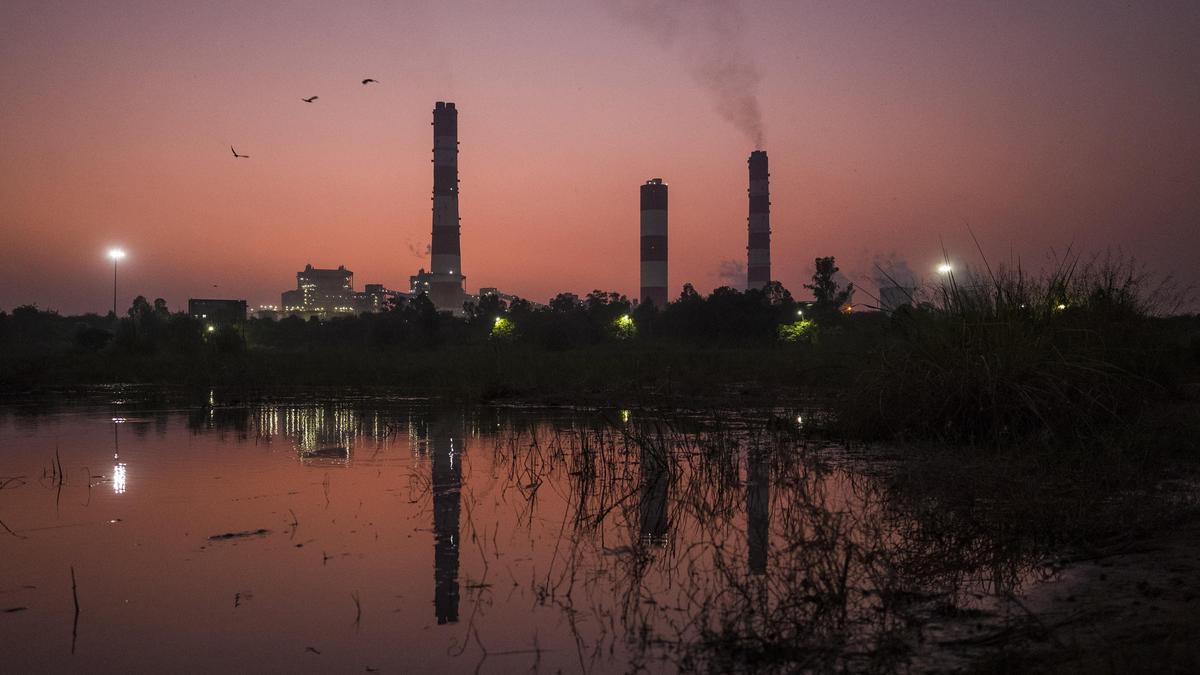
The coal-fired NTPC Ltd. Dadri Power Plant in Gautam Budh Nagar district, Uttar Pradesh, India | Photo Credit: ANINDITO MUKHERJEE On September 28, Union Coal and Mines Minister G. Kishan Reddy on Monday denied any shortage of coal in the country, despite data showing that more than 44% of India’s thermal power plants had critically low stocks. Mr. Reddy said the problem was not a coal shortage but a surge in power demand.According to the Central Electricity Authority (CEA), data as of September 30 show that among the 191 thermal power plants, 84 plants were critically low on stock. The CEA considers a power plant to be critical when inventories fall below 25% of the required normative stock or when the stock can support power generation for less than three days.While data contradict Mr. Reddy’s claim, he is right about the increase in demand. India saw an increase of 10% in power demand in 2026 — the highest year-on-year increase in the past decade.India also saw a surge in power shortages in September 2026, the highest since August 2023, according to a Reuters report. The report also states that reliance on coal-fired thermal power plants has increased during this period due to a decline in hydro-power generation. It links this to the El Nino phenomenon (a warming of the central and eastern Pacific that alters atmospheric circulation and weakens monsoon winds over the subcontinent).India has seen weaker monsoons in the last six years in which it experienced strong El Nino events.The chart below shows India’s rainfall departure percentage over the past 20 years, specifically in the monsoon months; June, July, August, and September. The rainfall departure percentage compares the rain that actually fell against the historical average for that exact location and period. The data show that in June, India experienced its highest rainfall deficit for that month since 2014, another year that saw a strong El Nino event.Coal was the primary source for 79% of the total energy generated in 2024-25, according to the “Energy Statistics India 2026” report by the Ministry of Statistics and Programme ImplementationThe International Energy Agency (IEA) posits that unprecedented higher temperatures experienced around the world contributed heavily to the rising demand for electricity.The chart below compares India’s average power demand (in gigawatts) per month in 2025 with each month’s highest temperatures. The country’s average power demand rose in the beginning months of the year along with the temperatures, which went from a maximum of 25.53°C in January 2025 to an annual peak of 35.97°C in April 2025.The consequent decline in the demand for energy saw a concomitant dip in temperatures. In their report regarding thermal comfort in India, the IEA states that the surge in energy demand is driven by rising ownership of cooling technologies such as fans and ACs.According to the IMD, India experienced its hottest August, since nationwide record-keeping began in 1901, along with the rest of the world, in 2026. The national average mean temperature soared to 28.01°C, which is 0.67°C higher than the “normal” temperature of 27.34°C. The country also saw its highest power demand of all-time recently: 270.8 GW on May 21, 2026.Although India’s coal stocks are deteriorating by the day, the later months of the year generally promise lower temperatures and eased power demand. However, the decreased pressure on coal stocks does not imply a decreasing shortage of supply.With inputs from Gauri Singavarapu, who is internng with The Hindu Data Team Published - October 09, 2026 08:00 am IST
Coal stocks critically low as power demand rises in India
Full Article
Original Source
Read the full article at Thehindu →KhanList aggregates and links to publicly available news content. We do not host full articles from third-party sources. Always verify important information with original sources.