
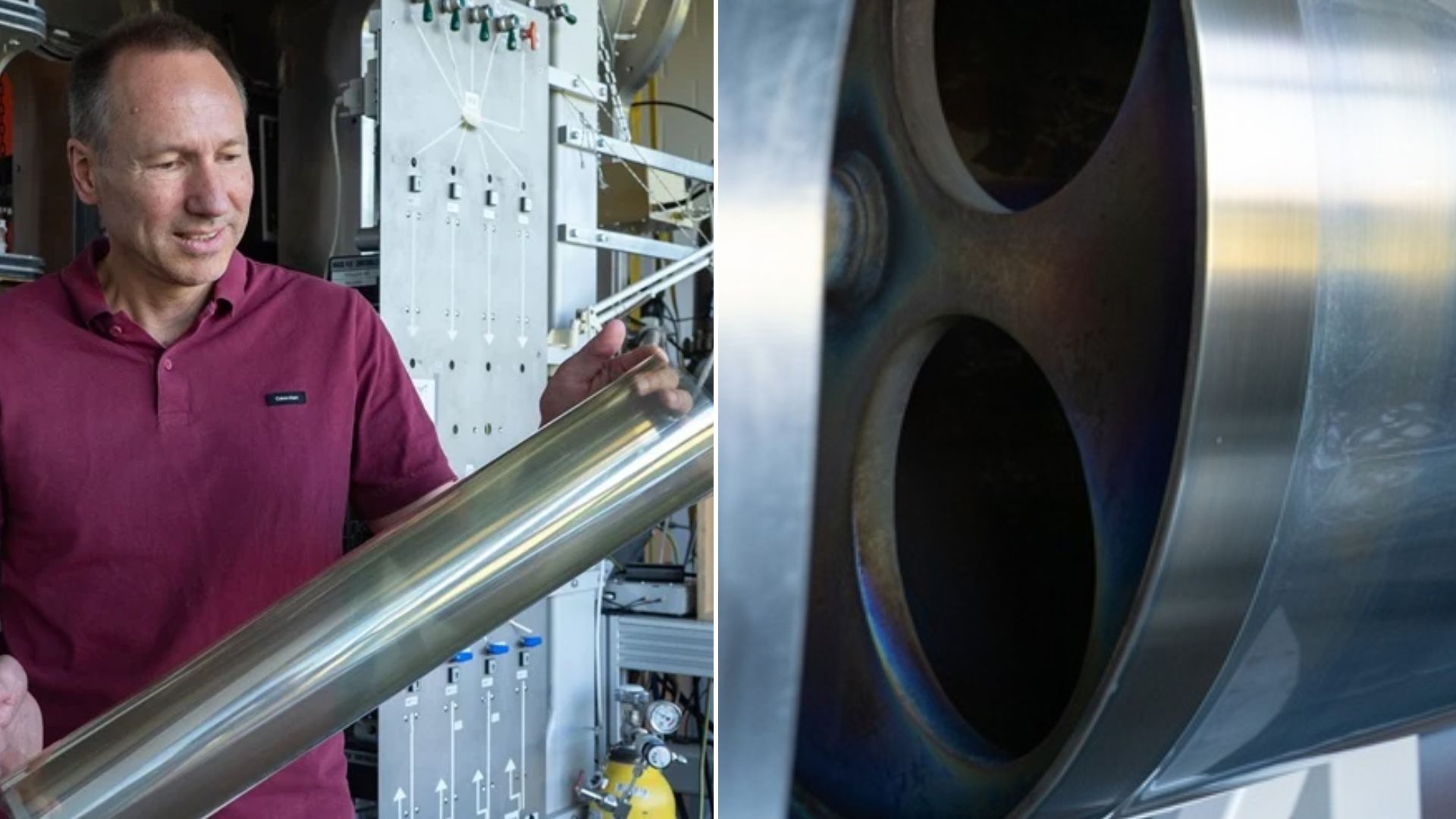
Researchers at Switzerland’s Empa research institute are developing a direct air capture technology that removes carbon dioxide from the atmosphere in cycles lasting less than one second. The approach replaces bulky porous filters with ultra-thin, amine-containing coatings that can rapidly absorb and release CO₂. The technology is part of Empa’s Mining the Atmosphere research initiative, which explores ways to capture atmospheric carbon and turn it into reusable materials and chemicals. Researchers have conducted initial flow and process simulations, but experimental testing is still needed to determine whether the approach can compete with existing direct air capture systems. Thin coatings could speed up carbon capture Direct air capture systems typically move large volumes of air through porous materials that bind CO₂. The captured gas is then released, often by heating the material and applying a vacuum or steam. Because atmospheric CO₂ concentrations are only around 430 parts per million, these systems must process large volumes of air to collect meaningful amounts of the greenhouse gas. Empa’s approach takes a different route. Rather than maximizing the amount of CO₂ captured in each cycle, the researchers aim to capture smaller quantities much more frequently. The proposed system uses ultra-thin coatings made from amine-containing materials. Instead of allowing CO₂ to penetrate deep into a porous adsorbent, the coating binds it at or near the surface. This reduces the amount of material that must be heated during the release stage. “The process can be significantly accelerated thanks to the low thermal mass,” Empa researcher Dirk Hegemann explained in the institute’s announcement. The thin layers can heat up and cool down quickly, allowing adsorption and desorption, the capture and release of CO₂, to alternate at much shorter intervals than in conventional systems. Empa researcher Sandra Galmarini says the target is to complete a cycle in less than a second, compared with several minutes for conventional approaches. A moving surface could continuously capture CO₂ The proposed design resembles a conveyor belt. A continuously moving surface coated with the capture material passes through two zones. In the first, ambient air flows across the coating, allowing CO₂ to bind to its surface. In the second, the material is heated under reduced pressure, releasing the captured gas and preparing the coating for another cycle. Separating these stages allows each zone to operate under different conditions. The capture section needs sufficient airflow, while the release section benefits from a small gas volume to reduce the energy required for heating and creating a vacuum. The researchers also see potential advantages in the system’s modular design. Multiple smaller units could be combined rather than building increasingly large and complex capture facilities. The moving surface might also help transport air, potentially reducing the energy required by fans. Experimental testing remains a key hurdle Despite the promising simulations, the researchers have not yet experimentally demonstrated the proposed sub-second capture cycle. Empa says a new measurement platform is needed to determine how quickly CO₂ binds to and separates from the thin coatings. The team also needs to evaluate how much CO₂ the system can capture per unit of volume and time, whether the coatings remain stable through repeated cycles, and how well seals and pressure zones perform at high rotational speeds. Hegemann is functionalizing surfaces with plasma coating, while the broader research team is developing the experimental setup needed to test the process. The central challenge is whether the speed advantage can translate into meaningful overall performance. Capturing less CO₂ per cycle means the system must operate rapidly and repeatedly to achieve competitive throughput without consuming excessive energy for heating, cooling, airflow, and vacuum generation. If those challenges can be addressed, the technology could offer a more flexible approach to direct air capture. Get the latest in engineering, tech, space & science - delivered daily to your inbox.Kaif Shaikh is a journalist and writer passionate about turning complex information into clear, impactful stories. His writing covers technology, sustainability, geopolitics, and occasionally fiction. A graduate in Journalism and Mass Communication, his work has appeared in the Times of India and beyond. After a near-fatal experience, Kaif began seeing both stories and silences differently. Outside work, he juggles far too many projects and passions, but always makes time to read, reflect, and hold onto the thread of wonder.
CO2 capture in under one second: Scientists test a faster way to clean air
Full Article
Original Source
Read the full article at Interestingengineering →KhanList aggregates and links to publicly available news content. We do not host full articles from third-party sources. Always verify important information with original sources.