
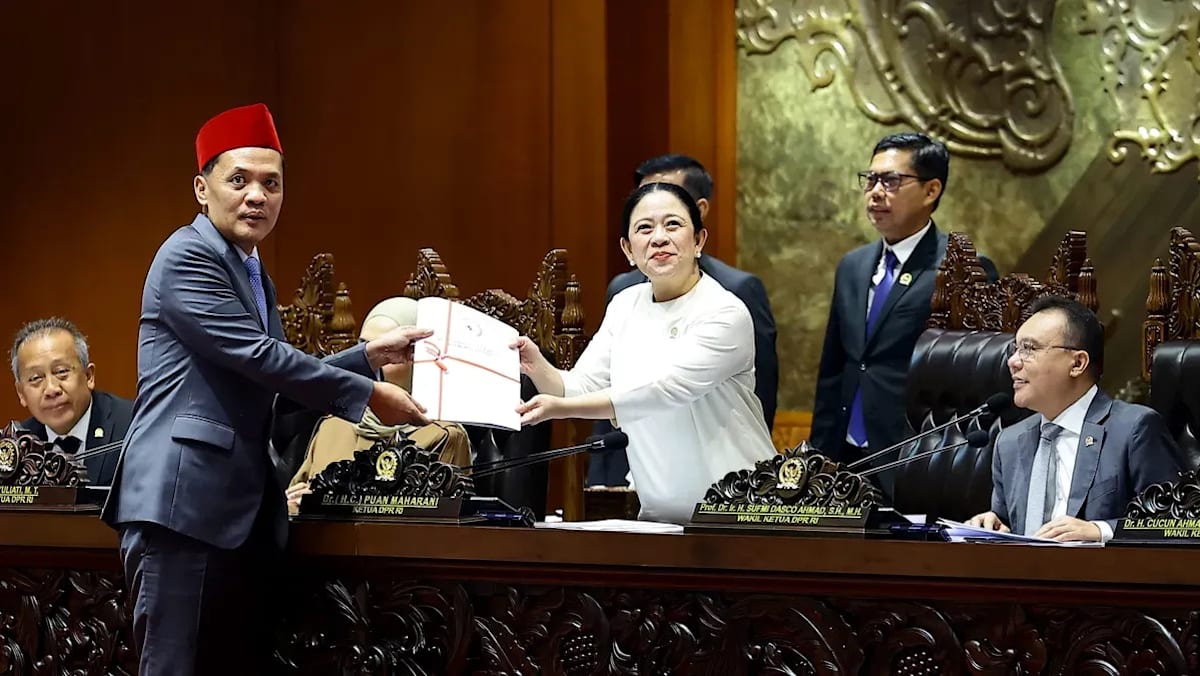
Asia Indonesia's new asset forfeiture law introduces changes to how authorities recover assets linked to criminal offences. CNA examines the mechanisms involved, the types of assets covered, the rights of property owners and the institutions responsible for managing and overseeing the process. Indonesian Speaker of the House Puan Maharani chairs a plenary session to pass the Asset Forfeiture Law at the parliament building in Senayan, Jakarta (Photo: House of Representatives E-Media/Runi) New: You can now listen to articles. This audio is generated by an AI tool. SINGAPORE: Indonesia's parliament has passed a long-awaited law that gives the state greater powers to recover wealth linked to criminal activity, including in cases where suspects have died, fled or cannot be identified.The House of Representatives (DPR) passed the Asset Forfeiture Law Related to Corruption and Other Criminal Offences at a plenary session on Thursday (Nov 19), after years of debate.The idea dates back to 2008, when the Financial Transaction Reports and Analysis Center (PPATK) began exploring ways to recover the proceeds of crime. A draft bill was submitted to parliament in 2012, but efforts to pass it stalled for years. The government brought it back in 2023, but it failed to clear parliament before the 2019-2024 legislative term ended. Discussions resumed in January 2026.The law's biggest change is that authorities no longer always need a criminal conviction before seeking to confiscate assets suspected of being linked to crime. They can pursue confiscation without a conviction in certain circumstances, subject to court approval.But what does this mean in practice? Could the state seize assets transferred to family members? And what happens when property belongs to someone who had nothing to do with the crime?CNA takes a deeper look at the law and its implications. What is the law and why is it needed?Previously, Indonesian authorities generally had to secure a final and binding criminal conviction before they could confiscate an offender's assets as an additional penalty.That requirement can make recovering criminal proceeds difficult when a suspect dies, goes into hiding or cannot be found. Without a complete criminal case, authorities may have no way to confiscate assets believed to have been acquired through crime.Sandra Sahelangi, a senior adviser at political and regulatory advisory firm Flint Global, said the law could strengthen Indonesia’s anti-corruption efforts while helping honest businesses compete."A credible threat that criminal proceeds will be traced and taken, even when a suspect flees or dies, makes corruption more costly and helps honest firms compete," she told CNA.The new law creates two routes for confiscation: conviction-based forfeiture (CBF) and non-conviction-based forfeiture (NCBF).CBF follows a criminal conviction. Once the conviction is final and binding, the court can order the offender's assets to be confiscated as an additional penalty.NCBF works differently. It allows authorities to seek confiscation without first securing a criminal conviction, provided the case meets specific conditions. Rather than making confiscation part of an individual's criminal prosecution, this process focuses on the assets suspected of being linked to crime.That does not mean authorities can simply take someone's assets on suspicion alone. A final and binding court ruling is still needed before the assets can be permanently transferred to the state. A worker walks on the roof of Indonesian Parliament Building in Jakarta, Indonesia on Dec 5, 2022. (Photo: Reuters/Willy Kurniawan) When can assets be confiscated without conviction?NCBF allows confiscation in five situations:The suspect or defendant has died.The suspect or defendant has fled.The suspect or defendant suffers from a permanent illness.The offender's identity is unknown.The offender's whereabouts are unknown.There is a minimum value requirement: the assets must be worth at least 1 billion rupiah (US$55,000). The calculation is based on their value when acquired, not their market value when proceedings begin.What assets can be confiscated?The law covers four types of assets. This includes proceeds of crime: wealth obtained through criminal activity, assets transferred to other people or converted into different forms, and any income or economic benefits generated from them.Authorities can also target assets used to commit crimes, such as illegal weapons in terrorism cases or hazardous substances in drug-related offences.Another category is criminal assets where the owners cannot be identified. Examples include illegally harvested timber and smuggled goods.The fourth category is substitute assets. If the original proceeds of crime cannot be recovered, authorities can seek to confiscate other assets legally acquired by the offender instead. This requires a final and binding court ruling, with the value of those substitute assets taken into account.Transferring assets to someone else does not automatically put them beyond the authorities' reach. Assets passed on to spouses, children, relatives, colleagues or friends can still be confiscated if authorities establish a link to the underlying offence. But relatives do not automatically lose their property because of their relationship with a suspect. The connection to criminal activity must be demonstrated.Even turning criminal proceeds into public facilities does not necessarily protect them from confiscation. Schools, universities, mosques, churches, playgrounds and green spaces can still be seized, but must continue serving their existing public functions.Beyond corruption, the law covers six other categories of offences:Drug-related crimes, including narcotics and psychotropic substances.Terrorism and terrorism financing.Human smuggling.Smuggling of weapons, ammunition and hazardous materials.Human trafficking.Fraud or embezzlement involving information technology and/or affecting the wider economy, including certain cases involving online gambling, investment schemes, Haj and Umrah travel, and cryptocurrencies.Indonesian lawmakers left out the so-called illicit enrichment, which refers to unexplained increases in a public official's wealth that cannot be accounted for by legitimate income. Indonesia Corruption Watch (ICW) - an independent anti-corruption watchdog - criticised the omission, arguing that the provision could help expose officials whose wealth far exceeds their legitimate earnings.House Judiciary Committee chairman Habiburokhman said lawmakers had considered public and expert feedback, as well as human rights concerns. He said the law establishes legal procedures rather than creating new criminal offences or penalties. Chairman of the Indonesian House Judiciary Committee Habiburokhman (Photo: House of Representatives E-Media/Devi) What happens if suspects flee or hold assets overseas?Fleeing Indonesia or holding assets overseas does not necessarily put suspected criminal proceeds beyond the authorities' reach.For fugitives, prosecutors can seek confiscation without a criminal conviction once the suspect has been on the police wanted list for at least 60 days.If the fugitive is subsequently arrested while the application is being heard, the confiscation proceedings must stop so the criminal case can resume. Authorities can file a fresh application if the legal conditions are met.If the criminal case ends in an acquittal or the defendant is released from all charges, the confiscation application must also be discontinued. The process does not remove the suspect's criminal liability.The law also allows investigators to pursue assets held overseas.They can ask foreign authorities to freeze or seize property linked to crime. If that request is rejected, investigators can instead seek to freeze or seize other assets belonging to the same person in Indonesia, up to an equivalent value.Such action requires court approval, with the value of substitute assets assessed professionally and proportionately.Applications involving assets located overseas must be filed with the Central Jakarta District Court.How will assets be seized and confiscated?Investigators can begin tracing assets once a criminal case has been identified or a suspect named. They can request information and documents from individuals, government agencies and other institutions.Authorities may suspend transactions, freeze assets or seize property, subject to legal procedures and required court approval. These are temporary measures; assets can only be permanently transferred to the state after a final and binding court ruling.For NCBF cases, state attorneys must apply to the court, identifying the assets, the legal grounds and supporting evidence. The application must be publicised through the courts and media so interested parties can challenge the proposed confiscation. Those providing information in good faith during asset-tracing investigations are protected from civil, administrative and criminal proceedings.What happens if someone else's property is caught up in the case?Third parties can challenge confiscation if their property is wrongly targeted. For example, someone might buy a house without knowing that the previous owner paid for it with criminal proceeds.State attorneys must establish the property's link to the alleged crime, while the buyer must show they legally own it and purchased it in good faith.Objections can be filed after the application is made public but before the court issues its first instance ruling. The case must be heard in open court using authentic and lawfully obtained evidence. If the objection succeeds, the property must be returned.Those affected can also seek compensation, capped at the assessed value of the frozen or seized assets, from an endowment fund provided for under Indonesia's criminal procedure law.This right does not extend to suspects or defendants who have fled or are on the wanted list, defendants tried in absentia, or their lawyers.The court has 60 days to decide. A party that filed an objection can appeal to the Indonesian Supreme Court within 14 days of the ruling. The Supreme Court's decision is final and binding. A file photo of the Indonesian Supreme Court building in Jakarta. (File photo: AFP/Yasuyoshi Chiba) Who will oversee asset forfeiture?The president will establish two agencies to manage confiscated assets and oversee enforcement.The Asset Forfeiture Management Agency will safeguard, maintain and value assets, and oversee their use, sale or return after a final court ruling. Assets at risk of deterioration or losing value may be sold earlier with court approval, with proceeds returned if forfeiture is rejected.The Asset Forfeiture Supervisory Agency will have five members serving five-year terms, renewable once. It will monitor investigators, state attorneys and asset managers, investigate alleged ethical violations and receive public complaints.The president will nominate members of the supervisory agency, subject to approval by the House of Representatives. However, the independence of both agencies has raised concerns.Sandra from Flint Global, said effective implementation would depend on institutional credibility and independent enforcement."Two things will decide it: the institutions and the independence of enforcement," she said.She warned that political patronage could undermine public trust, calling for merit-based appointments, conflict-of-interest rules and transparency over assets frozen, seized, sold or returned.Anti-corruption watchdog ICW similarly questioned the agencies' independence because both would be established by the president."What is missing are the safeguards: independent oversight, transparent criteria and transparency of the asset registry enshrined in the law," ICW said.Habiburokhman said separating asset management from law enforcement was intended to prevent conflicts of interest."The Asset Forfeiture Law must not become a tool for those in power to oppress people outside the ruling establishment, nor should it be used by law enforcement officers for extortion," he said.Sandra also emphasised the law's impact on investor confidence would depend on its implementation."In principle, the law should help. In practice, investors will judge it by how it is used, not by what it says," she said.Selective enforcement, according to her, could increase investment risks, while credible action against criminal proceeds could strengthen confidence.The management agency must report to the president and House every six months or when required. Officials who abuse their powers may face administrative, ethical or criminal sanctions.The law will not apply retrospectively. It will take effect 12 months after promulgation, provided the two agencies have been established. The government must also issue implementing regulations within 12 months of promulgation.
CNA Explains: What is Indonesia's new asset forfeiture law and can wealth be seized without a criminal conviction?
Full Article
Original Source
Read the full article at Channelnewsasia →KhanList aggregates and links to publicly available news content. We do not host full articles from third-party sources. Always verify important information with original sources.