
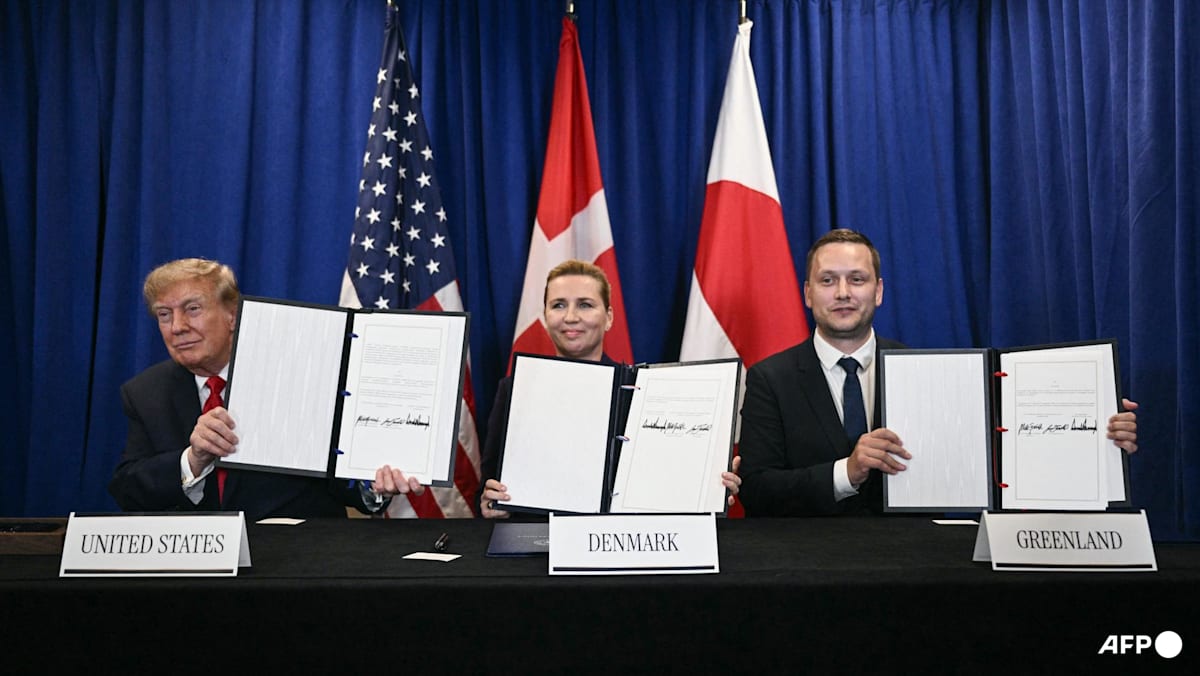
World The US, Denmark and Greenland signed a security pact on Tuesday, granting Washington a stronger military presence on the semi-autonomous Danish territory. US President Donald Trump, Denmark's Prime Minister Mette Frederiksen and Greenland's Prime Minister Jens-Frederik Nielsen sign a trilateral security deal on the sidelines of the 81st United Nations General Assembly in New York, on Sep 22, 2026. (Photo: AFP/Brendan Smialowski) New: You can now listen to articles. This audio is generated by an AI tool. After months of threats and diplomatic tensions over Greenland, the United States has struck a deal that allows it to significantly expand its military presence on the strategically located semi-autonomous Danish territory.US President Donald Trump signed the security agreement with Danish Prime Minister Mette Frederiksen and Greenland Prime Minister Jens-Frederik Nielsen on Tuesday (Sep 22), on the sidelines of the United Nations General Assembly in New York.The pact allows Washington to establish two new military sites in Greenland, deploy its planned Golden Dome missile defence system there and prevent potential adversaries from gaining military or economic footholds on the island.Trump described the agreement as giving the US "permanent control" over Greenland's security. But the agreement reaffirms the sovereignty and territorial integrity of the Kingdom of Denmark as well as Greenland's right to self-determination. So what exactly is in the agreement, what has actually changed, and why does it matter?What is in the deal?The 10-page agreement covers two main areas - an expanded US military presence and restrictions on foreign investment in Greenland.It allows the US to establish two new military bases - at Narsarsuaq, a former Cold War airbase in southern Greenland, and Mestersvig on the east coast.These would be in addition to the Pituffik Space Base in northwestern Greenland, which the US already operates and which supports missile warning, missile defence and space surveillance.Washington can also seek additional military sites in future, although these would have to be agreed upon by the parties. The agreement also allows the US to establish Trump's planned "Golden Dome" missile defence system in Greenland, while granting US aircraft and vessels broad access across Greenland and its territorial waters.On investment, the pact restricts states and investors from countries outside NATO, NATO partner states and the European Union from gaining control or significant influence in sensitive sectors, including critical infrastructure and resource extraction.It also bars non-NATO states from establishing military installations in Greenland."No US adversary will ever be permitted to establish a military presence in Greenland any more, or make sensitive investments there without our express written approval," Trump said.The agreement has no expiry date and can be amended only by mutual consent. Its provisions are intended to remain in force even if Greenland eventually becomes independent from Denmark.The pact still requires approval from the parliaments of Denmark and Greenland. Pituffik Space Base in northern Greenland on Oct 4, 2023. (File photo: Ritzau Scanpix via AP/Thomas Traasdahl) How significant is the US military expansion?This would be the first major increase in American military infrastructure there since the Cold War.At its peak during the Cold War, Washington maintained 17 military installations and more than 10,000 personnel on the island.Greenland's strategic location explains its military importance. Sitting between Europe and North America, it lies along the shortest route for missiles between Russia and the US. It is also a critical location for detecting and potentially intercepting missile threats approaching the US.Elizabeth Buchanan, a senior fellow at the Australian Strategic Policy Institute (ASPI), described the planned expansion as having "immense strategic weight" for the Arctic. Its significance extends beyond the number of bases or troops stationed there, she said.Expanded facilities could give the US Space Force greater scope to operate radar, satellite and other space-related capabilities.“Looking ahead, as the space domain emerges as a sphere for great power contest, the strategic edge delivered by bolstering networked radar and satellite linkages in Greenland is clear,” she told CNA.Couldn't the US already do much of this?Despite Trump's portrayal of the agreement as a major breakthrough, analysts said the deal seems more modest. A 1951 defence agreement between Washington and Copenhagen already gave the US extensive military access to Greenland. It was updated in 2004 to give Greenland a greater role.Under the existing arrangement, Washington was already able to increase its military presence as long as Denmark and Greenland were informed in advance.Assistant Professor William James of the S Rajaratnam School of International Studies said much of what has been announced therefore builds on rights Washington already possessed."The substance seems more modest than the lofty rhetoric," he told CNA."Greenland remains Danish ... and a crisis that began with threats has seemingly ended with a negotiated text."The prohibition on foreign military bases also largely formalises the existing situation, analysts said.Rasmus Sinding, a senior researcher at the Danish Institute for International Studies, noted that Denmark, Greenland and the US already had a policy of preventing non-NATO countries from establishing military bases in Greenland.Dr James similarly said that Denmark, which is responsible for Greenland's defence and foreign policy, was never likely to permit Russia or China to establish a military foothold there. So what exactly is new?The agreement has two new provisions - banning US enemies from making "sensitive investments" in Greenland and the permanence of the deal.The agreement goes beyond preventing foreign military bases by restricting investors from countries outside NATO, NATO partner states and the European Union from gaining control or significant influence over sensitive sectors in Greenland.The restrictions appear principally aimed at China and Russia.Dr Buchanan noted that this aspect of the deal would make it harder for China in particular to gain a strategic foothold in Greenland as Beijing seeks a greater role in Arctic affairs.Russia, however, is a different case, she said. As the country with the largest Arctic territory, Moscow already possesses other locations from which it can project power and challenge the US."The idea that Moscow has or had designs on Greenland in presence or basing terms seems to be a stretch. They can make use of their position elsewhere in the region to frustrate or target Washington without expanding to Greenland," she said.The second potential significant change is the fact that the pact has no end date and can only be amended by mutual consent. This means that Greenland must continue to abide by the agreement even if it obtains independence from Denmark, Dr James pointed out. That is the most significant change in the package, as it is designed to outlast any change in Greenland's status, he said. US President Donald Trump shakes hands with Greenland Prime Minister Jens-Frederik Nielsen as Danish Prime Minister Mette Frederiksen reacts, as they attend a trilateral signing event regarding a deal on Greenland's security, during the 81st United Nations General Assembly (UNGA), in New York City, US, on Sep 22, 2026. (Photo: Reuters/Kylie Cooper) What is NATO's role? Denmark and Greenland have sought to frame the agreement not simply as a bilateral arrangement with Washington, but as part of a wider strengthening of NATO's northern defences.Both Frederiksen and Nielsen stressed NATO's role during the signing.The agreement also commits Denmark to strengthening its own security posture in the region.If Greenland becomes independent, Denmark and Greenland are expected to ensure that the new state remains within NATO, including applying for membership if necessary.Dr Sinding said Denmark and Greenland have consistently sought to make Arctic security a NATO issue, as the Arctic assumes growing strategic importance.Russia has built up military infrastructure across its Arctic territory, while China has sought a greater economic and research presence in the region."The greater US military presence in Greenland increases the militarisation of the Arctic," DIIS’ Sinding said.For China, Dr Buchanan said the agreement further narrows the avenues through which Beijing can establish itself in the Arctic.China could instead intensify research missions, economic engagement and activities elsewhere in the region as it seeks to normalise its role as a polar power, she said.What rights does Greenland have?Analysts said there is a clear distinction between what was agreed upon for Greenland’s sovereignty and defence responsibilities.The agreement respects Greenland's right to self-determination, and the US must act in a way that respects Greenlandic society and the Greenlandic way of life.ASPI’s Buchanan noted that while Greenland would remain part of Denmark, its defence and security would shift from Danish responsibility to Washington’s – akin to a US "protectorate".“Sovereignty and territorial integrity remain Danish, Greenlandic people feel heard and hopeful of their own independence journey continuing, and Washington is able to bolster her long-held ‘fortress’ ambitions for the island,” she summed up. Dr Sinding said Trump’s posturing reflects his desire to promote the agreement as a victory that only he was able to achieve.“There is no reason to believe that Greenland and Denmark would agree to an agreement that infringes Greenland’s right to self-determination and the sovereignty of the Danish Realm,” he told CNA. Greenland's Prime Minister Jens-Frederik Nielsen, Denmark's Prime Minister Mette Frederiksen and US President Donald Trump arrive to sign a trilateral security deal on the sidelines of the 81st United Nations General Assembly in New York, on Sep 22, 2026. (Photo: AFP/Brendan Smialowski) Did Trump’s pressure work?Yes, to an extent, analysts said.Trump's months-long pressure campaign accelerated negotiations over Greenland's security and forced Denmark, Greenland and their European allies to respond to Washington's concerns."Trump's pressure was certainly the driving force that led to the specific agreement," Dr Sinding said.But he added that a similar security arrangement could probably have been reached through conventional diplomacy without threats.The outcome is also notably different from what Trump initially demanded, which was to acquire Greenland.Dr James noted that while Trump’s coercion did have some influence, the Europeans have also got better at “managing” the US president, who dropped his demand for ownership over Greenland.“Europeans are paying greater attention to Trump's concerns, and his pressure led to this deal, but the outcome is not the one he demanded,” he said.“Ultimately, the approach taken by Denmark and its closest partners, including the UK, worked: treat the security concern as legitimate, keep sovereignty non-negotiable, and put money and forces behind both.” Want an issue or topic explained? Email us at digitalnews [at] mediacorp.com.sg. Your question might become a story on our site.
CNA Explains: What does the US-Greenland security deal actually change?
Full Article
Original Source
Read the full article at Channelnewsasia →KhanList aggregates and links to publicly available news content. We do not host full articles from third-party sources. Always verify important information with original sources.