
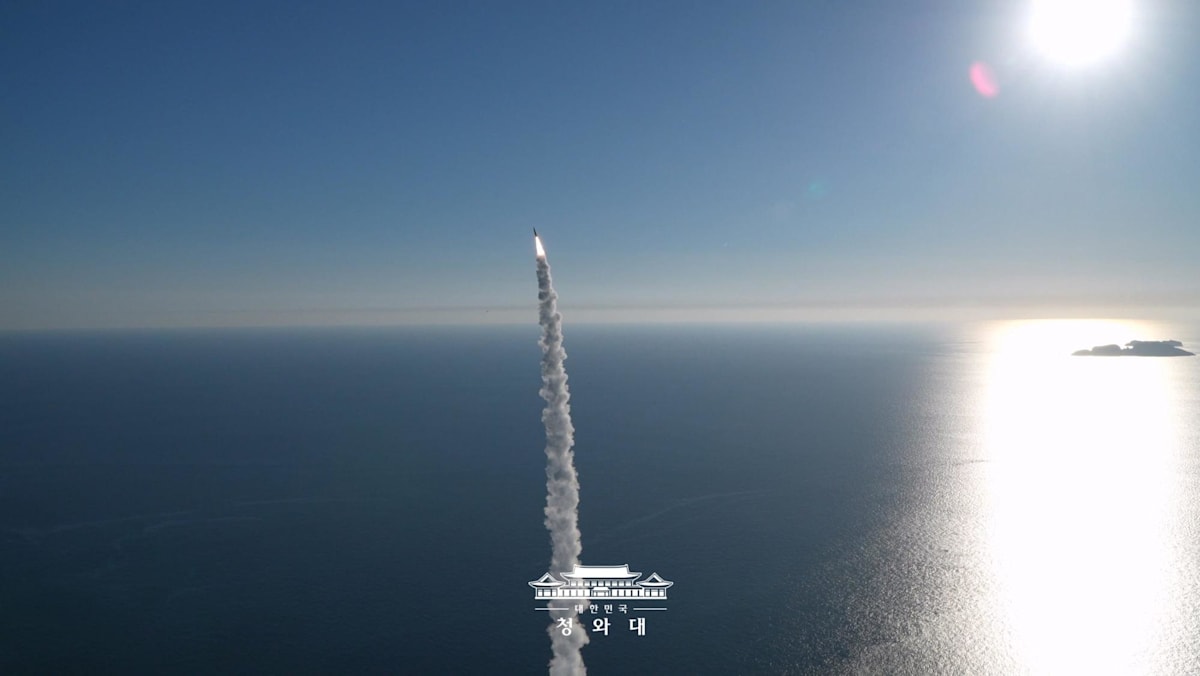
East Asia South Korea tested a hypersonic weapon on Oct 8, days after North Korea launched what it claimed was a hypersonic missile, drawing fresh attention to the technology and its implications for regional security. South Korea tested its first domestically developed hypersonic weapon on Oct 8, 2026. (Photo: The Blue House) New: You can now listen to articles. This audio is generated by an AI tool. BEIJING: South Korea has test-fired its first domestically developed hypersonic weapon, bringing Seoul a step closer to what it says could be game-changing weapons capabilities.The launch on Oct 8 came just days after North Korea tested what it described as an intermediate-range hypersonic missile, amid heightened tensions on the Korean Peninsula.The developments have drawn fresh attention to the growing pursuit of the advanced technology and its implications for regional security.What are hypersonic weapons?Hypersonic weapons are generally defined as capable of travelling at least five times the speed of sound, or Mach 5. While ballistic missiles can also reach hypersonic speeds, modern hypersonic weapons are typically distinguished by their ability to manoeuvre during flight.There are two main types - hypersonic glide vehicles and cruise missiles.Hypersonic glide vehicles are launched via rocket boosters before separating and gliding towards targets without sustained engine power. South Korea tested such a vehicle on Oct 8. “Boost-glide vehicles can have ranges of up to thousands of kilometres, effectively making them ICBM (intercontinental ballistic missile) equivalents,” the research organisation Center for Arms Control and Non-Proliferation said in a factsheet.Meanwhile, hypersonic cruise missiles use specialised engines, typically air-breathing scramjets, to sustain high-speed flight.Hypersonic weapons can be designed to carry either conventional or nuclear warheads.Why are they hard to intercept?The challenge lies in a potent combination of extreme speed and manoeuvrability.Traditional ballistic missiles generally follow a high, arcing trajectory, allowing defence systems to calculate their likely path and determine where to intercept them.By contrast, hypersonic glide vehicles and cruise missiles can travel at relatively low altitudes, delaying detection by ground-based radar systems due to the Earth’s curvature.Crucially, their ability to change course makes it harder to predict where they will strike, further complicating interception efforts. “The distinct challenge posed by hypersonic weapons is due not to their speed but to their potential to evade mid-course defences and overcome terminal-phase defences,” according to the Center for Arms Control and Non-Proliferation.Mid-course defences aim to intercept missiles during the middle stage of flight, while terminal-phase defences target them during their final approach.Who has hypersonic weapons?Several countries are developing hypersonic weapons, although relatively few have confirmed operational capabilities.China and Russia are widely regarded as leading the pack.Beijing has deployed the DF-17 hypersonic missile system, which US defence assessments indicate entered service around 2020.It also showcased several hypersonic anti-ship missiles, including the YJ-17, YJ-19 and YJ-20, at a major military parade in September last year, although the extent to which these systems are operational is unclear. YJ-21 hypersonic anti-ship ballistic missiles are seen during a military parade marking the 80th anniversary of victory over Japan and the end of World War II, in Beijing’s Tiananmen Square on Sep 3, 2025. (Photo: AFP/Greg Baker) “China is among the world’s most advanced countries in hypersonic weapons development,” Lami Kim, Korea chair in advanced technologies, national security and defence at the International Institute for Strategic Studies (IISS), told CNA.Meanwhile, Moscow has deployed the Avangard hypersonic glide vehicle and Zircon cruise missile.Russia announced that Avangard entered service in 2019, while Zircon was reportedly deployed aboard a warship in 2023.Russia has also used its Kinzhal and Oreshnik ballistic missiles in Ukraine. Both travel at hypersonic speeds, although experts have questioned whether they possess the advanced manoeuvrability associated with modern hypersonic weapons. Russian missiles, which appear to be the Oreshnik hypersonic ballistic missile, according to the Ukrainian Air Force, fly during a Russian missile and drone strike, amid Russia's attack on Ukraine, in Kyiv, Ukraine, on May 24, 2026. (Image: Reuters/Gleb Garanich) The United States has tested hypersonic weapons and deployed its Long-Range Hypersonic Weapon, known as Dark Eagle, for military exercises, including Exercise Valiant Shield in June.However, the US Army had yet to complete equipping its first Dark Eagle unit, including with missiles, when the programme was assessed earlier this year, US defence publication National Defense reported in September, citing the Government Accountability Office.South Korea's latest test marks a significant step in its own development programme, although the weapon is not yet operational.Its rival neighbour North Korea has repeatedly tested missiles it describes as hypersonic, but their capabilities and operational readiness remain difficult to verify independently. North Korea launched what it described as a hypersonic missile from an undisclosed location in the country on Jan 6, 2025. (Photo: AFP/KCNA via KNS) Japan announced the deployment of an initial version of its homegrown Hyper Velocity Gliding Projectile in March, while India said in November 2024 that it had successfully tested a domestically developed long-range hypersonic missile.Elsewhere, Iran’s Revolutionary Guard claimed in June 2025 that it had fired Fattah 1 hypersonic missiles towards Israel. However, analysts questioned whether they possessed the capabilities associated with modern hypersonic systems.What does their spread mean for Asia?The spread of hypersonic weapons could have far-reaching regional security implications, although their strategic impact varies depending on the countries involved, analysts said.China's advances in hypersonic weapons development pose challenges for the United States and its allies and partners in the Indo-Pacific, Kim said.She noted that Beijing’s hypersonic glide vehicles could strengthen its ability to penetrate missile defences and complicate Washington’s military planning. Military vehicles carrying DF-17 missiles participate in a military parade at Tiananmen Square in Beijing on Oct 1, 2019, to mark the 70th anniversary of the founding of the People’s Republic of China. (Photo: AFP/Greg Baker) “By increasing the risks and potential costs associated with US military intervention, such capabilities could undermine the credibility of US extended deterrence in the region,” Kim said.Extended deterrence refers to the US commitment to protecting its allies and partners, including through its nuclear capabilities.The proliferation of advanced hypersonic strike capabilities could also increase the risk of instability during a crisis.In an online summary of a chapter from its Asia-Pacific Regional Security Assessment 2026 report, IISS warned that the expansion of long-range conventional strike capabilities, including hypersonic missiles, could “inadvertently undermine deterrence and mutual vulnerability”. An intermediate-range missile, subsequently described as hypersonic, is fired from the eastern region of North Korea toward the East Sea, Oct 3, 2026. (Photo: KCNA via Reuters) On the Korean Peninsula, analysts said South Korea's emerging hypersonic weapon capabilities would be unlikely to fundamentally alter the military balance.“A South Korean hypersonic capability, while indicative of Seoul's technological sophistication, is overkill against North Korea, which lacks anything resembling sophisticated air and missile defence of its own,” Ankit Panda, Stanton Senior Fellow in the Nuclear Policy Program at Carnegie Endowment for International Peace, told CNA.However, the strategic significance of South Korea's hypersonic capabilities could increase if North Korea acquired more advanced missile-defence systems or if Seoul eventually developed nuclear weapons, said IISS’ Kim.“In either case, the ability of HGVs (hypersonic glide vehicles) to penetrate missile defences and deliver highly survivable strikes would become substantially more consequential,” she added. Want an issue or topic explained? Email us at digitalnews [at] mediacorp.com.sg. Your question might become a story on our site.
CNA Explains: What are hypersonic weapons, who has them and why do they matter for Asia?
Full Article
Original Source
Read the full article at Channelnewsasia →KhanList aggregates and links to publicly available news content. We do not host full articles from third-party sources. Always verify important information with original sources.