
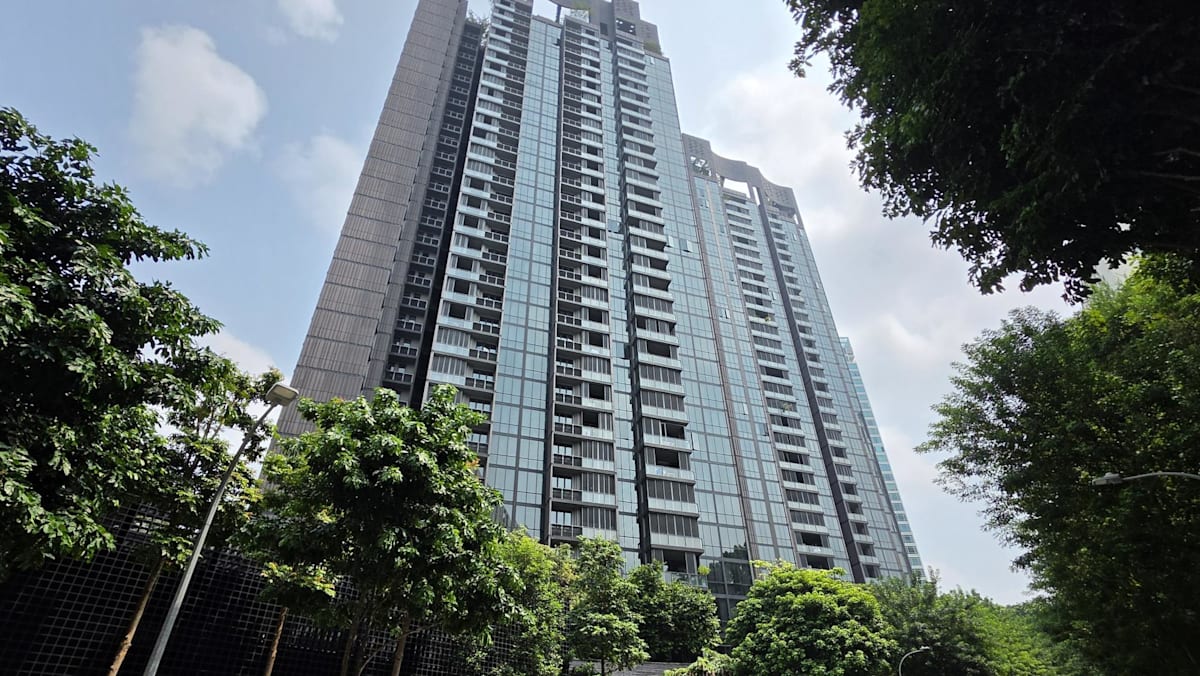
Singapore The properties for auction include a Grade A office with a guide price of S$11.5 million and a four-bedroom penthouse listed at a guide price of S$25.3 million. The facade of Martin Modern. (Photo: SRI) New: You can now listen to articles. This audio is generated by an AI tool. SINGAPORE: The first batch of properties seized in connection with Singapore’s largest money laundering case will soon go under the hammer in a series of property auctions this month.The 25 properties, which include a Grade A office at Suntec City and a 4-bedroom penthouse at South Beach Residences, are among the over 80 properties that will be put up for sale from September to mid-2027.They are part of the S$3 billion (US$2.4 billion) worth of assets seized after islandwide raids in August 2023 uncovered millions of dollars earned from an illicit gambling ring in Southeast Asia.Knight Frank will hold an auction on Thursday (Sep 17), and SRI and Edmund Tie and Company (ETC) will hold one each on Sep 23. How does a property auction work, and what makes the upcoming auctions different?Why are properties put up for auction?It is “very rare” for assets and real estate seized in connection with such a high-profile money laundering case to be put up for sale, said chief research officer of property portal Mogul.sg Nicholas Mak.But property auctions are not novel. Some real estate agencies hold auctions regularly and feature mortgagee sales, where lenders seek to recover outstanding loans, voluntary sales by owners, disposal of assets from deceased estates or liquidations and court-ordered sales.In the first half of 2026, 292 properties were listed for auction, of which 216 were mortgagee sales, according to data from ETC.By itself, an auction listing does not mean that the owner is in financial distress, said Mr Tan Tee Khoon, the head of auction and sales at Knight Frank Singapore.“For sellers, auctions offer a structured marketing timetable and an open, competitive bidding process. They provide an opportunity to test market demand and establish a sale price, with greater certainty over the transaction once a property is successfully sold under the hammer,” he said.Ms Joy Tan, head of auction and sales at ETC, added that the auction process is transparent, which could help sellers achieve a higher reserve price on a hotly contested property.Auctions may also offer an alternative avenue for sellers of niche properties that have been challenging to sell via private treaty or those with investment potential.“Considering that both the auction and completion dates are fixed, property disposal via an auction will allow owners to avoid delays, especially those who may have a timeline to meet,” she said. What is the process of an auction?An auction usually begins with an auctioneer introducing a property and its key attributes before commencing the bidding at an opening price.Interested bidders raise their bids until no higher bids are made.When the auctioneer accepts the successful bid and brings down the hammer, a binding commitment to purchase arises under the applicable conditions of sale, said Mr Tan.The buyer must sign the sale documentation and pay the prescribed deposit – usually about 10 per cent of the sale price – immediately.Mr Tan said this is a commitment to buy, rather than an option to decide later. If the buyer is unable to fulfil the sale, the deposit is forfeited in accordance with the conditions of sale, and legal recourse may follow, he added.The buyer’s solicitor will coordinate the legal documentation and payment of the balance, and the sale will be completed within the contractual timeframe, he added. If there are no bids, or bidding does not reach the reserve price - the minimum price the seller has authorised for the auction sale - the property remains unsold.The property may be offered again, or negotiations may continue afterwards through private treaty, said Mr Tan.“An unsuccessful auction does not automatically mean the seller will accept a lower price,” he said.Who can purchase a property at an auction?Anyone may purchase a property at an auction, ETC’s Ms Tan said. That is provided they meet the legal and regulatory eligibility criteria for the property being sold.Prospective buyers should also ensure that they have obtained the necessary In-Principle Approval from their bank, where applicable, and are strongly encouraged to inspect the property where possible and conduct their necessary due diligence before the auction, Ms Tan said.Interested bidders are also required to register their intention to participate in advance with the appointed salesperson or representative before attending the auction, she added.Members of the public may also attend auctions as observers, subject to the event’s arrangements and venue capacity.Mr Tan said their events usually attract anywhere between a handful and dozens of attendees, depending on the type of listings offered and prevailing market interest. For Knight Frank’s auctions, registered bidders can also use their app.Mr Mak said property auctions usually attract more “busybodies and speculators” than buyers.“The parties who will be watching the auctions of the seized assets more closely than other people will include interested buyers, owners of properties in the same condominium project or nearby projects because either they are interested to buy or they are simply curious,” he said. Auctions in September Knight Frank will hold its auction on Sep 17, 2.30pm at Ocean Financial Centre. The seized properties include:Gramercy Park - Four units with guide prices from S$3.8 million to S$7.6 million Sloane Residences - Two units with guide prices from S$3.6 million to S$3.7 million Suntec Tower 1 - Grade A office space with a guide price of S$11.5 millionETC’s auction is on Sep 23, 2.30 pm at UIC Building. The seized properties include: South Beach Residences - Five units with guide prices from S$4.45 million to S$25.32 million 8 Saint Thomas - Two units with guide prices from S$4.4 million to S$5.72 million Paterson Suites - One unit at a guide price of S$5.18 millionSRI’s auction is on Sep 23, 2.30pm at Great World City. The seized properties include:Wallich Residence - Four units with guide prices ranging from S$4.42 million to S$6.78 million. Martin Modern - Six units with guide prices from S$2.238 million to S$4.98 million. Collapse Expand Are auctioned properties cheaper than those on the market?Properties at auction come with guide prices, which take into account recent comparable transactions, prevailing market conditions, the property’s location, tenure and condition, and the seller’s instructions, with reference to valuations in some cases, said Mr Tan.A guide price is indicative and is not necessarily the same as the reserve price, he added.Mr Mak said the guide prices of the seized properties put up for auction in September are “within a reasonable range” of the valuation of the properties, based on his company’s research.All the seized residential properties for sale by the three agencies in September are luxury properties within the core central region. They include units at Wallich Residences, Paterson Suites and Sloane Residences.The properties are fairly new, he noted. Except for Martin Modern, the other units are more than 1,000 sq ft, with guide prices of the larger units starting from S$4 million.Of the first 25 seized properties up for auction, the property with the highest guide price is a 6,727 sq ft 4-bedroom penthouse at South Beach Residences at S$25.32 million.“Because a guide price is not legally binding, it acts as a fluid benchmark rather than a hard rule. It can be the starting point for negotiation or an auction,” said Mr Mak.“The guide price signals the seller's broad expectations to the public to attract potential buyers. A buyer is entirely free to offer a price lower or higher than the guide price based on current market conditions.”But Mr Tan said auction properties are “not automatically bargains”.While buyers may identify value opportunities, the eventual price depends on the property’s merits, the seller’s expectations and the level of competition.“Buyers should assess the total cost of acquiring and holding the property, rather than assume a discount simply because it is being auctioned,” he said. Could the connection to the case affect the auction?Mr Mak said the properties’ link to the high-profile crime is unlikely to adversely affect the prices and demand for the properties.He noted that the properties are linked to criminals. “I don’t think their activities would cause the properties to be haunted or damage the health of the occupants,” he said.The upcoming auctions will not only feature the seized properties, but also other commercial and residential properties that have no connection to the case.ETC’s Ms Tan said they expect the upcoming auction to attract strong interest with a healthy turnout, given the range of properties available.The eventual level of participation will depend on buyer interest closer to the auction date, she said.Knight Frank’s Mr Tan said that given the high profile of the case, they are preparing for the possibility of a larger turnout on Thursday.“However, public attention and enquiries should not be equated with actual bids or completed sales. For prospective purchasers, the considerations remain the same: the property’s location, condition, tenure, pricing and suitability for their needs,” he said.“The profile of the case does not replace the need for proper due diligence.” Outside the auction process, some selected properties will also be offered for sale through an expression of interest process run by List International Realty.These properties are sold this way due to their steep price point and smaller pool of potential buyers, Mr Mak said.The Singapore Police Force handed over the assets from the money laundering case to audit firm Deloitte for liquidation in August last year.Proceeds would be paid into the government’s consolidated fund, Senior Minister K Shanmugam said in a parliamentary reply to a question in February last year.According to the parliament website, Singapore's revenues are paid into this fund. It is also used to provide for government spending.
CNA Explains: First properties seized in S$3b money laundering case go to auction this week. How will it work?
Full Article
Original Source
Read the full article at Channelnewsasia →KhanList aggregates and links to publicly available news content. We do not host full articles from third-party sources. Always verify important information with original sources.