
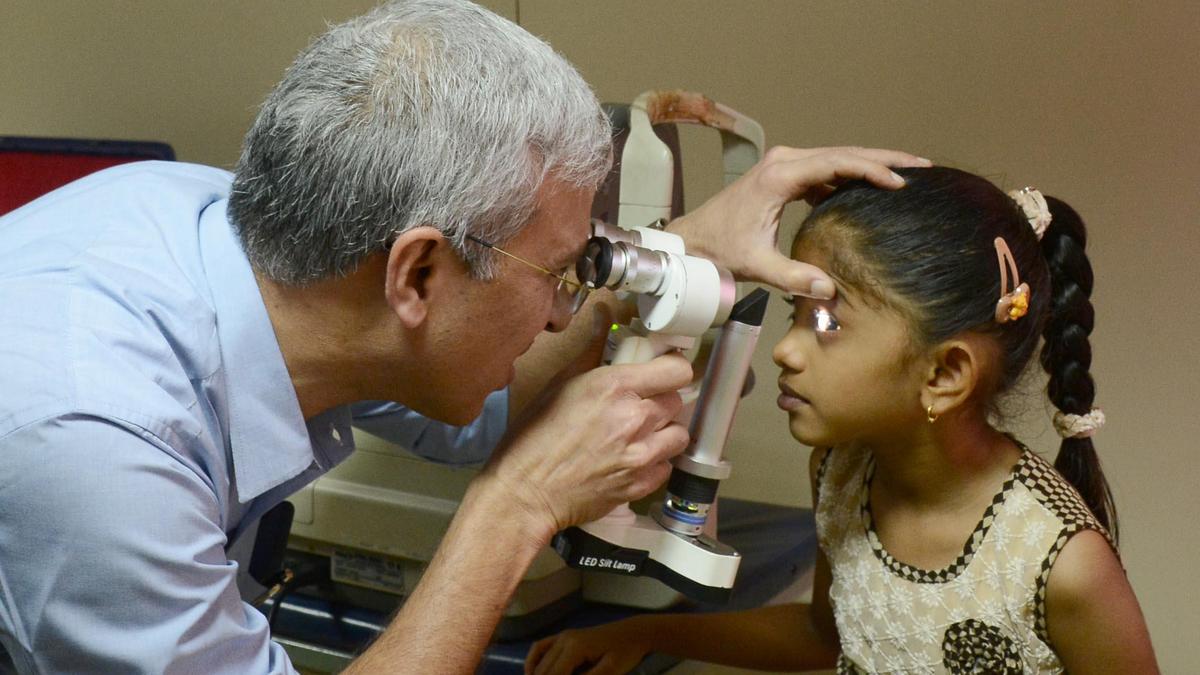
The World Health Organization (WHO) reports that there are approximately 19 million visually impaired children in the world, and 1.4 million are blind. In India, about 3 lakh children are said to be blind. Yet, nearly half of these cases are entirely preventable or treatable if caught in time. This month, global campaigns will urge the world to protect child eye health. There will be calls for governments around the world to unlock funding and prioritise eye care so everyone, everywhere can access the care they need along with community screening camps, eye care in schools and global pledges. And while these are vital calls, as a clinician standing on the frontlines of an outpatient department (OPD), I am forced to confront a quiet, uncomfortable truth: threats to a child’s vision are not always due to a lack of access to healthcare; they are sometimes also due to a missed opportunity to identify visual problems within healthcare systems that the child has already accessed.What happens in the systemConsider a recent encounter in my clinic. A couple walked in with their five-year-old daughter; I will call her Anu. I could immediately see that she was visually impaired. She was one of a twin. Her parents felt that her sibling was developing normally, while she seemed to have delays in reaching developmental milestones. Gradually they started to notice that Anu could not see clearly. On examination, I found that Anu had dense bilateral cataracts with nystagmus (involuntary movement of the eyes). The presence of nystagmus says that the visual impairment had been present since infancy. When I asked why they had waited five years to seek help, they explained that they were simply overwhelmed by the weight of raising twins and assumed it was best to wait until she was older so she could ‘cooperate’ during a standard eye examination. Now they had arrived, but a bit too late.Childhood eye diseases that cause profound visual impairment need to be detected and treated early. A baby is born with an immature visual system, and the development of vision happens through the interaction between the eye and the developing brain. When clear images do not reach the brain during this critical period, amblyopia, or lazy eye, can develop. Once this period of visual development has passed, treatment cannot fully restore the lost visual potential. Anu had lost the chance of getting back her vision fully, even if she was operated upon now.What doesn’t get seen Anu had not been completely outside the health system; her vaccinations were perfectly up-to-date, and she had documented encounters with health personnel seven distinct times from birth to age five. Yet, across all these visits her profound visual impairment went entirely unnoticed. Why did this happen?One of the reasons is the poor integration of vision screening with the vaccination schedule and general paediatric screening.India has an extensive network of frontline health workers and child health programmes. The Rashtriya Bal Swasthya Karyakram (RBSK), for example, is designed to identify and manage health conditions in children from birth to 18 years. Screening programmes, notably have demonstrated that large numbers of school-aged children with vision problems can be screened. The tools placed in the hands of mobile health teams to detect developmental delays are proven to be highly capable of detecting developmental delays at the community level. What then is going wrong?Let’s take the example of Karnataka. There is no published standalone government data of the number of children screened, ocular morbidity detected and treated, for the 0–6 age category. However, according to the Karnataka Health & Family Welfare Department’s Annual Report 2023–24, the State screened 62,45,424 children (6 to 16 yrs) in government and government-aided schools. But only 1.2 lakh children received spectacles, representing a distribution rate of just 1.9%. This is in sharp contrast to localised epidemiological studies in Karnataka’s southern districts, which place the actual prevalence of paediatric refractive errors as high as 8%. This pronounced gap could be due to operational challenges such as drop-outs in the multi-tier referral system and supply chain delays. A study assessing the coverage gaps in child health screening under RBSK found that only 47.4% of children detected to have health problems received further care, indicating a significant treatment gap. Even if the system successfully flags a child, the path from detection to actual restoration of sight remains riddled with problems. Independent field evaluations in Tumkur highlight that the system has some problems when dealing with younger children and follow-up care. The management process faces significant on-the-ground challenges, including parental non-cooperation for follow-up, logistical barriers, and potential training gaps among screening teams. In my own experience, when talking to the ASHAs in Tumkur district, they said they did not have the training required to detect eye diseases in children. If the parents or caregiver of the children specifically complained about any vision related issues, the ASHAs referred them to the paediatrician who visited the taluk hospital once a week. This exposes a significant gap in training frontline workers.Bridging gapsThere is no need for an entirely new system. We need to make better use of the system that already exists.The red reflex test: A simple red reflex examination using the direct ophthalmoscope is one example. The test takes less than 30 seconds, does not require a child to cooperate verbally, and can identify major, sight and life-threatening abnormalities such as cataract, retinoblastoma (eye cancer) and high refractive errors. RBSK mobile health teams, primary health centre nurses, and paediatric residents must be trained to perform this test. This simple check must become as routine as measuring a child’s weight and must get incorporated in the immunisation schedule, so it is never missed. Improving frontline training for pre-verbal visual milestones: We also need to train ASHAs in simple ways of assessing visual behaviour in infants and young children who cannot read a chart or respond reliably to conventional visual-acuity testing. Can the infant fix and follow light and objects? Is there visual engagement? Is there an abnormal or asymmetric corneal light reflex suggesting a squint? These are not sophisticated examinations. They are observations that, with appropriate training and referral protocols, can help identify children who need an eye examination.Strengthening referral pathways from the periphery to tertiary care centre: Detection, however, is only the first step. A child identified with a possible eye problem must reach the appropriate facility where treatment is available. Referral pathways need to be clear, practical and monitored. Where possible, digital systems could link frontline screening with appointments at district or tertiary eye-care facilities. Tele-ophthalmology could also help connect peripheral health workers with specialists and reduce some of the logistical barriers that cause families to drop out of care.Anu’s story is not simply about a child who reached an eye hospital too late. It is about a child who was already within the health system, but whose eyes were never looked at. Young children cannot be expected to understand there is a problem; parents may not recognise signs or may believe problems will resolve with age. A child should not have to reach the age of five, with dense cataracts and established nystagmus, before a visual problem that could have been detected in infancy comes to attention.India already has an extensive network of frontline health workers, immunisation services, RBSK teams, school health programmes and primary and tertiary healthcare facilities. The challenge now is to connect these pieces. The goal should, therefore, not be merely to increase the number of children screened. It should be to build a system in which every contact with a child is an opportunity to protect vision, every abnormal finding triggers a clear referral, and every referral is followed through to care.As we mark World Sight Day, the question we should ask is not only how do we reach more children. It is also how many children are already within our health system whom we are failing to see. For children like Anu, finding the problem a few years earlier can mean the difference between having sight and living a life with visual disability, because preventing blindness in a child is not merely about saving sight. It is about protecting education, independence and the opportunity to reach their full potential.(Dr. Vasudha Kemmanu is a paediatric ophthalmologist and a public eye health specialist at Narayana Nethralaya, Rajaji Nagar, Bengaluru. vasudhakemmanu@gmail.com)
Closing the gaps in early childhood eye care
Full Article
Original Source
Read the full article at Thehindu →KhanList aggregates and links to publicly available news content. We do not host full articles from third-party sources. Always verify important information with original sources.