
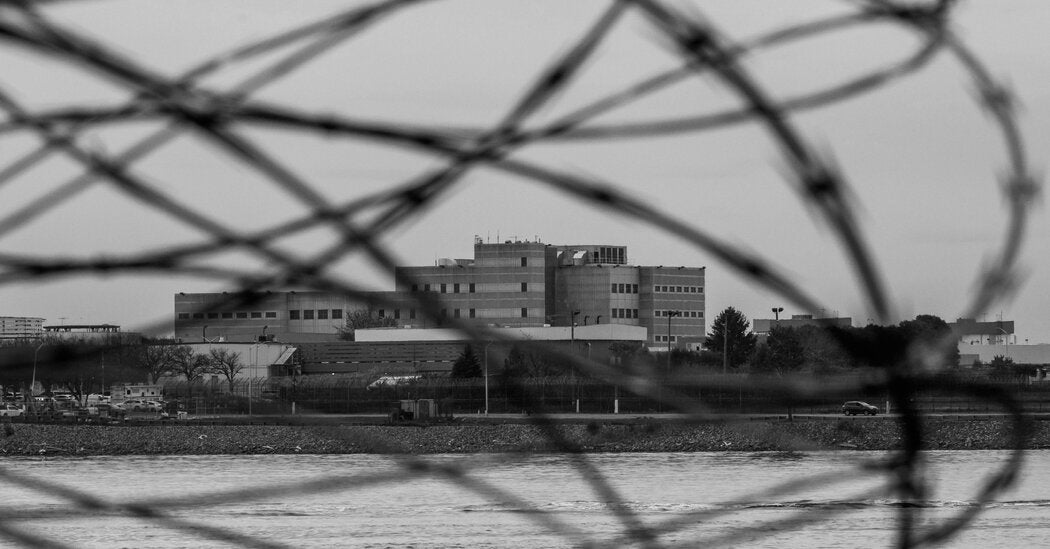
AdvertisementSKIP ADVERTISEMENTGuest EssayNov. 17, 2026, 5:03 a.m. ETCredit...Karsten Moran for The New York TimesElizabeth GlazerMs. Glazer led New York City’s Office of Criminal Justice under Mayor Bill de Blasio.Nearly a decade ago, as Mayor Bill de Blasio’s criminal justice adviser, I helped create a plan to close New York City’s jails on Rikers Island. The wretched conditions on what had been nicknamed Torture Island were hardly a secret — reporters, activists, lawyers and oversight groups had been documenting the widespread violence there for years. Deteriorating buildings, badly managed staff members and crowded facilities created an environment so brutal and chaotic that in 2015, a federal judge declared the conditions unconstitutional.Since the 1950s, Rikers, on an island between Queens and the Bronx, has been the city’s primary jail complex for people awaiting trial or serving short sentences. The jails there are starkly at odds with New York City’s self-conception as a bastion of reform-oriented liberal ideals. Since the 1970s, hardly a year has passed when the jails weren’t under court-mandated federal supervision to address horrendous conditions. In the past decade alone, more than 100 people have died in custody, including nine so far this year.In 2016, people who had been incarcerated on the island helped start a campaign to close Rikers, which drew attention to the conditions that decades of federal oversight had been unable to fix. Their efforts led Mayor de Blasio to declare in 2017 that his administration would take concrete steps to close the complex.Two years later, the City Council passed the de Blasio administration’s plan into law. The law approved the construction of four new jails in neighborhoods across the city to replace Rikers and ultimately forbade the incarceration of any person on the island beyond August 2027.Today, that plan has fallen apart, bogged down by mounting delays, soaring costs and a jail population too large for the new facilities alone to hold. Given these challenges, Mayor Zohran Mamdani should do what the de Blasio plan forbade: rebuild or renovate the jails on Rikers into safe, humane facilities.No one, including Mr. Mamdani, believes that the deadline to close the jail complex can be met. The new neighborhood jails are years behind schedule and their costs have soared from an already eye-watering $8 billion to $16 billion, a sum sure to continue to increase with time.This experience taught me that treating a campaign slogan as the operating instructions for policymaking can do real harm. The “Close Rikers” campaign was successful in drawing attention to the conditions on the island, but the absolutism of the slogan obstructed what our plan was meant to achieve in the first place: decent and humane jails free from endemic violence.If this goal had been at the center of our thinking, then a different imperative would have followed. The city would have built new, high-quality facilities wherever they could be finished quickly — including on Rikers.Our plan has already cost plenty in human suffering. For decades, the jails have been deteriorating with deadly results, as pieces of the crumbling buildings were fashioned into weapons and cells lacking air-conditioning boiled in the summer months. Although there was money in the budget to build a new jail on Rikers in 2017 — with air-conditioning, new space for recreation and programs, better sightlines for officers, working locks and more — we didn’t pursue that approach. By then, Mr. de Blasio had wedded himself to the campaign to close Rikers.There were other costs to adopting the “Close Rikers” slogan as the driving goal. Tangled zoning laws and local politics forced the city onto smaller sites for the neighborhood-based jails, strictly capping how many people each could hold. This left no fail-safe option if, as is now the case, the number of people detained exceeded the capacity of the new jails. Today, the city incarcerates nearly 7,000 people — more than 2,000 people above what the new facilities were designed to hold.The brutality inside the Rikers jails has continued to increase since our plan to close the island was enacted. Today it seems an unreachable dream to return even to 2015’s unconstitutional levels of violence. Modernizing the jails on Rikers won’t curb this violence on its own, but it would be a first step.So, what now?The Mamdani administration will need to ask the City Council for an extension of the deadline to end incarceration on Rikers. Mr. Mamdani’s team should negotiate with the Council for an extension that would allow them to build on Rikers immediately, even as it continues to build the neighborhood-based jails. Construction could be completed swiftly because the island is city-owned land and not subject to onerous land regulation.Straightforward design changes could drastically cut down on the number of attacks in the jail complex. Research has shown that well-designed and well-lit buildings can reduce tension and increase positive connections among the people who live and work in them.If the city doesn’t fix how its jails are run, it risks merely exporting the violence of Rikers into new ZIP codes when the neighborhood-based facilities are completed. Building on Rikers would give the city an opportunity to test out new models of how to run a humane jail, like the Scandinavian approach, which is built on mutual trust between staff members and detainees. Changes like these cannot take root in decaying, chaotic cellblocks; they require facilities designed to respect basic human dignity.Supporters of the “Close Rikers” campaign have long argued that shuttering the complex would cap jail capacity, forcing the city to incarcerate fewer people. While the city must reduce its jail population, this framing presents a false choice. We do not have to leave people in squalor to prove the city’s commitment to locking up fewer New Yorkers.The fastest path to shrinking the city’s jail population is pushing to resolve cases sooner, whether the result is conviction, acquittal or dismissal. Currently, over 20 percent of those on Rikers awaiting their day in court have been locked up for more than a year — an unconscionable reality for people who are presumed innocent.Mr. Mamdani has shown a willingness to discard simplistic mantras — abandoning the call to “defund the police,” prioritizing fast buses over fast and free buses, reversing his position on mayoral control of the city’s schools — in order to focus on delivering results for New Yorkers. That’s the path forward here.The distant promise of closing Rikers does not alleviate the abysmal conditions for those incarcerated and working on the island today. Don’t go back to old slogans. Go forward, with principle and pragmatism.Elizabeth Glazer is the founder of Vital City, a New York City-based policy journal. She led New York City’s Office of Criminal Justice under Mayor Bill de Blasio and oversaw New York’s criminal justice agencies under Gov. Andrew Cuomo.The Times is committed to publishing a diversity of letters to the editor. We’d like to hear what you think about this or any of our articles. Here are some tips. And here’s our email: letters@nytimes.com.Follow the New York Times Opinion section on Facebook, Instagram, TikTok, Bluesky, WhatsApp and Threads.Related ContentAdvertisementSKIP ADVERTISEMENT
‘Close Rikers’ Was a Great Slogan. It’s Bad Policy.
Full Article
Original Source
Read the full article at Nytimes →KhanList aggregates and links to publicly available news content. We do not host full articles from third-party sources. Always verify important information with original sources.