
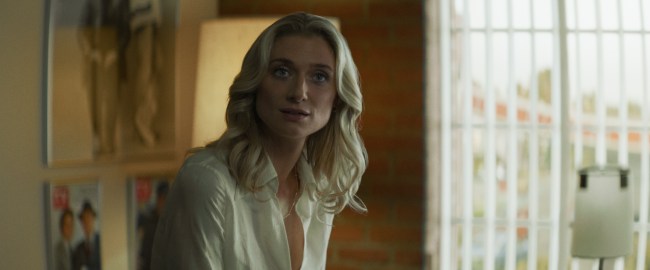
Don’t let the title fool you: “The Further Mis-Adventures of Cliff Booth” might offer up a breezy, very fun-to-watch new entry into the life and times of titular (and fictitious) Hollywood stuntman, but co-star Elizabeth Debicki steals the show in David Fincher’s film (in addition to stealing the heart of Brad Pitt’s Cliff). Is it time to greenlight “The New Adventures of Karen Crosby”? We think so. The much-anticipated sequel to Quentin Tarantino’s “Once Upon in Hollywood” picks up nearly a decade after the Oscar-winning antics of the previous film, finding Cliff pursuing new professional endeavors (film projecting! bartending! contract killing, kind of!). Stunt work? Eh, only when he feels like, and he certainly feels like after taking an unexpected meeting with Hollywood agent Karen Crosby (Debicki), whose grace and good humor instantly delight both Cliff and the audience. Tossed together by the wacky demands of Karen’s marquee client, actor Charlie Nelson (Scott Caan), the shaggy, Tarantino-penned “Cliff Booth” meanders its way through every corner of Hollywood, finding real emotional ballast and crackling chemistry every time Pitt and Debicki share the screen. Characteristically wordy and dense, we learn plenty about Karen along the way (including her early forays into film criticism and her current feelings about movies), and she wins Cliff’s heart by, well, literally and physically slapping the crap out of him. Ahead, IndieWire catches up with the Aussie star (who gets to use her real accent this time) about Fincher’s film, from slapping her co-star to some serious ruminations on the instantly iconic “pig monologue speech.” No wonder Cliff went so crazy for Karen; she’s a delight. The following interview has been edited and condensed for clarity and length. IndieWire: What was your relationship with “Once Upon a Time in Hollywood” when the film came out in 2019? Elizabeth Debicki: I went to see it in the cinema. I think I went by myself, which makes me think I must have been on a job. I was definitely in the States, maybe I was in L.A., and I went one afternoon. I went and sat in the cinema, and I loved it. It’s really vivid in my memory. I didn’t watch it again before we made this for performance reasons. In a way, I realized I didn’t really need to because, [there’s] something about Quentin’s movies, they just kind of wedge themselves in your brain. I can literally see the Playboy Mansion scene. I can see the Manson kids driving up to the house. I can see Margaret Qualley’s feet on the dashboard. I can see everything. So it sounds like you came into this as a Tarantino fan. Absolutely. Yeah. I mean, he’s seminal. And to get Tarantino and Fincher is this incredible two-for-one. It’s funny, because obviously in the making of this, I had to sort of normalize that. And they helped me do that because they were, from the second I got onto set — which was a two-week rehearsal period where we really worked through the script — we had Quentin for that whole period. [It was] very, very collaborative. A part of me wonders whether it was that thing where they have sat with the material for so long and had their full body relationship to it, and then I was fresh. I had my own thoughts and feelings. My memories of those rehearsal periods were really all three of them [Fincher, Tarantino, and Pitt] just turning to me and saying, “What do you think? What do you think?” The first time it happened, I was like, “Oh my God, what do I think?” After a little while, I started to actually say what I thought, which was great. Scott Caan, Yahya Abdul-Mateen II, Elizabeth Debicki, David Fincher, Brad Pitt, Carla Gugino, and Peter Weller attend the World Premiere of Netflix‘s ‘The Further Mis-Adventures of Cliff Booth‘FilmMagic What was your audition process like? I didn’t audition for this. David emailed me and asked me if I would be interested in playing a part. I remember he phrased it in an email as he hoped that I would consider playing a very tricky part in a film he was hoping to make in July. It was a very David-ism kind of email. I think it said something like, “I hope you understand the seriousness of this conundrum,” or something. And I called him up and yeah, I was obviously ready to say, “I’ll do it.” He was very, very insistent. He was like, “Wait, wait, wait. I really want to tell you everything about it.” Because at that point he and Quentin were doing a massive edit of the script. He couldn’t send it to me there and then. Karen is so singular, but she is in a familiar position if you’re working in Hollywood. Did you base any part of your performance on any agents or managers or publicists that you know or have encountered? When I first read the script, there were things that just rang so true to me, and might seem outrageous for anyone or slightly absurd maybe for anyone who doesn’t work in this industry. The incredible pig scene where Cliff talks about killing a pig, and then the scene in the car where Karen says, “Now because of you, I now have to spend my entire morning finding a pig. That is not a joke, that is literally what I have to get up and do. And you know what? I had a lot of things I had to do, and it wasn’t find a pig. And now I have to drive your ass all the way to Marina del Rey because I have to just deliver you because that’s what my client needed.” It’s kind of this absurd ask, but it’s folded into “that’s what I need for my process.” Quentin and David, they’re so fascinating because they are Hollywood. They are Hollywood, and also they sit outside it, and they observe it from these very, very unique vantage points. Quentin, in particular, his love affair with L.A. is so profound, and with Hollywood. Part of the thing I loved about her too is that she’s sort of accidentally an agent, which is not frequently do you come across that. One of the things too that feels very human about her is that she sort of had this other dream, but she took one really bad knock, and it broke her heart, and she just buried it deep inside and then made decisions based off that. When we get to that scene with Karen and Cliff when you’re talking about how Karen had this other career as a film critic, I how much of that was lifted from what would’ve been Quentin’s movie, “The Movie Critic”? I don’t know. I don’t actually know the answer to that question in terms of the parallel there. But I do love that in the middle of this film about 1977 in Hollywood, that there’s a really important moment where we think about Pauline Kael, and we think about her and she lives in this film. I’m so glad that there’s this moment where my character gets to say, “Pauline Kael is my god,” because she was. She was incredible. As Karen, you have this great monologue explaining to Cliff who you used to be, what had happened with that career path, how wonderful it was that Pauline supported you, and then it didn’t work out. And then you have another monologue about seeing movies as hamburgers. It’s a really funny tension for Karen, because the audience likely assumes she loves movies and does see them as art. That’s right, there is a tension there. I feel like one of the things that Quentin can do so well, and kind of totally unique to his own brain, is that he sort of plucks an idea out of the zeitgeist, something that we’re all thinking about, and he feeds it through his characters in a way that feels very organic. This is a big conversation that people are having as the industry shifts and changes. It also was a huge conversation that was happening in 1977. There was this big question of, “Is that art still if it’s commercial, if its box office success equates to this?” I think that the dichotomy of what she believes in her heart and wants to be true and what she spouts in front of people, I sort of think both things are true at once, and I think that’s just the kind of human element. But I also think that it’s important to remember in that monologue that Charlie really pulls it out of her. She really doesn’t want to do the dance, the dancing monkey, or what did she say? “There’s a dancing bear aspect to your request,” I think is such a great line. But yeah, I think both things are true for her. ‘The Further Mis-Adventures of Cliff Booth’Courtesy of Netflix © 2026 You have the sense she’s said this speech before, and again, maybe she doesn’t totally believe it, but Charlie just loves it and so she has to do it. David and I spoke about it a lot, and we sort of landed on we feel like she did it once off the cuff, like at a table at the Emmys or the Globes, and everyone went, “Gee, Karen, that’s genius.” And Charlie heard it and went, “Yeah, that’s genius. She’s my agent, look how smart she is. She’s so great.” Then she’s done it one other time at a dinner. So, by the time we get to the pool, she’s like, “Oh, my God.” It’s becoming a routine against her will, which was also a really fun element to play with in terms of how much she does or doesn’t enjoy it, and finding that balance. Do you personally read reviews of your work? I do not, no. Has that always been the case for you? Has it always been the case? [Smiles] I’m sure anyone who doesn’t read a review once read a bad review. And that’s it. It doesn’t even have to be a bad one. What I learned is, you can read a review that is seemingly positive, but it might not be what you were trying to do, and then you feel heartbroken about that too. So yes, I really avoid it. Yeah. You get to slap Brad Pitt a lot in this film. Was that hard to do? It’s a very beautiful face, and we had to do it. We had to do it. And Brad is a very good sport and a very good stuntman. I think that Brad was very, very comfortable, and I was very nervous. We shot the dialogue for two days, that we were just in almost this sort of trance of the two of them, and of the very unusual power dynamic that [they have]. One of the best things about that scene to me, which I didn’t analyze at the time, it’s so intricate the way that Quentin wrote it. It’s this moment where, in revealing what he wants, he becomes so vulnerable that the power dynamic kind of very subtly shifts in this kind of core foundational way between these two characters. So, we shot that for two days and then all of a sudden it was like, “Oh, my God, it ends, and I need to figure out how to do this.” We had an amazing stunt coordinator on that job. Of course! We had to do extremely complex things with people, but with me, I was like, “Hey Dave, could we just pop out the back there and have a little chat about the slap…?” Everyone knows that David likes to do a lot of takes. How many takes was the actual slapping? Not so many! It was probably the least amount of takes we did. We probably did a couple, five, maybe six. And then I do remember that Brad sort of went, “OK, I think we got it. I think we’re good now,” and we moved on. But we did the inside [slap] first. It was such a joy to do. It’s such a happy memory. We filmed it, and then we all ran around to the monitor, and we watched it in playback, and we’re like, “Oh, my God, it’s so good.” And then we filmed it again. We were so pleased with ourselves. [Laughs] ‘The Further Mis-Adventures of Cliff Booth’Courtesy of Netflix © 2026 What scenes did David ask for the most takes? The thing about the takes is, it’s coverage-dependent. So, if you have four actors in a scene, like the hamburger monologue, let’s say there’s four setups on each actor, you do 10 takes per setup. So, that becomes a lot. I will say that in the pig speech monologue, I don’t have a lot of lines, but we did just as much coverage on me as we did on Brad and Scott. That was one of my first days on set, and I remember thinking, “This is so, so unusual. Why is he doing this?” And then a couple weeks later, he showed me a kind of rough edit, and I thought, “Oh, my God, that’s why he did it.” He is using Karen as the kind of go-between. As David would always say, at least there’s one grown-up in the room, and it’s Karen. So I do have this really funny memory too of doing that during the pig monologue scene. I was off-camera, or we were catching just the side of me; I was very much out of focus, and I took a drag of the cigarette, and I remember he gave me a note for that, something about the speed of it or the intention of it. And I remember thinking … “You saw that?” Exactly! I was like, “You saw that?” And he was right, he was absolutely right, but I thought, “OK, this is not a set where we get away with anything.” Especially in that scene, you have these facial expressions where you are having the appropriate reaction to what we’re hearing, but in such a beautiful way. I think that’s when we all fall in love with Karen. We’re like, “She gets it. She knows how ridiculous this is,” but she is part of this world. I’m particularly proud of the Tic Tac crunch; that was my prop idea, and I just thought we should end with her crunching down on something, because she’s so pissed about having to then go and spend her entire morning looking for a hog in Malibu Colony or something. Where is she even going to find that pig? Well, she did it. She did it. I mean, David and I would talk about that too. I’m like, “Do you think she did it or she sent Mallory, her assistant, to go do it?” Either way, someone did it, someone paid for it. Speaking of falling in love with Karen, there’s been this sentiment circulating as people see the film that there is a real rom-com built into it with Cliff and Karen. Do you see it that way? I don’t think it’s a rom-com, but I think it’s romantic, and I think they’re funny. Don’t get me wrong, rom-coms are my religion. Yesterday I was walking through New York, and I literally felt like I was in “You’ve Got Mail.” I was like, “This fall day, I need a bunch of sharpened pencils.” But I don’t think that this necessarily falls into that category. It’s sort of undefinable, indefinable, but I do think it’s really romantic. I felt that when we were playing it, and we really enjoyed that together. The romance of it is kind of surprising, because it surprises her. It’s sort of best case scenario romance, that you think you have it all together, and this person walks in that you absolutely dismiss in terms of that, and then little by little they just sort of reveal this thing. More beautifully, they pull something out of you. I didn’t necessarily intellectualize any of this while we were shooting it, it’s just that I can see that now retrospectively. Not that I read anything, but I am curious what people will make of them. Netflix will release “The Further Mis-Adventures of Cliff Booth” in IMAX theaters on Wednesday, November 25. It will be available to stream on Netflix starting Wednesday, December 23.
‘Cliff Booth’ Star Elizabeth Debicki on Slapping Brad Pitt, ‘The Movie Critic,’ and the Rom-Com Question
Full Article
Original Source
Read the full article at Indiewire →KhanList aggregates and links to publicly available news content. We do not host full articles from third-party sources. Always verify important information with original sources.