
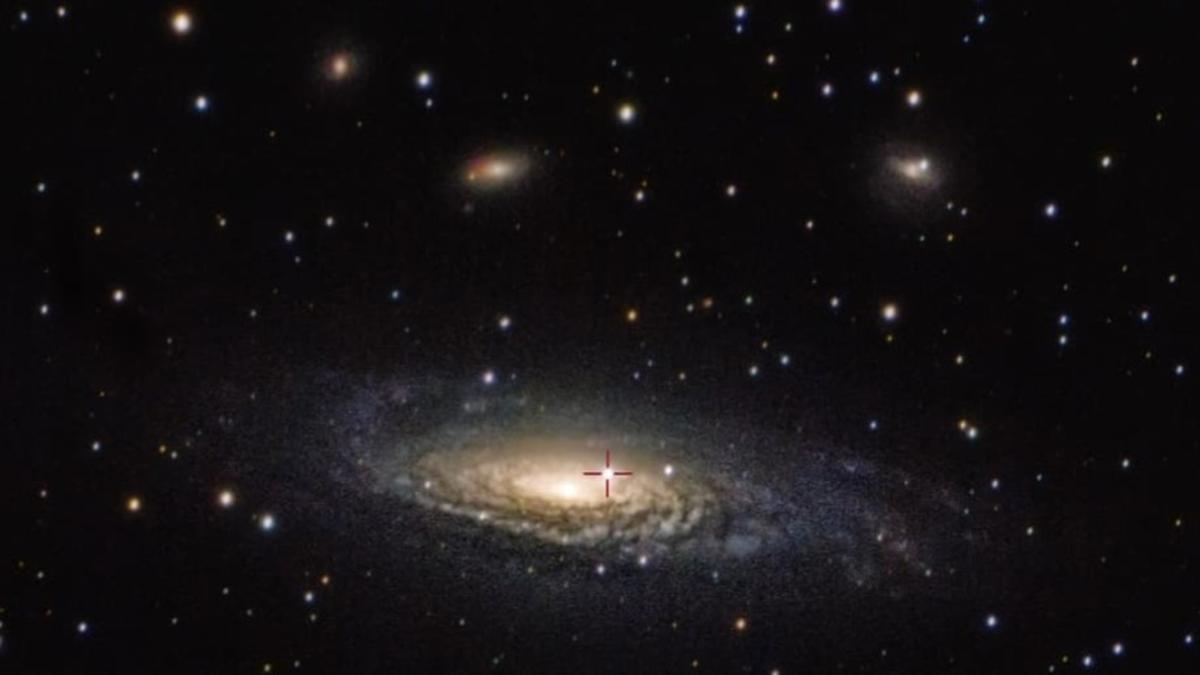
The image of the supernova (seen in cross-hairs within the galaxy) captured by the IIST student astronomy club. | Photo Credit: Special arrangement Imagine standing in Thiruvananthapuram in the present moment and photographing the death explosion of a star that happened some 45 million years ago. That’s what Celestials, the student astronomy club of the Indian Institute of Space Science and Technology (IIST), here, did this month.The club members have joined the global community of astronomers and astrophotographers who have successfully clicked the image of the supernova SN 2026aaiv which was observed in NGC 7331, a spiral galaxy located in the direction of the constellation Pegasus roughly 45 million light years away from earth. The IIST image shows the supernova in NGC 7331 as an astonishingly bright spot toward its upper right.Mind-bogglingly longA light year is the distance that light travels in a year, at the speed of approximately 3,00,000 km per second. By that calculation, the light of the exploding star took roughly 45 million years to reach earth. Earth was in the Eocene epoch when this celestial event occurred and its light began its mind-boggling long ‘trip’ to earth across the vast gulfs of the universe.SN 2026aaiv was discovered on September 1 by the ATLAS Survey (Asteroid Terrestrial-impact Last Alert System funded by NASA and developed by the University of Hawaii) and reported worldwide. The IIST team imaged it a week later using the institute’s telescope camera system. The photograph was taken at the IIST observatory by students Paramveer Singh and Basavaraj Manurakar, according to the institute.The photograph is actually a stack of 400 individual frames merged into one final image, enhancing the cumulative exposure time while bringing down the noise (unwanted electronic or physical elements). The supernova is shown in the crosshairs of the image, and the inset image shows a zoom-in on the galaxy, the institute said. Published - September 15, 2026 07:43 pm IST
Clicking a star’s death explosion from 45 million years ago
Full Article
Original Source
Read the full article at Thehindu →KhanList aggregates and links to publicly available news content. We do not host full articles from third-party sources. Always verify important information with original sources.