
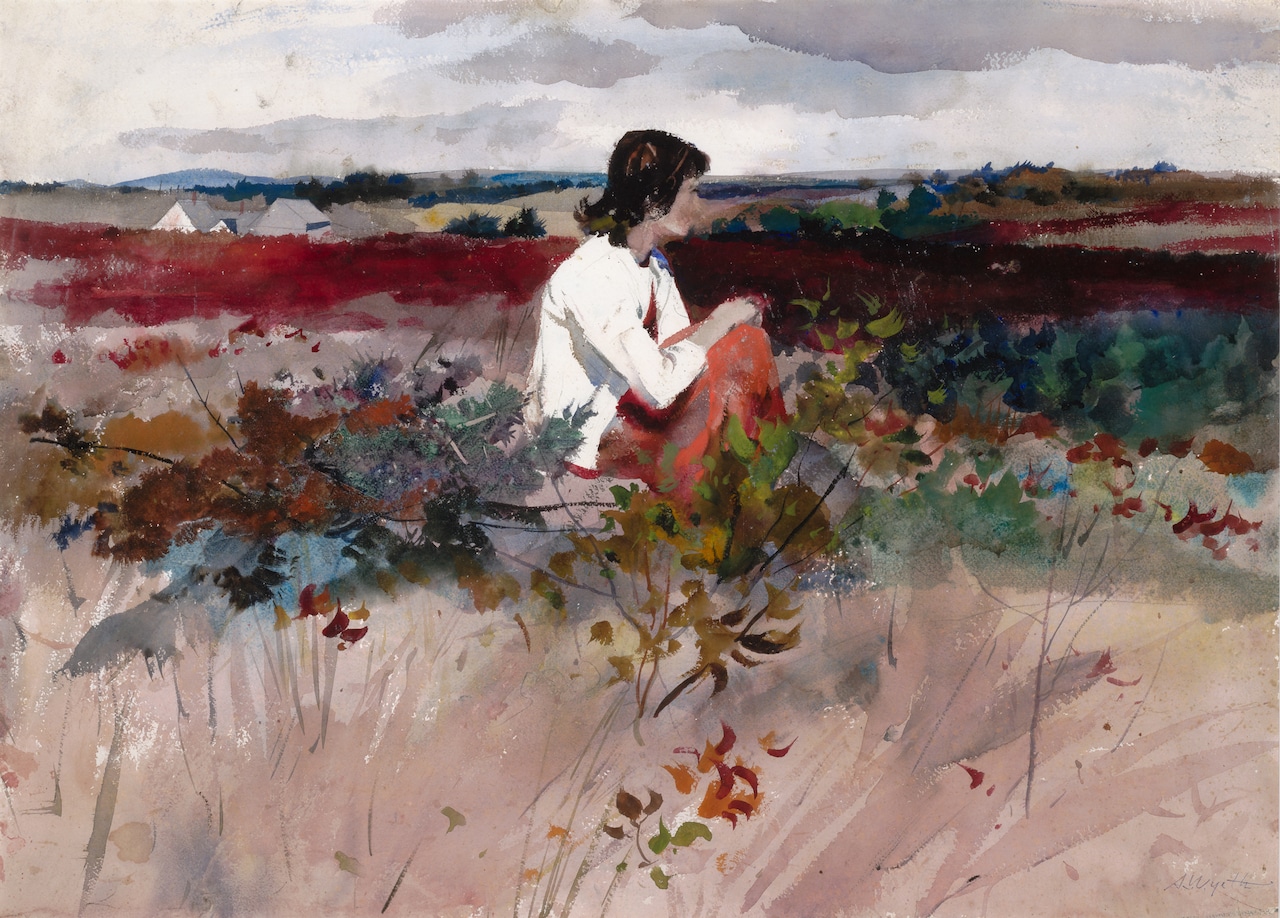
CLEVELAND, Ohio -- If you know American artist Andrew Wyeth (1917-2009), you probably think of “Christina’s World,” his haunting image of a woman in a pale pink dress lying in a field, looking toward a distant farmhouse.But there’s much more to Wyeth’s work, and the Cleveland Museum of Art is presenting it in “Spectacular Freedom: Andrew Wyeth and the Modern American Watercolor,” Sept. 20 through Jan. 18, 2027, in the Kelvin and Eleanor Smith Foundation Gallery.You won’t find “Christina’s World.” In fact, you won’t find any Wyeth works from the museum’s permanent collection. The CMA has just one and it’s on loan.This new ticketed exhibition brings together nearly 75 rarely seen watercolors from Wyeth’s estate, including 17 that have never been publicly exhibited and five that have not been shown in nearly a century.Britany Salsbury, the CMA’s curator of prints and drawings, combed through a collection of about 7,000 Wyeth watercolors to select this grouping. She worked in collaboration with the Brandywine Museum of Art in Chadds Ford, Pa., which is known for its holdings of the Wyeth family of artists.“I, and the rest of our team, learned so much about Wyeth’s watercolor practice from conversations and looking with them, and their unique perspective on Wyeth and his work really informed the show,” Salsbury said of the collaboration.What surprised her during the selection process was the depth of watercolor work. “Like most people, I’d known Wyeth mostly for the tempera paintings that made him famous,” she said. “I knew, of course, that he made watercolors, but I was really struck by just how many and what a sort of default setting watercolor was for his practice. “He used it constantly and thought through literally any subject that appealed to him in watercolor first. He was never satisfied with working with it in a traditional way but always pushing to see what he could do with it and rethinking its possibilities.”What emerges from this collection is a Wyeth who is moody, thoughtful and contemplative, but also experimental and surprisingly hands-on.Below the Dam—First Version, 1963. Andrew Wyeth (American, 1917–2009). Watercolor on paper; 55.9 x 75.6 cm. Wyeth Foundation for American Art Collection, P1058. © 2026 Wyeth Foundation for American Art / Artists Rights Society (ARS), New YoCleveland Museum of ArtLook at the textured paper Wyeth used for “Below the Dam,” 1963. In this work, he altered the surface with sandpaper, smoothing it so he could achieve the effect he wanted. “He would dig into the paper to create an illusion of water’s movement,” Salsbury said of the work.The results can look spontaneous, but the process was anything but.“He’s very deliberate even though the end result looks improvisational,” she said.She also points out that he wasn’t “precious” about the watercolors.That becomes apparent when you get close to the work.Take a pencil-on-paper study for “The New Church,” 1940, displayed in a case in the gallery. Look closely and you can see barely noticeable footprints carelessly left behind on the paper.Their origin is a mystery. Are they Wyeth’s? A visitor’s? That tension is central to “Spectacular Freedom,” which explores Wyeth’s relationship with watercolor in greater depth than previous exhibitions.Watercolor was not a minor sideline for Wyeth. He received a set of paints when he was 13 and began experimenting with the medium at a time when watercolor was hugely popular in the United States.By the time he was 20, in 1937, he had his first major solo exhibition of watercolors. One critic described the work as having “spectacular freedom,” providing the title for the Cleveland exhibition.Watercolor also gave Wyeth a practical freedom. He could carry the materials outdoors and work directly from nature, returning again and again to places around his homes in rural Pennsylvania and coastal Maine.Those places became recurring subjects throughout his career.Wyeth was working within a long American tradition of watercolor landscape painting, but he pushed the medium in his own direction, using unexpected details and unusual viewpoints.Lobster #7, 1940. Andrew Wyeth (American, 1917–2009). Watercolor on paper; 52.7 x 73 cm. Wyeth Foundation for American Art Collection, M1040. © 2026 Wyeth Foundation for American Art / Artists Rights Society (ARS), New YorkCleveland Museum of Art“An especially memorable watercolor, for me,” said Salsbury, “is actually a group of watercolors: an image of a lobster in a shallow pool that we see represented in four different ways in the galleries.“Wyeth actually made a total of twelve images of the lobster, which really gives a sense of his constant desire to go deeper,” she explained. “In the works, I think we get a wonderful sense of what he has learned from previous generations of American watercolor artists—this desire to be bold with his brushwork and to work outdoors—but also the way that he was making the medium something completely his own and doing something revolutionary with it.”“Spectacular Freedom” is divided into several thematic sections, covering Wyeth’s early work, his landscapes of Maine and Pennsylvania, his reimagining of landscape, intimate scenes of private life and his unexpected experiments with abstraction.A few tempera paintings are included. They help show the sometimes-surprising relationship between Wyeth’s two primary mediums and how much of his artistic life involved thinking about and working on paper.The exhibition also includes some of Wyeth’s own materials, including paints, brushes and other tools.“Beginning in the 1930s, Andrew Wyeth built a monumental reputation for his evocative use of watercolor, depicting the people and places that surrounded him in rural Pennsylvania and Maine,” Salsbury said.Self Portrait, #8, 1953. Andrew Wyeth (American, 1917–2009). Watercolor on paper; 50.5 x 35.6 cm. Wyeth Foundation for American Art Collection, M0408. © 2026 Wyeth Foundation for American Art / Artists Rights Society (ARS), New YorkCleveland Museum of ArtAlthough Wyeth is perhaps better known today for his tempera paintings, watercolor remained a constant throughout his long and prolific career.“His works in the medium reveal a completely new and surprising side of an otherwise well-known artist,” Salsbury said.That may be the most rewarding part of the exhibition: seeing familiar ideas in an unfamiliar medium.Wyeth created thousands of watercolors over his career, and they range from vivid landscapes and precisely rendered interiors to abstract compositions and preparatory studies for his tempera paintings.Some look like quick sketches. Others are painstakingly finished.Together, they show an artist continually testing what watercolor and paper could do.“Spectacular Freedom” is also a reminder that looking at art does not always reward a quick walk through a gallery.Slow down. Get close.There are footprints to find. There is paper that has been sanded and carved.“Spectacular Freedom: Andrew Wyeth and the Modern American Watercolor” runs Sept. 20, 2026, through Jan. 18, 2027, at the Cleveland Museum of Art. The exhibition is ticketed.A richly illustrated exhibition publication, with essays by historians of American art and works on paper, accompanies the show. And if the exhibition leaves you wanting to try watercolor yourself, the museum store has watercolor books and kits.
Cleveland Museum of Art opens rare Andrew Wyeth watercolor show featuring 17 never-before-seen works
Full Article
Original Source
Read the full article at Cleveland →KhanList aggregates and links to publicly available news content. We do not host full articles from third-party sources. Always verify important information with original sources.