
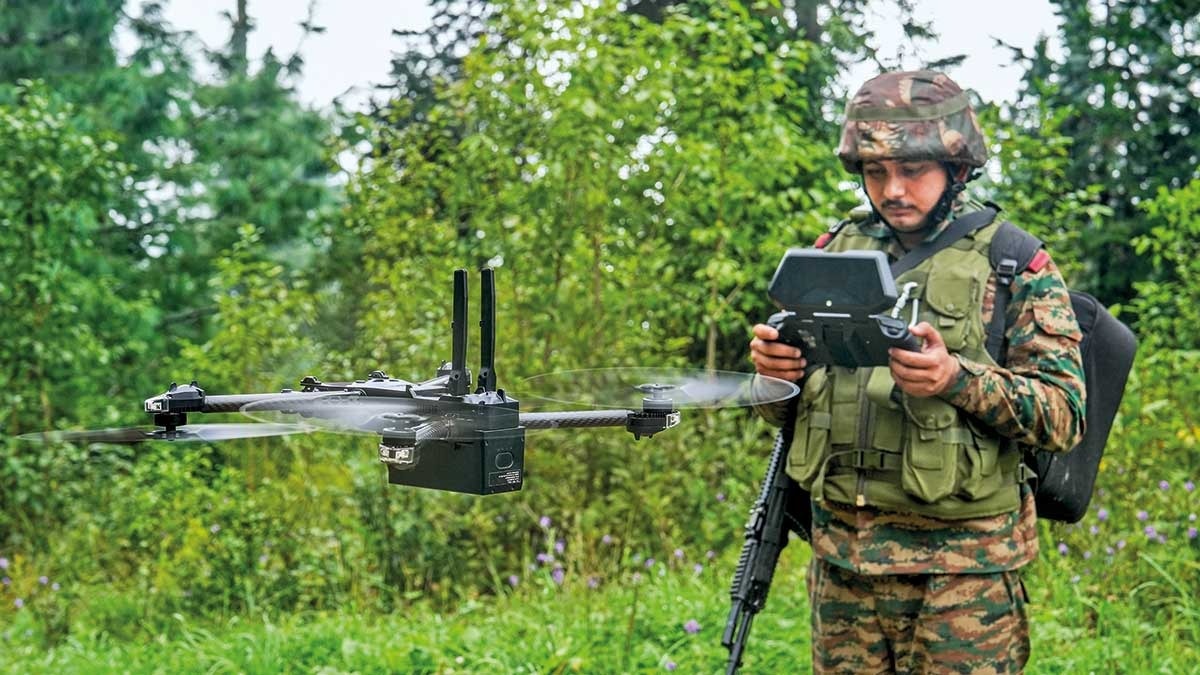
In October, Russia fielded the newest technological breakthrough of its four-year war with Ukraine—the Filin (Eurasian eagle-owl), a ground-launched jet-powered drone which can fly the Delhi-Mumbai air distance, around 1,200 kilometers, at a speed of 800 kmph.The Filin flies at twice the speed of propeller-driven drones like the Shahed-136 which Russia also uses, more importantly, the satellite-steered munition costs roughly USD 50,000, a fraction of a USD 2 million Tomahawk cruise missile. This means Russia can build thousands of Filins to generate ‘precision mass’ – where precision attacks can be carried out in large numbers at lower costs than conventional missiles.The IAF has known the force-multiplier capabilities of jet-powered drones – it ordered 200 Sureshastra Smart Unmanned Munitions Systems (S-UMS) made by Veda Aeronautics in August 2024. Now, over the next few weeks, the Indian Army will begin trial evaluations of jet-powered kamikaze drones from a dozen Indian firms.The army hopes to buy 540 such high-speed drones, its largest purchase of this weapon class. These are the newest big-ticket drone purchases since Operation Sindoor last year, where, in the words of Air Chief Marshal AP Singh, drones went on from being ‘eyes in the sky’ to ‘claws in the sky’. The 88-hour conflict was among the world’s first instances of non-contact kinetic warfare, in which adversaries did not cross borders to do battle. Army drones hit Pakistani terror training camps, IAF Brahmos missiles shattered runways and destroyed hangars with aircraft inside them, and IAF Harop one-way attack drones plunged into Pakistani radars and command posts.India’s drone arsenal is surging. Over the next five years, the three services will acquire drones cumulatively worth over 1.5 lakh crore (over USD 15 billion), or roughly half the cost of its biggest ever defence deal for conventional hardware—an upcoming buy of 114 Rafale fighter jets from France. Jet-powered drones are the most significant accretion of tri-services strike capabilities since the Brahmos cruise missile was inducted in the 2010s. Other buys encompass a full spectrum of operations, from sea level to the stratosphere— High Altitude Pseudo Satellites (HAPS), High Altitude Long Endurance (HALE) UAVs, Medium Altitude Long Endurance (MALE) UAVs for surveillance missions, Collaborative Long Range Destructive Swarms (CLRDS), and jet-powered canisterised drones launched from IAF cargo aircraft, which would enable the IAF to hit targets in China, across the heavily-defended expanse of the Tibetan plateau. The IAF plans to acquire over 100 Ghatak stealth bomber drones worth over Rs 60,000 crore to complement its manned fighters.The army plans to train and deploy over 100,000 drone operators to operate a range of surveillance and strike drones inducted by its 385 infantry battalions. The Indian Navy was the first service to fire missiles, in the 1971 Indo-Pak war. It is now looking to acquire a new class of long-range jet-powered drones costing a fraction of ship-launched cruise missiles. The navy is also inducting large fleets of unmanned surface vessels (USVs) which will handle hazardous tasks like mine clearance and launch kamikaze strikes on enemy warships using missiles and explosives.Acquiring drones off the shelf, it would seem, is the easy part. The focus has been on the fighting edge rather than the long tail of logistics, components, doctrines and industrial capacity.THE MISSING MASSDuring the 40-day US-Iran conflict which began on February 28, Iran launched multiple attacks on US air bases and ports across seven Gulf Arab countries, making up for its missing air force and navy with thousands of drones and missiles stockpiled in underground missile cities. This year, Russia and Ukraine are both set to produce over 6 million (60 lakh) drones each year.India lacks the capacity to build drones at such industrial scale, to enable ‘surge capacity’, an expansion of production in conflict. It has no factory complexes like Russia’s gigantic Alabuga complex in Tatarstan that churns out over 36,000 Shahed-type drones per year.This is because India’s drone orders come in penny packets. A 540-drone order for instance, does not allow manufacturers to invest in production capacity. There is no guarantee of more orders. One reason for the small numbers are because the armed forces still see drones as a niche capability, a cheaper way of delivering ordnance on target, rather than an integrated and networked force-multiplier.Single-service initiatives have produced outstanding domestic tech advances. In 2018, the IAF’s visionary Mehar Baba Swarm Drone competition dangled Rs 100 crore-order before Indian industry and went on to create a group of companies that have so far bagged orders worth over Rs 10,000 crore.The defence ministry’s Innovations for Defence Excellence (IDEX) scheme launched in 2018 has also nurtured this ecosystem as have Indian Navy initiatives like SPRINT and Swavlamban to develop in-house technological solutions. But without an integrated, top-down approach for acquiring drones and building an architecture for integrating unmanned systems, these measures are insufficient.“The problem is that every military drone procurement worries about the here and now and not the future,” says Smit Shah, President of the Drone Federation of India. South Block’s drone push, while seemingly large, is dissipated in single service silos. Each service buys small numbers of its own drones. The central armed police forces (CAPFs) and the paramilitary forces buy their own drones. There is no roadmap for joint development of drones for the armed forces. Since orders come in small numbers, and often ordered through emergency procurements, the underlying industrial base is not built. “Penny packets don’t give you sustenance and resilience in conflict, and they don’t allow for technology development – the industrial layers never get the sustained money they need. It does not produce standard designs, long production runs or interoperable fleets. What happens is that you end up becoming a customer in somebody else’s supply chain,” says Lt General PR Shankar, former Director General Artillery.A drone developer explains the chicken-and-egg problem : “You can scale-up only when you can sell. And no one is able to sell at scale.”The large orders that would have enabled industrial capacities, it would seem, are reserved for imports-- $3.5 billion for 31 MQ-9B armed UAVs from the US in 2024 — more than what India had spent for buying UAVs the previous decade.The Indian military’s High Altitude Long Endurance (HALE) and Medium Altitude Long Endurance (MALE) drones, pilotless aircraft which can stay airborne for nearly 24 hours carrying weapons and sensors, are entirely imported from Israel and the US.Experts speak of the need to review all of India’s multiple drone programs to build indigenous alternatives on a war-footing and integrate developers, users and production agencies under one roof.“All our large drone programs for HALE and MALE UAVs are stand-alone programs with minimal user-involvement which is why they are struggling for years-- the services provide test pilots and qualitative requirements, nothing else. Large drones which should have been inducted years ago are still stuck in development. The Ghatak program is yet to be formally approved, the Kaveri derivative engine is yet to be cleared for induction. Indecision is impacting our drone programs,” warns Group Captain Rajiv Narang, Senior Fellow at the MoD think-tank, Manohar Parrikar-IDSA.THE COMPONENTS DEPENDENCYDrones are essentially flying computers-- they are made up of a frame, motors, propellers, and a flight controller with different sensors and optronics. All these components are dominated by China which controls over 80 per cent of the global drone market, and dominates the supply of critical minerals and raw materials. In 2022, India completely banned Chinese components in military-grade drones over security concerns.Indian private sector drone ecosystem comprising over 600 drone and drone-component manufacturers now sources critical parts from US and European suppliers.When a service declares a drone tender, a race begins to become the lowest bidder or ‘L1’. Designs and components are imported, assembled and supplied to the military. The components dependency in propellers, brushless DC motors, carbon fibre, printed circuit boards, and frames, is only part of the story.Underneath the parts sits the chip problem—a lack of indigenous semiconductors with homegrown IP in design and fabrication.Each drone has over 100 chips, controlling various aspects like flight, altitude stabilisation and memory. The number of chips increase with the size and complexity of the drone.A palm-sized First- Person View (FPV) drone, has at least ten specialised chips, an aircraft-sized MQ-9B has over a thousand chips. Nearly all of India’s drones fly on chips imported from the US, a critical vulnerability.The flight controllers, the brain and central nervous systems of the drone, that run on these chips are either imported, or built under license-- only a handful of Indian firms make their own flight controllers.Imported drone designs also hobble spiral development—companies that assemble drones cannot field improved versions of the platforms. Lack of R&D means India risks missing out the advances in electronics that are creating smarter drones-- autonomous, AI-powered platforms with terminal guidance modules that lock on targets and strike and drones operating with radio repeaters which would allow them to operate over the horizon.“Proven microchip-based hardware design and manufacture, besides building indigenous components to include motors, flight controllers and customised, non-hackable payloads for drones are an imperative. This system of systems will not only require home grown chips but indigenous strapped on component manufacturing to achieve scale,” says Colonel Anurag Awasthi (retired), Executive Director, Mobile and Electronics Export Promotion Council. The first Indian semiconductors will come out of the single fab, approved under the Indian Semiconductor Mission, only between 2027 and 2029.The policy response looks small next to the order book. The only component policy with real heft so far is the Defence Acquisition Procedure (DAP) 2026 move to classify drone engine manufacturing as a project of national importance.“We need to get rid of the L1 culture (the lowest bidder)- you can have L1 for standard form- fit products, but when there are credible technologies available, where the government and the services have an intention to buy the best technology, the policy doesn’t allow them to do so,” says Nikunj Parasher, Founder CEO of Sagar Defence Engineering.THE MISSING LINKSThe Russia-Ukraine war became the most consequential use of drones in history because both countries put unmanned systems at the centre of their campaign. Russia created an Unmanned Systems Force in 2025, a distinct combat arm like armour and artillery. Ukraine, lacking an effective navy or air force, went a step ahead and created a separate branch of the military—an Unmanned Systems Force. Kyiv slowed down Moscow’s ground offensive using FPV drones while simultaneously launching waves of long- range precision drones over 2,000 kilometres deep inside Russia. Wars are unique in themselves and unlikely to be exactly replicated elsewhere, but they offer important lessons in the character and conduct of future conflict.India’s arms procurement cycles have traditionally lagged doctrinal and operational changes. Drone acquisitions are outpacing the creation of doctrines and structures.“Our drones are not networked, they don’t talk to each other, they are being bought in small quantities—there are no centralised ground control stations, no standardisation of equipment. I feel we are in the stage of tanks in the First World War —and, don’t forget, French tanks didn’t even have radios during the Second World War,” says a drone manufacturer.India has built impressive command and control (C2) on the defensive side. Akashteer integrates air defence sensors, radars and communication nodes into one network and was used during Sindoor. The army’s SAKSHAM (Situational Awareness for Kinetic Soft and Hard Kill Assets Management) is an indigenous, AI-powered counter-unmanned aerial system (C-UAS) and command-and-control grid meant to anchor a counter-UAS grid over the Army Data Network. While investment has gone into tracking and killing drones, there is less investment in an equivalent offensive backbone for tasking, networking and sustaining thousands of drones across services.This offensive backbone would flow from an unmanned systems doctrine which would integrate drones into how forces sense, decide and act, rather than treating them as isolated gadgets. It will lead to the creation of a kill web, a distributed network of many sensors, platforms and shooters to create precision mass. A kill web is akin to the tiles of a mosaic, smaller and interchangeable, and hence far more resilient and harder for an adversary to disrupt.“We need a coherent drone doctrine which will guide the combat employment of drones in algorithmic warfare and we need an organisation to set up a kill web—call it the Kill Web Integration Task Force with representatives from the DRDO, Academia, ISRO and industry, “says Lt General Raj Shukla, former GoC-in-C Army Training Command (ARTRAC).Such kill webs need space-based sensors like satellite constellations to seamlessly steer drones. Ukraine’s defensive architecture, for instance, is heavily reliant on Elon Musk’s Starshield, the military arm of SpaceX’s Starlink satellite constellation. India is yet to field a low-earth constellation which will allow its drones to strike at long ranges or defend itself from drones and missiles fired by adversaries.Issues like Identification Friend and Foe (IFF) remain unaddressed. There is an urgent need to identify and segregate drones flying at lower altitudes, the so-called ‘air littoral’ stretching from the earth’s surface up to roughly 3,000 metres—where ground forces, low-flying aircraft and uncrewed systems interact. Four months after Operation Sindoor, an Indian army corps commander mentioned at a public forum how, at a given point during the 88-hour conflict, there were over 8,000 drones flying over his Corps Battle Area (around 600 kilometres). “Today minor combat units have 40- 60 drones, major combat units have over 100 drones,” he said. How do we avoid drone fratricide?” he asked. The answer is for dedicated airspace situational awareness—a drone and counter-drone unmanned traffic management system which automatically detects and tracks drones.India has an impressive drone arsenal. The gaps in its drone-verse mean it is not a drone power yet.- Ends
Claws in the sky: Decoding India's massive drone buys
Full Article
Original Source
Read the full article at Indiatoday →KhanList aggregates and links to publicly available news content. We do not host full articles from third-party sources. Always verify important information with original sources.