
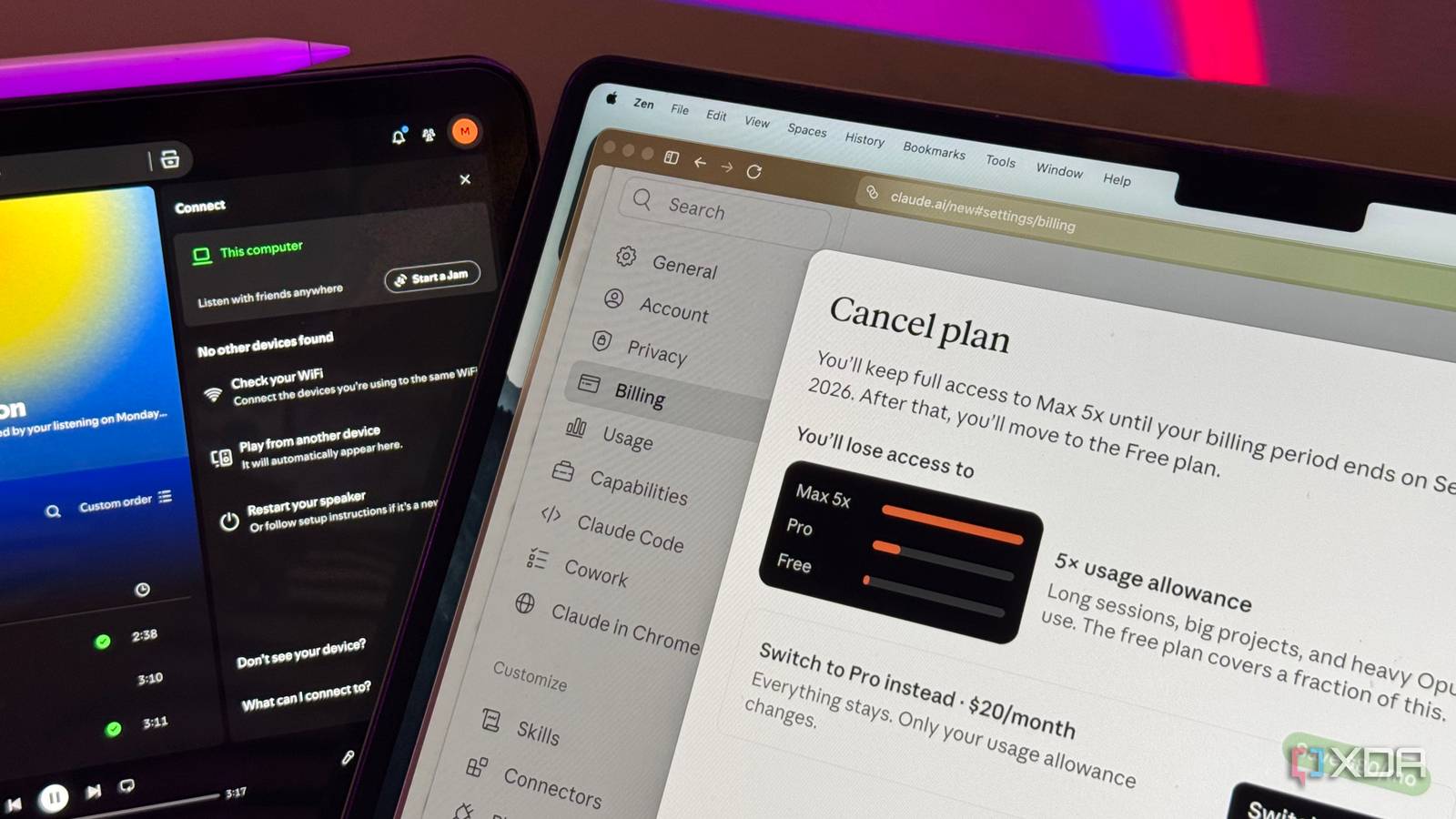
Published Aug 26, 2026, 12:30 PM EDT Mahnoor Faisal is a tech journalist covering AI and productivity tools with bylines at XDA, SlashGear, MakeUseOf, Laptop Mag, and Android Police. She's been writing professionally since she was sixteen, and has since penned hundreds of articles. This includes in-depth coverage of AI tools like NotebookLM to breaking news across the AI space. Her passion for technology started when she received her first iPod Touch (4th generation) on her 8th birthday, and she's been deep in the tech world ever since. Currently pursuing a degree in computer science, Mahnoor brings both a journalist's eye and a technical foundation to her coverage of how AI is reshaping the way we work and learn. I've been a huge Claude fan from its very early days. I've been one of its loyal users since it was still a relatively niche product mostly talked about in developer and technical communities, and I've been extremely vocal about my support for the tool ever since. In the past few months, there have even been instances where my support for Anthropic has only increased. The company's stance on the whole Department of War saga certainly won me over even further, and its streak of launching banger feature after banger kept that momentum going. For a while, it felt like every other week Anthropic was giving me another reason to justify my subscription. Unfortunately, things seem to have taken a sharp turn, and I've found that using Claude has become increasingly exhausting. I've even found myself questioning whether my Claude subscription is worth keeping around at all. Claude doesn't seem as good at research anymore Claude is in too much of a hurry to answer Research has been one of my primary use cases for Claude for a long time. I'm not necessarily asking it to do all the work for me, but I do rely on it as an extra pair of hands to find sources, dig up information I might've missed, and point me in the right direction when I'm looking into something. Lately, though, I've found that Claude's models seem to be in a hurry to give me an answer rather than spend the time needed to give me the best possible one. Mind you, I'm talking about Opus 5 on the highest possible effort setting here. Even then, I've had plenty of instances where Claude conducts a surprisingly small amount of research before deciding it has enough information to answer my question! There are also a lot of times when Claude simply doesn't head to the web at all. Instead, it'll answer based on its existing knowledge unless I explicitly tell it to browse the web and look for current sources. That gets frustrating pretty quickly when the whole reason I'm asking Claude the question in the first place is because I want it to help me research something, rather than give me an answer based on whatever it already knows. Even when Claude does head to the web, I've found that it still struggles to pull information from plenty of websites and community forums like Reddit. That naturally narrows the pool of information it has to work with, and I often end up going back and forth with Claude, correcting information it found or asking it to dig deeper into something it glossed over the first time. The difference became obvious when I tried another assistant ChatGPT made Claude's shortcuts obvious I'd been noticing this for a few weeks, but it eventually got frustrating enough that I decided to try the exact same question somewhere else. I just wanted to figure out whether Claude's research was the problem, or whether I was simply asking the kind of question that an LLM couldn't answer particularly well. Since I'm also subscribed to ChatGPT Plus, I pasted in the exact same question I'd asked Claude. The difference was immediate! Claude had spent roughly a minute and a half conducting its research and putting together an answer. ChatGPT spent around 12 minutes on the same question, digging through considerably more information before responding. Sure, waiting 12 minutes for an answer is far less convenient than waiting a minute and a half. But the answer I got at the end was actually worth reading and pulling information from. More importantly, it eliminated almost all of the back-and-forth I'd have needed with Claude afterward. Ultimately, the time Claude saved me by producing an answer faster wasn't really time saved at all. I was simply spending that time later, asking follow-up questions, correcting what it had found, and repeatedly telling it to look deeper into things I expected it to investigate properly the first time. Claude has started rationing my subscription for me Apparently, Claude is worried about my usage limits too Despite all the good things I've had to say about Claude all these months, one thing I've continuously whined about is its usage limits. They're terrible, and they keep getting worse. However, the usage limits themselves aren't what I'm going to complain about here. Somehow, Claude has found a way to make them even more frustrating by occasionally deciding for me that I'm too close to my limit to keep working. I was using Claude Code per usual one day. It was a busy day, so I was at 90% of my session limit when Claude suddenly decided it was time to call it quits. Instead of continuing with the task I'd asked it to complete, it essentially told me I was getting too close to my usage limit and that it would be better to stop there. It kept pushing the fact that I'm approaching my limit, and this isn't something I had noticed before. I assumed it was an one-off quirk initially, and brushed it off. Then I started seeing other Claude users complain about the exact same thing. Over the past few days, I've come across multiple Reddit posts from users reporting that Claude has started slowing down or outright refusing to continue working once they're close to their usage limits. In one particularly ridiculous example, a Claude Max 20x user said Claude Design noticed they were at 90% usage and decided it would be safer not to start the task at all. They eventually got it to cooperate, but only after asking four times. The funniest part is that the task itself ended up consuming less than 1% of their allowance. Another user reported Claude Code repeatedly stopping once their usage reached around 90%, even after they'd added instructions to their CLAUDE.md telling it to ignore usage warnings and keep working. They said the behavior had gotten to the point where they had to babysit Claude, only to discover midway through testing that several things they'd asked it to do hadn't actually been completed. To be clear, I completely understand the logic behind warning Claude that a usage limit is approaching. There's little value in having it start some massive task when it only has enough usage left to get halfway through it. However, there is a massive difference between giving the model that information and letting it decide that the remaining usage I've already paid for isn't worth using. I shouldn't have to argue with Claude to convince it to do a task because it has decided I might be better off saving my remaining allowance. In some of these cases, users are literally burning more usage repeatedly telling Claude to get on with the task than the task itself ends up consuming (which might just be a trick from Anthropic's end). If I have 10% of my usage left, I want to be able to use that 10% without Claude rationing my subscription for me. Claude's strengths don't feel exclusive anymore I never really had to justify my Claude Max subscription to myself. It practically paid for itself with how much I used it and how often I preferred Claude over everything else. Lately, though, that gap has narrowed enough that all the friction surrounding Claude is becoming much harder to ignore. Unfortunately, it feels like its time to bid farewell to Claude Max for good.
Claude has become exhausting to use, and I'm starting to regret paying for it
Full Article
Original Source
Read the full article at Xda-developers →KhanList aggregates and links to publicly available news content. We do not host full articles from third-party sources. Always verify important information with original sources.