
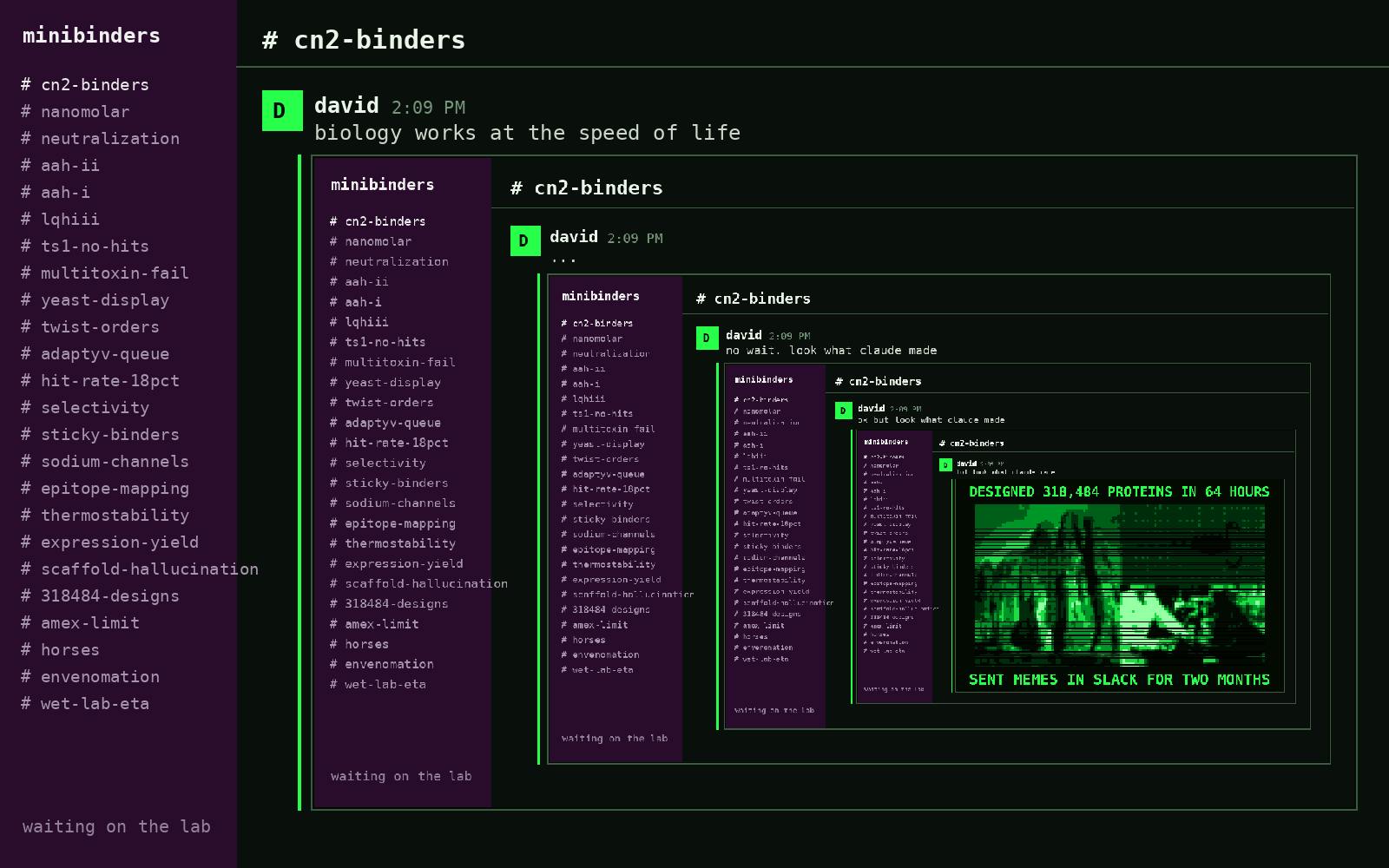
Citrini Research has no lab, no biologists, and no drug discovery experience. It flew to Anthropic's New York office, ran an unreleased Claude against five scorpion toxins, and paid the wet lab on a credit card. The number everyone is quoting from Anthropic's scorpion antivenom post is 318,484 — the count of protein designs an internal Claude model generated in 64 hours before narrowing to 180 for lab testing. It's the wrong number to fixate on. The interesting numbers are 5 and 40. Five is the size of the team that commissioned the work: Citrini Research, a thematic equity research shop that sells investment notes, not medicines. Forty is roughly how many days it took to turn the designs into physical molecules and get data back. A stock research firm walked into a frontier lab Anthropic's framing is that it wanted to test whether motivated nonexperts could take a real swing at a human health problem. Citrini approached Anthropic with that question a month before Anthropic published its first protein binder results in August. Nathan C. Frey of Anthropic's team described the result as an entertaining, candid and humbling account of nonexperts — "filthy casuals," in Citrini's self-description — going after a real health problem with Claude. Hunterbrook Media, which embedded with Citrini for the two-day visit, is blunter about what that required. The team didn't do this from a laptop at home. They sat in a conference room on the second floor of Anthropic's NYC office and ran a powerful unreleased model — supervised, but without the bioscience guardrails that demote this kind of work to a less capable model on Anthropic's public tier. Prompts included internal tactics the reporter wasn't permitted to record. The initial prompt itself ran roughly 35 pages. So the headline isn't "nonexperts designed a drug with AI." It's "nonexperts designed a drug with the AI you can't access." Hunterbrook's CEO, a molecular biologist who has co-founded two AI drug design companies, says the gap between Anthropic's public warnings and ordinary users' experience exists because we are not using the same tools. Claude placed the order itself The operational detail buried in Anthropic's writeup: at the team's request, Claude emailed the sequences to Twist Bioscience in messages flagged as written by Claude. Twist and Adaptyv Bio synthesized and tested all 211 designs. Per Citrini's own account of the project, the wet lab quoted about $85,000 for the samples, which the firm put on an American Express card, against roughly $200,000 total committed. Set that against how scorpion antivenom is made today. The sole FDA-approved product comes from immunizing horses with milked venom and purifying their antibodies — a method Southern African sting-response expert Jonathan Leeming compared to the moon landing in its era and considers overdue for replacement. The Mexican program behind it took 25 years, then another decade of US trials. Then biology did what biology does Seventeen of 211 designs met Anthropic's binding criteria. Among the 60 single-toxin designs, 11 were binders — an 18% hit rate Anthropic's own technical report calls consistent with typical protein design campaigns. None of the 151 multitoxin designs bound more than one toxin, which was the ambitious goal and the one that would have mattered most for a cheap universal cocktail. Anthropic does not claim an antivenom. Nothing was tested for neutralization in cells or in animals. Hunterbrook adds that broader testing flagged some binders as potentially sticky, leaving selectivity unconfirmed. The sharpest pushback showed up within hours, in the replies to Citrini's own announcement: proteins that bind scorpion toxins were demonstrated in the literature more than fifteen years ago, and the part that actually matters — neutralization — is exactly the part nobody ran. Naoual Oukkache, who directs an antivenom lab at the Pasteur Institute of Morocco, told Hunterbrook much the same thing in gentler terms: computational design can rationalize several stages of research, but AI-designed molecules are not about to replace polyclonal antivenoms, and are better understood for now as complementary treatments that still need standardized manufacturing and clinical validation. And then the clock. Citrini's own line about it is the best thing written on this entire project: their virtual biologist may have squeezed a year of work into a couple of days, but "biology works at the speed of life." They watched Claude move through problems at a pace that was hard to follow, and then spent the next two months getting acquainted with laboratory turnaround times — an education that, by their account, consisted largely of posting memes in Slack while they waited. Hunterbrook's CEO, who spent a decade in biotech before leaving it, has his own name for that stretch: "the boredom of biotechnology." Contracts, shipping, reagents, subcontractors, emails. Where the bottleneck actually moved CNIO researcher Susana Vázquez Torres, one of two outside experts Anthropic sent the work to, gave the line that reframes the whole thing: designing a binder against almost any target no longer looks unrealistic, and "binding itself is no longer the main bottleneck." The other reviewer, Timothy P. Jenkins of the Technical University of Denmark, framed the same point commercially: hitting five toxins in parallel in a matter of days is the AI-driven shift in therapeutic discovery made legible, and it matters most for diseases like envenomation that have been starved of innovation precisely because nobody could make the economics work. That is a claim about where cost and time now live. If design collapses to a weekend and synthesis-plus-assay becomes the gating step, the scarce resource is wet lab throughput, not computational cleverness. Citrini, being Citrini, turned that into a trade favoring contract research organizations. Everyone with operating experience says the same thing a different way. Transfyr CEO Anna Marie Wagner describes drug development as a funnel that has always been top-heavy: widen the top without widening the middle and you have simply built a tighter bottleneck. Amy Abernethy, formerly a senior FDA leader and now at Insitro, puts the choke point further downstream still — AI is supercharging discovery, but clinical development is a brick wall that arrives sooner or later regardless. And Insitro CEO Daphne Koller pushed back on the premise entirely: making more molecules isn't the hard part. Knowing what to aim them at is, and most failures come from not knowing. This is the second time in two years that a protein milestone has been read as more finished than it is. When AlphaFold won the Nobel, the honest assessment from inside the field was that structure prediction solved one box and left others unticked, even as the downstream effects kept surprising people. Anthropic, to its credit, wrote the caveats into the post rather than the comments, and released all 211 designs and their data so anyone can check. The thing worth watching isn't whether Cn2-B1 becomes a drug. It's that the list of people who can credibly start a drug program now includes five analysts with a spreadsheet habit and a corporate card.
Claude Designed 211 Proteins in Two Days. The Memes-in-Slack Phase Took Two Months
Full Article
Original Source
Read the full article at Hackernoon →KhanList aggregates and links to publicly available news content. We do not host full articles from third-party sources. Always verify important information with original sources.