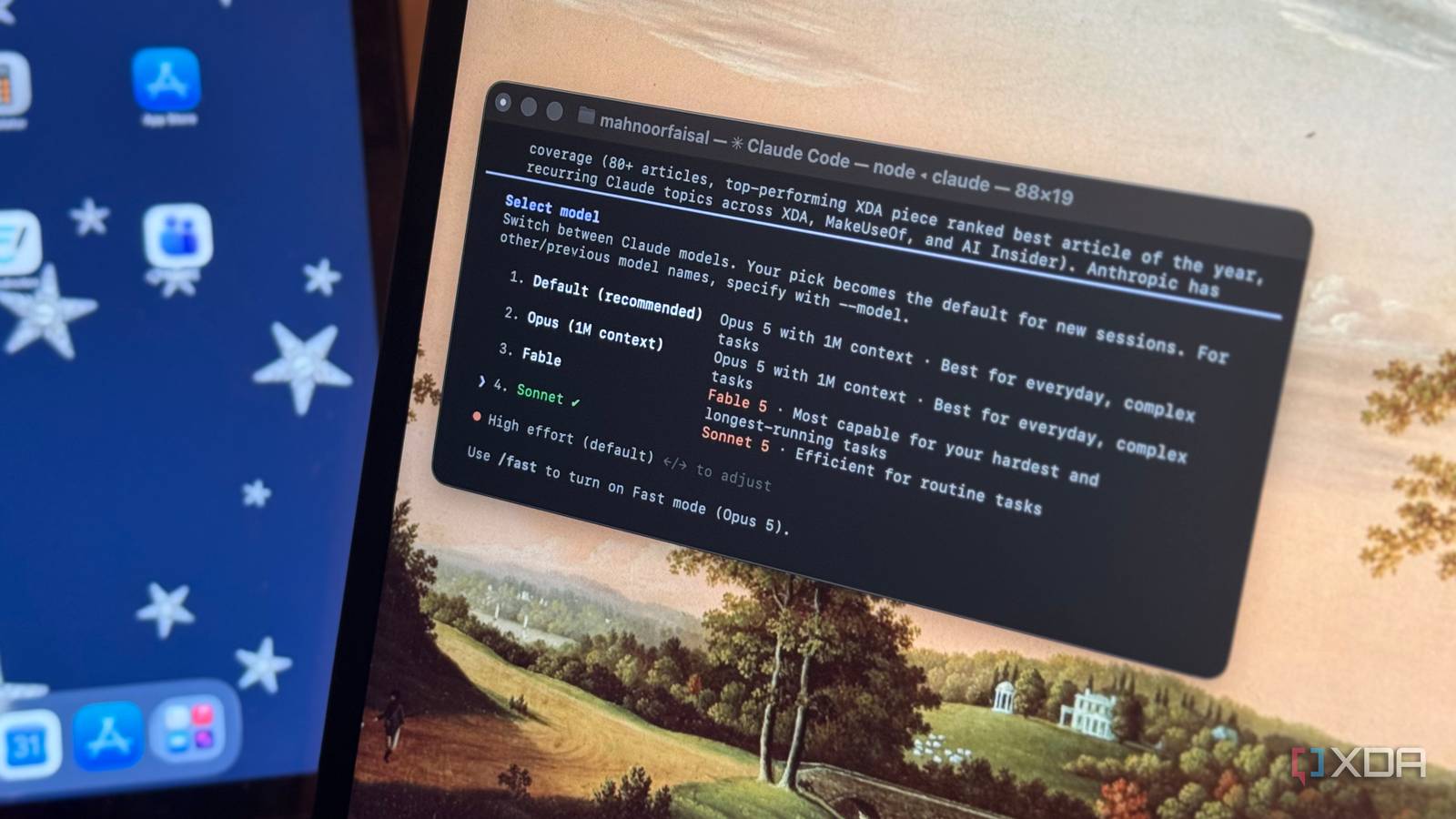
Published Aug 5, 2026, 6:00 PM EDT Mahnoor Faisal is a tech journalist covering AI and productivity tools with bylines at XDA, SlashGear, MakeUseOf, Laptop Mag, and Android Police. She's been writing professionally since she was sixteen, and has since penned hundreds of articles. This includes in-depth coverage of AI tools like NotebookLM to breaking news across the AI space. Her passion for technology started when she received her first iPod Touch (4th generation) on her 8th birthday, and she's been deep in the tech world ever since. Currently pursuing a degree in computer science, Mahnoor brings both a journalist's eye and a technical foundation to her coverage of how AI is reshaping the way we work and learn. The AI game right now is very different from how it was two years ago. Actually, scratch that. The current reality is very different from how it was just two weeks ago. LLMs launch faster than you can realistically keep track of and put to the test. It's the 4th of August when I'm drafting this introduction, and a tracker on the LMMarketCap website claims that 29 models were added this past month alone, from more than a dozen different providers. By the time you finish reading this article, I wouldn't be surprised if that number had already ticked upward. So when a tool gives me fewer models instead of more, my instinct (like anyone's) is to see it as a limitation. While there are a lot of reasons I keep coming back to Claude Code, this one might be the most counterintuitive — that fewer models is exactly why it works so well for me. More models means more paralysis Drowning in the dropdown Let me tell you something about me before we get into Claude. I'm an extremely indecisive person, and decision fatigue is something I fight with more than I'd like to admit. I've reached the point where I ask my friends not to hand me the menu when we're out to eat, and that I'll just have whatever they're having. Now take this exact problem and point it at the way most of us use AI now. While the default was once "just GPT it," that era is well and truly over. OpenAI's models are no longer the default, and we now have countless AI labs launching competitive models like Google's Gemini, Anthropic's Claude, DeepSeek, Meta's Llama, Alibaba's Qwen, X's Grok, and so on. Instead of the AI labs shipping just one model, they ship a whole family: a big one, a fast one, a cheap one, a reasoning one, a mini one, and so on. If you open practically any AI tool today, the very first thing you'll be met with is a dropdown, before you've typed a single word. Now, where you land on this dropdown depends a lot on which tool you've opened. Some of them keep it simple by keeping it in-house, whereas others throw the whole buffet at you. For instance, ChatGPT, Gemini, and Claude all keep it in the family. Open ChatGPT and every option in that dropdown is an OpenAI model, open the Gemini app, and it's all Google, open Claude and it's all Anthropic. Microsoft Copilot, on the other hand, works differently and lets you swap in models from different providers. However, the most intensive of the bunch are coding tools. Take Cursor and Antigravity, for example. Both are incredible coding tools and harnesses, and both make model choice a challenge. Open Cursor's model picker, and you'll find OpenAI, Anthropic, Google, and xAI, plus Cursor's own in-house engines. Google's Antigravity does the same thing: you'll find Gemini models alongside Anthropic's Claude models and even OpenAI's open-weight GPT-OSS. This is all marketed as flexibility, and for plenty of people, it genuinely is a selling point. However, if you're anything like me, that screen isn't really a world of possibilities. It's the restaurant menu all over again, except now every dish comes from a different kitchen, and I'm somehow expected to know which chef is having a good week. Now, given I work in this very field, I do keep tabs on which models are pulling ahead and which are falling behind more closely than most people. Despite that, it doesn't make the choice easier for me. It does the opposite. I know the model game well, but I also know that the best model is a moving target. Given all you really see on the model picker is the model's name and maybe a one-line tagline, that knowledge doesn't actually help me in the moment. There's no benchmark chart baked into the dropdown, and no "here's the one that'll handle your task best" hint. So instead of picking with confidence, I second-guess. I mentally cross-reference results I half-remember, hover over three options, and burn the exact energy I opened the tool to spend on the actual work. And if the dropdown does that to someone who follows this stuff for a living, it's worth asking what it does to everyone else. Anthropic's models are really the only ones you need The only shortlist you need Here's the thing that makes all of the above bearable in Claude Code: the models it does give you are the ones you'd probably have picked anyway. Anthropic's models have sat at or near the top of the coding charts for a while now, and that hasn't changed with the latest wave. Instead of citing Anthropic's own claims and telling you to take Anthropic's word for it, let's look at a scoreboard kept by one of its competitors. Cursor runs its own coding benchmark, CursorBench, which grades models on messy, multi-file tasks pulled from real Cursor sessions. At the time of writing, the top of the leaderboard is almost entirely Anthropic. Fable 5 sits at number one, Opus 5 right behind it, and Anthropic's models fill out most of the top ten, If you don't keep up with Anthropic's model family, let me give you a quick refresher. At the bottom sits Haiku, the fast and cheap one built for lightweight tasks. In the middle is Sonnet, the everyday model that balances speed and smarts. At the top is Opus, the heavy hitter you reach for when a problem is genuinely hard. Above even that sits Anthropic's newest frontier tier, the Fable and Mythos line, for the most demanding work. There's essentially a tier for any kind of work you'd want to throw at Claude, and given they're all incredibly capable in their own right, you're not choosing between a good option and a bad one. While competitors like Codex also keep it in the family, Anthropic's models are what I've found best for my coding needs so far. Beyond just the model's capabilities, I'm also a huge fan of everything else Claude Code offers as a whole. So, while this article has focused on the models, it's worth being clear that the models are only part of why I keep coming back. Claude Code is widely regarded as one of the strongest coding harnesses out there, and a big reason for that is exactly the restraint I've been describing. Since Anthropic builds both the models and the tool wrapped around them, it can tune the two together as a single system.
Claude Code gives me very few models to work with, and that's exactly why I keep going back to it
Full Article
Original Source
Read the full article at Xda-developers →KhanList aggregates and links to publicly available news content. We do not host full articles from third-party sources. Always verify important information with original sources.