
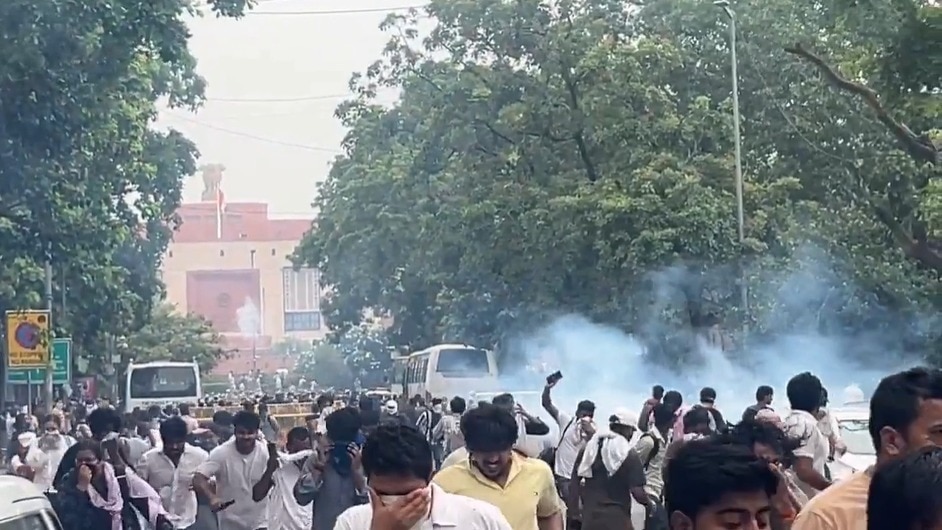
Security forces used tear gas near Shastri Bhawan after protesters tried to breach barricades and head towards Jantar Mantar. The unrest spread across central Delhi, prompting metro restrictions, tighter security and dispersal efforts at Rail Bhawan.Chaotic scenes erupted across central Delhi on Monday as security forces fired tear gas shells, resorted to lathi charges and deployed anti-riot vehicles as protesters participating in the Cockroach Janta Party's (CJP) marched to Parliament, breaching security barricades.Protesters and police clashed at multiple locations, including Jantar Mantar, Connaught Place, Rail Bhawan, Shastri Bhawan and parts of Janpath, as thousands of demonstrators converged on the national capital amid heavy security arrangements in the high-security zone surrounding Parliament.As the protest intensified, agitators attempted to push through multiple barricades erected in the high-security area near Parliament. A scuffle ensued, during which several protesters and police personnel sustained minor injuries.Visuals from Rail Bhawan showed tense scenes as large crowds of protesters faced heavy police deployment. Authorities repeatedly appealed to demonstrators to disperse before firing tear gas shells after sections of the crowd tried to force their way through the barricades. Security personnel later intensified crowd-control measures to prevent protesters from advancing towards Parliament. As the protest spread beyond Jantar Mantar, large groups of demonstrators also reached Connaught Place, prompting authorities to tighten security in the commercial hub. Traffic on the Outer Circle was brought to a halt after police stopped buses and other vehicles to prevent protesters from moving further.Authorities also deployed Vajra anti-riot vehicles, water cannons and rapid response teams at key junctions around Rail Bhawan, Shastri Bhawan, Janpath and Connaught Place to contain the march and prevent protesters from advancing towards Parliament. The South Gate entry to Parliament for vehicles was closed as part of the security arrangements, triggering traffic disruptions across several parts of central Delhi.Several commuters were stranded inside nearby Delhi Metro stations after authorities restricted access and temporarily closed the gates of five stations as a precautionary measure. Protesters were also seen raising slogans inside and outside metro stations, including Mandi House and other key transit points.Visuals from Rail Bhawan showed tense scenes as large numbers of protesters gathered while police repeatedly made announcements asking them to disperse.Protesters also alleged that internet and mobile connectivity in and around the protest site had been disrupted due to the use of signal jammers, although there was no immediate official confirmation of the claim.Meanwhile, the CJP leadership claimed that the central government had agreed to hold talks with the protesters. However, there was no official statement from the government confirming any such engagement.The CJP called the 'Chalo Sansad' march from Jantar Mantar to Parliament to demand education reforms and seek the resignation of Union Education Minister Dharmendra Pradhan over the alleged irregularities in the NEET examination. The march coincided with the opening day of the Monsoon Session of Parliament.The Delhi Police rolled out a multi-layered security plan, deploying over 5,000 Delhi Police personnel and paramilitary forces across the New Delhi district. More than 25 battalions of the Central Armed Police Forces (CAPF), including women personnel, have been stationed at key locations to strengthen the security grid.The New Delhi district was divided into 15 security zones, each placed under the supervision of senior police officers. Special Commissioners, Joint Commissioners and Deputy Commissioners of Police were assigned specific responsibilities to oversee deployments and coordinate real-time responses. Intelligence agencies and the Delhi Police Special Branch also maintained hourly monitoring of the number of protesters arriving at, departing from and staying around Jantar Mantar.Authorities declared several high-security areas, including the Parliament precinct, out of bounds for demonstrations and maintained that no permission had been sought or granted for the march to Parliament. Prohibitory orders under Section 163 of the Bharatiya Nagarik Suraksha Sanhita (BNSS) remained in force across the New Delhi district, banning protest marches, processions and the assembly of five or more persons outside designated protest sites.- EndsPublished On: Jul 20, 2026 13:27 IST
CJP protesters near Parliament, face barricades, lathicharge, tear gas
Full Article
Original Source
Read the full article at Indiatoday →KhanList aggregates and links to publicly available news content. We do not host full articles from third-party sources. Always verify important information with original sources.