
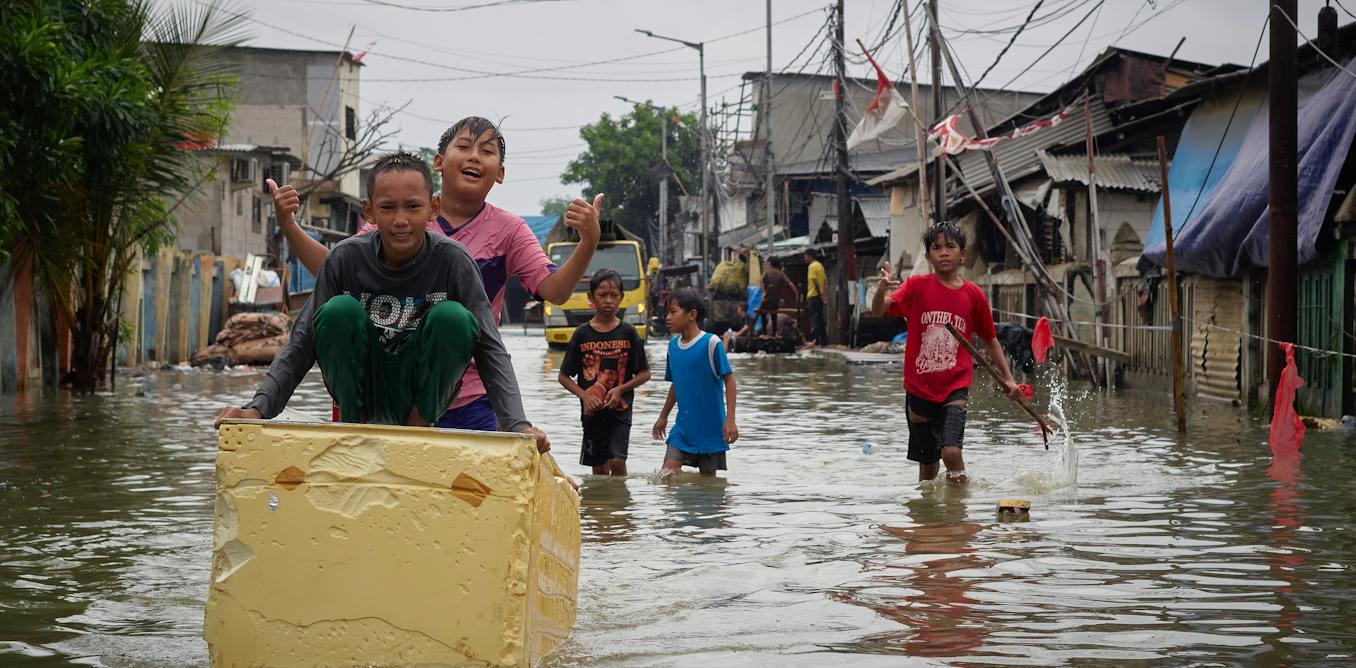
Cities worldwide are sinking at alarming rates, but that doesn’t mean the ground is sinking at the same rate everywhere. Some neighbourhoods may be far more affected than others close by, with serious consequences for their residents. Land subsidence – the gradual sinking of the ground surface – is a global urban problem. Rapid development often drives excessive groundwater extraction, which can cause underground sediments to compact and the land above to sink. The risk of flooding is exacerbated by rising sea levels and more intense rainfall associated with climate change. One recent study estimated that about 71% of the global coastal population lives in subsiding regions, many of which are densely populated and already threatened by sea-level rise. Advances in satellite monitoring now allow researchers to measure subsidence across cities at fine spatial scales. In a new study in Nature Cities a team of Chinese scientists used nine years of these satellite images to assess 465 large cities worldwide. They found cities in Asia are subsiding fastest, and that cities in developing countries are generally sinking faster than those in wealthier countries. But citywide patterns can conceal big differences within individual cities, with important implications for where flood protection is most needed. Jakarta – among the world’s fastest sinking cities We have become very aware of this in our own research in the Indonesian capital Jakarta. Now the world’s most populous city, Jakarta has for many years been the poster child for sinking cities. Significant areas already lie below sea level and continued subsidence could put more of the city below it. Some areas in Jakarta are sinking more rapidly than others: the city’s northern coastal area, for instance, sinks up to 7cm a year according to our model for 2016-24. Subsidence rates in Jakarta 2016-2024, showing regions in the north west sinking the fastest. (Left = sinking rates across all Jakarta; right = only the most reliable and high-confidence data points) Shabrina et al (2026) As a low-lying delta city in the tropics, crossed by 13 rivers, Jakarta is already vulnerable to floods from both rivers and tides. Land subsidence makes these floods more frequent and severe. In coastal northern areas such as Muara Angke, where informal settlements are common, flooding can occur every other day. This affects some of the city’s most vulnerable communities. Land subsidence is a planning problem To protect the city, Jakarta has constructed a network of seawalls, water gates, polder systems, dykes, and pumping stations. Something similar is needed in many other subsiding coastal cities on Java, the world’s most populated island, and there are now plans to construct a giant sea wall across much of northern Java. Drone images of coastal north Jakarta. Some of this land is sinking by around 7cm a year. Shabrina & Colven Yet flood defences alone won’t be able to cope and protect Jakarta or other Javanese cities from flooding without changes to the overall planning system. Land subsidence had not been fully integrated into Jakarta’s flood management planning until recently. Groundwater extraction regulations were introduced in 2021 and implemented in 2023, despite land subsidence being discussed for more than three decades. A core problem remains the lack of a reliable piped water supply, making it desirable for residential and large commercial buildings to extract their own groundwater. Enforcement has improved but remains challenging: groundwater is notoriously difficult to manage as it is a hidden or “fugitive” resource. Fortunately, land subsidence from excessive groundwater extraction can be reversed. When groundwater is replenished, the land surface may rise again. That being said, even immediately stopping groundwater extraction would not halt sinking abruptly. Long-term adaptive management is urgently needed, supported by a comprehensive policy framework that combines groundwater regulation, extraction control, and overall water supply management. Parts of Las Vegas sank by a metre or more in the 20th century, thanks to excessive groundwater extraction. Nicholas J Klein / shutterstock Injecting water into the ground to replenish the aquifer has proven effective in managing subsidence in places such as Las Vegas and Shanghai. But the same approach is not straightforward in Jakarta, where land subsidence is driven by a combination of factors, including water loss deep below ground. Addressing this is technically complex and expensive, making regulation and piped water essential to tackling the problem. Subsidence may be a global problem, but it is driven by locally specific factors and can only be addressed with an understanding of local patterns. This is because the causes and impacts of land subsidence are shaped by urban development, water management, and all the other policies and decisions in the making of the city. As cities worldwide continue to sink, we need to continually examine these changes at the local scale. Averages across a whole city can tell us how big the problem is, but knowing where the land is sinking fastest – and who lives there – is essential to deciding how best to respond.
Cities are sinking – but citywide averages hide the real problem
Full Article
Original Source
Read the full article at Theconversation →KhanList aggregates and links to publicly available news content. We do not host full articles from third-party sources. Always verify important information with original sources.