
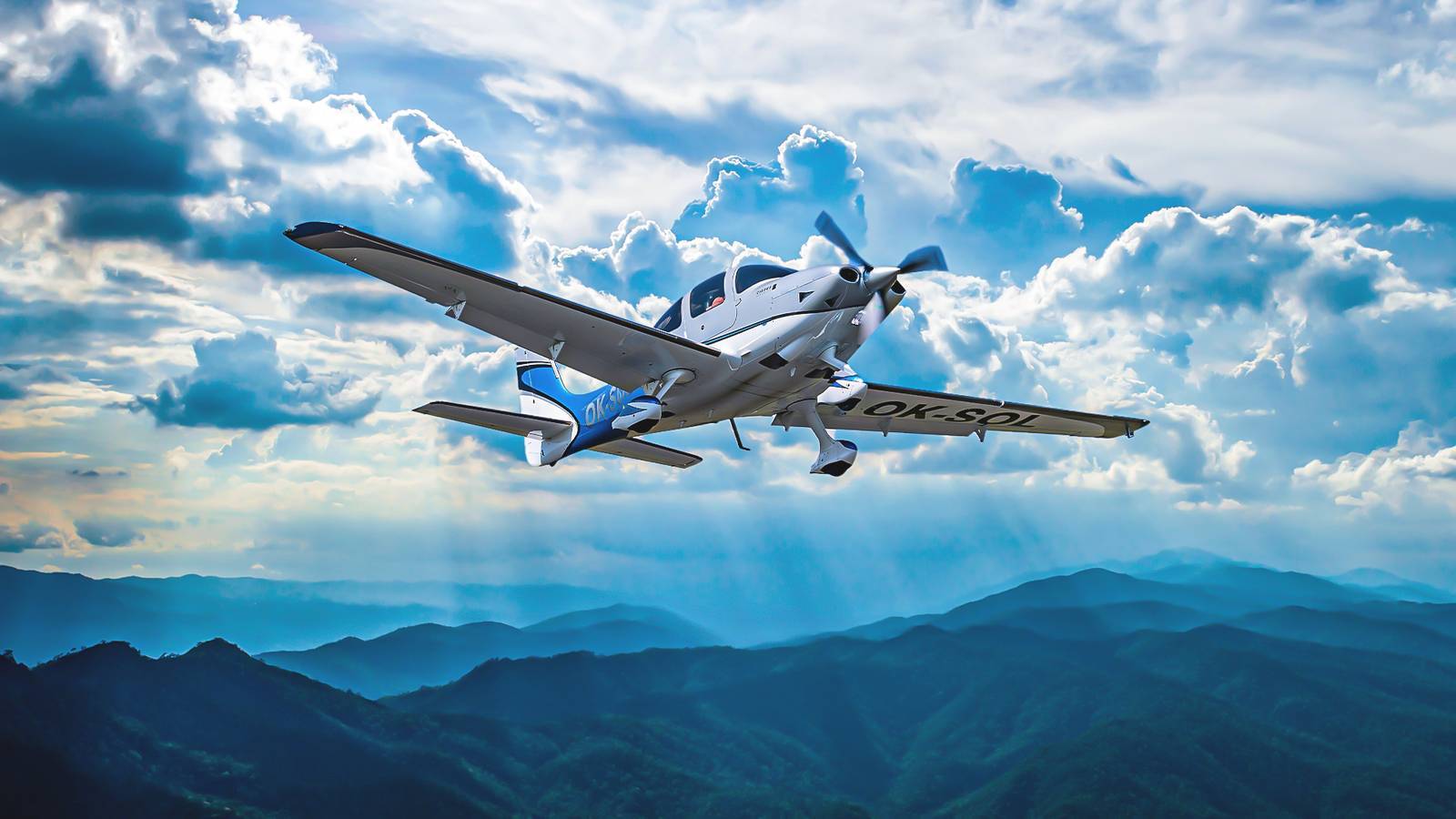
Cirrus has revolutionized the world of general aviation in the 21st century with its SR22 series single-engine propeller planes, but the game-changing design choice was not due to performance or cost, but rather safety. The SR22 became the leading single-engine piston aircraft of the modern era by shifting industry focus from mechanics to pilot and passenger peace of mind. Cirrus completely upended the GA market with a modern, high-performance plane built entirely around an unprecedented safety mechanism: a whole-airplane parachute. The crown jewel of the SR20 family is the Cirrus Airframe Parachute System (CAPS), but it is far from the only innovative technology packed inside the lightweight, composite monoplane. Before the SR22 arrived in 2001, the light aircraft market was dominated by legacy, decades-old aluminum designs from manufacturers like Cessna and Piper. The SR22 is built from sleek, rivet-free fiberglass and carbon fiber composites rather than aluminum sheets, allowing for superior aerodynamics, higher speeds, and an incredibly strong cabin fuselage. The SR22 wings also feature a unique, NASA-designed discontinuous 'cuffed' leading edge. This advanced design makes the outer edges of the wing highly resistant to stalling, drastically minimizing the risk of a fatal spin occurring in critical phases of flight. The planes also feature the safe return emergency Auto Land system developed in collaboration with Garmin Avionics. All of this combined has launched the SR22 to the top sales spot every single year since 2003 and pushed Cirrus' market share to over 50% of global single-engine piston planes. Metrics That Matter: Why Peace of Mind Beats Pure Performance Credit: Milosz Maslanka | Shutterstock While the Cirrus SR22 is the best-selling cross-country machine for 24 consecutive years, it does not hold the crown for absolute top performance metrics like pure speed, payload capacity, or short-field flexibility. If speed is your only metric, the Mooney Acclaim Ultra completely outperforms the Cirrus. Meanwhile, the Cessna 182 Skylane is more rugged, and the Piper Archer is favored by flight schools for efficiency. Despite the performance disadvantage, Cirrus routinely sells 10 to 15 times more aircraft per year than its direct performance competitors. According to General Aviation News, the Turbocharged SR22T topped the list of piston singles with twice as many sales as the Cessna Skyhawk and the Piper Archer in 2025. As of early 2026, Cirrus has delivered over 8,700 individual SR22 and SR22T aircraft since its debut, and over 11,000 total SR-series planes. Specification SR22 SR22T Engine Power 310 horsepower (231 kW) 315 horsepower (235 kW) Maximum Cruise Speed 183 knots true airspeed (339 km/h) 213 knots true airspeed (394 km/h) Maximum Operating Altitude 17,500 feet (5,334 meters) 25,000 feet (7,620 meters) Other aircraft have been around much longer, so their historical lifetime production totals look larger, but their modern appeal has cratered in comparison. Cirrus delivered 691 planes in 2025, with the SR22 and turbocharged SR22T making up 70-80% of the total. While Cessna sells hundreds of 172s, only 40-60 182 Skylanes have been sold this year. Meanwhile, Beechcraft has handed over just about a dozen of its top-of-the-line Bonanza G36s in 2026. The 'Gimmick' That Won: Facing Down Flight Line Skepticism Credit: Khairil Azhar Junos | Shutterstock Founders Alan and Dale Klapmeier had a personal reason to care about safety when they designed the piston single that catapulted them to the top of the class. According to the Smithsonian, Alan barely survived a midair collision in 1985 and vowed to put a parachute into every future Cirrus. Cirrus now sells more airplanes than any other general aviation builder, but its initial reception was lukewarm. Cirrus pitched a different kind of airplane when the SR20 arrived in 1999. It came with a composite airframe, a side-mounted yoke, and the famed parachute. The very feature that makes it famous today, CAPS, was initially mocked as a dangerous marketing gimmick. Critics argued that a parachute was an admission of a flawed aerodynamic design. Veteran pilots openly mocked it, claiming it was a 'crutch.' For the 2001 model year, Cirrus announced the SR22. Cirrus kept fixed landing gear for safety, which many performance purists dismissed as inefficient compared to a Mooney or Bonanza. The SR22 abandoned the traditional heavy center yoke for a side-mounted flight stick, which veteran GA flyers dubbed 'plasticky,' like a video game controller. However, the real headwinds came when amateur pilots began to fall victim to a false sense of security. The initial skepticism turned into a full-blown safety crisis in the mid-2000s. Inexperienced pilots began flying into severe weather, heavy icing, and thunderstorms that they were not qualified to handle. Shockingly, in many early fatal crashes, pilots never pulled the parachute handle. By 2011, the SR22’s fatal accident rate spiked to 1.6 per 100,000 flight hours, significantly worse than the overall general aviation average of 1.2 at the time. Rewiring GA Safety Of Flight: From False Security To Gold Standard Credit: Nancy Anderson | Shutterstock Faced with a brand-destroying safety crisis, Cirrus Aircraft and the Cirrus Owners and Pilots Association (COPA) fundamentally changed emergency training. They institutionalized the rule: if you lose control, lose an engine over rough terrain, or experience spatial disorientation in the clouds, pull the handle immediately. The cultural shift worked. By 2014, the SR22's fatal accident rate dropped to 0.42, making it one of the safest single-engine planes in the world. The company advises pilots to deploy at or above 2,000 feet (610 meters) above the ground, and AOPA relays its advice to “pull early and pull often.” CAPS is a ballistic parachute attached to the airframe that launches via a small rocket. The cabin's red handle overhead releases it, the canopy opens, and the entire airplane descends slowly to the ground. AOPA says Cirrus fitted parachutes to all of its aircraft starting in 1998 and that it was the first parachute produced in an FAA-certified airplane. More than two decades later, AOPA adds, Cirrus remains the only company that includes a whole airframe parachute as standard equipment on every certified model it sells. Once the safety record matched the marketing hype, the SR22 became unstoppable. By successfully transforming a 'dangerous luxury toy' reputation into the gold standard of modern aviation safety, the SR22 completely wiped out its competition. Pilot spouses and families strongly prefer Cirrus over Cessnas or Pipers because they know they can pull the red handle if the pilot becomes incapacitated. Cirrus leaned in, continuously updating the plane with the first-ever full glass cockpit in a light piston plane in 2003 and eventually, the Safe Return Autoland button. The reward has been meteoric success. The Star Tribune reports that Cirrus delivered 797 aircraft in 2025, up 9% from the year before, while Textron Aviation, owner of the Cessna and Beechcraft brands, delivered 639. Cirrus billings reached about $1.18 billion. For context, compare that against $3.8 billion earned by Textron, which builds more expensive twins and jets for a larger class of airframes than Cirrus is even competing in. By The Numbers: What 269 Saved Lives Tell Us About The Future Credit: Philip Pilosian | Shutterstock AOPA says the parachute has been credited with saving 269 people across 132 deployments based on mishap data through the end of 2024. The count averages roughly two lives per deployment. The record also shows where the system runs out of room. AOPA notes that deployments involving injuries mostly happened at low altitude or after a late pull, which means the benefit depends on a decision made in seconds. A pilot who hesitates can erase the safety margin the canopy provides. That is why Cirrus pushes early deployment so hard and why training became central to the success story of its mighty little piston single. In 2003, the SR22 now in the Smithsonian collection, registered N266CD, became the first single-piston engine airplane certified with a glass panel. Flying magazine’s editor in 2012 called it the most sophisticated single-engine civilian airplane ever built. The brothers haven't rested on their laurels either. Cirrus introduced the SR Series G7+ in 2025 with Safe Return Emergency Autoland, built by Garmin, as standard equipment. Pushing the bar for how safe and advanced a light GA plane can be ever higher with every iterative improvement. Beyond The Chute: How Avionics Sealed The Deal Credit: Ryan Fletcher | Shutterstock The continuous upgrades have only served to further the Cirrus' reputation for innovation and quality. Cirrus says it is the first FAA-approved autonomous emergency landing system in a single-engine piston airplane. Until the SR22 debuted the feature, the technology had been limited to turboprop and jet-powered airplanes such as the company’s own Vision Jet. Anyone in the cabin can start the auto-land sequence by pressing a button on the overhead panel, much like the CAPS chute. The system can also begin on its own if the pilot stops responding. AVweb reports that it handles navigation, radio calls, a precision approach, the landing, and engine shutdown. Servo-driven emergency throttle and automatic mixture control let it manage the engine. The pilot can also cancel the landing at any time with the autopilot disconnect button. In short, safety made the Cirrus SR22 the best-selling GA aircraft by transforming safety from an abstract pilot skill into a tangible, foolproof engineering feature. While competitors chased a few extra knots of speed, Cirrus recognized that peace of mind is the ultimate luxury, allowing them to capture nearly half of the global piston market.
Cirrus Built The SR22 With A Whole-Airplane Parachute & Now It Is The Best-Selling Piston Single Of The Century
Full Article
Original Source
Read the full article at Simpleflying →KhanList aggregates and links to publicly available news content. We do not host full articles from third-party sources. Always verify important information with original sources.