
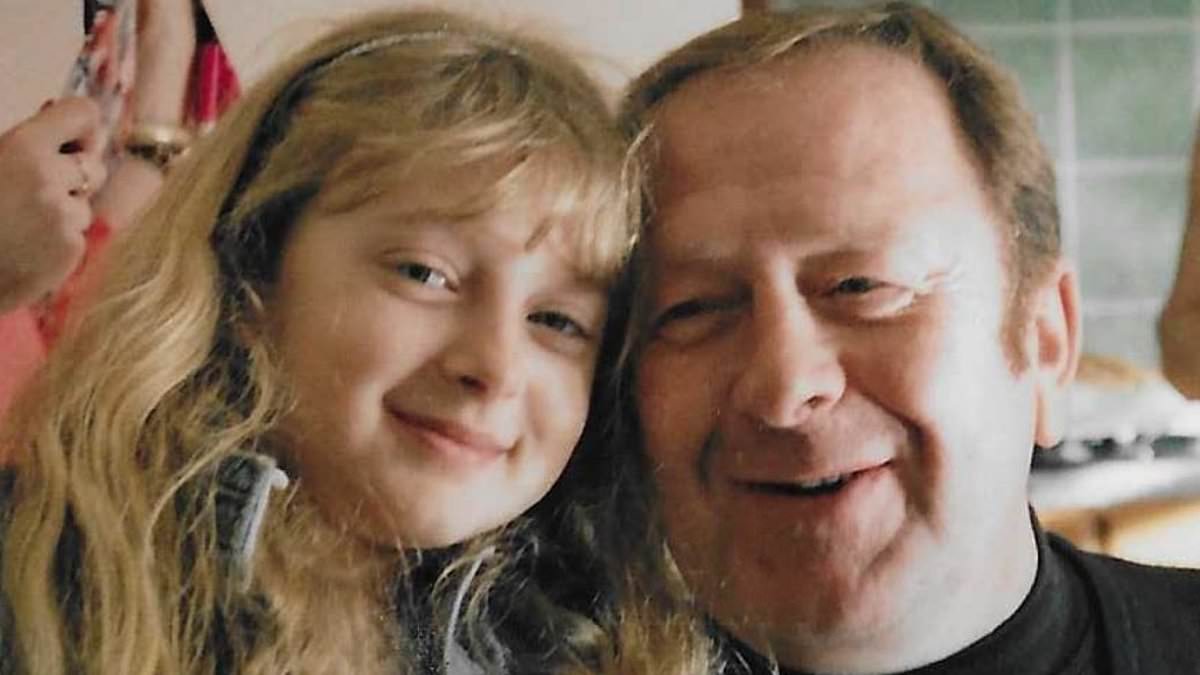
For 11-year-old Cici Willoughby, Sunday mornings meant caddying while her father, Neil, played golf.'I say caddy, but really I spent my time following Dad around and eating Mars bars,' remembers Cici, now 28, a trainee psychotherapist and dementia educator from south London.'Dad was an incredibly kind and loving man, and would always make sure he carved out time to do activities with the family. 'I loved spending that one-on-one time with him, and we had a really beautiful bond.'But it was during one of these golf sessions that Cici spotted something different about her father's behaviour.'I noticed that he was finding it harder to fill in his scorecard, something he'd done without any problems before,' she says.'There were times when he'd accidentally play off somebody else's ball instead of keeping track of his own, and at home he would misjudge where objects were, like clinking his cup against his plate when he put it down during dinner.'It was very subtle, but I knew something was wrong. At first, we put it down to clumsiness. Cici Willoughby and her father, Neil Willoughby, who was diagnosed with posterior cortical atrophy (PCA), a visual variant of Alzheimer's disease, at 54 years old, when Cici was 13 Cici found her life changing quickly as she became a young carer, looking after her father 'But he wasn't a clumsy man, and he never had been – he was very particular and precise. 'That in itself, looking back, was quite a big indicator that something wasn't quite right.'As Neil's symptoms began affecting other aspects of his life, he blamed his eyesight and booked a sight test.'He went to the optician four times in total and was given a prescription for progressive [varifocal] lenses despite having 20/20 vision,' says Cici.'Eventually he was referred to an ophthalmologist, who confirmed his eyesight was fine.'It took a little over two years from when his symptoms began for him to be referred to a neurologist, who provided the family with an accurate diagnosis.At just 54, Neil was diagnosed with posterior cortical atrophy (PCA), a rare type of young-onset dementia that primarily affects visual and spatial processing while typically, in the initial stages, sparing memory.Cici, who was 13 at the time, says: 'My parents didn't tell me or my brother about the diagnosis at first. When they shared it with us, I was devastated. 'As a kid, you can accept that a grandparent has dementia, but it didn't compute that Dad could have it too. 'I saw it as an old person's disease. I think some part of me believed I could save Dad if I researched it enough.'Cici, who quickly found herself in the position of a young carer, adds: 'After the diagnosis, life changed quite significantly.'Being so young and seeing a parent change because of dementia is a terribly painful thing.'My mum, my brother and I all became carers for Dad – a job that was an honour to do, but a very tough one.'At first, Cici says her caring role felt similar to helping a relative recover from surgery, ratherthan caring for someone with dementia. In the early stages her role involved supporting him with small things, such as helping him make a cup of tea and making sure he took his medication. But seeing her father lose his confidence and independence was devastating.'I remember trying to balance my life at school, making friends and socialising, all the changes that come with puberty, as well as coming home and seeing Dad was getting progressively worse,' she says.'I was dealing with a lot that other people my age weren't having to deal with, and eventually I became very depressed.'Of the 2.5 million people in the UK looking after someone with dementia, four in five have reached crisis point at least once, and seven in ten say their own health has suffered.'I remember going to dementia support groups and being just 17 in a room full of people who were in their mid-50s, and feeling like, 'This really isn't the right space,' ' says Cici.'I also remember how alone and confused I felt, not knowing where to look for information.'The Daily Mail and Mail Force charity recently launched a fundraising appeal to support Dementia Carers Together, a programme run by Alzheimer's Society and Alzheimer Scotland that will provide practical advice and support to families caring for someone with dementia.The Prime Minister has backed the campaign, highlighting the pressures faced by unpaid carers.By the time Cici left home for university at 18, her father required full support with personal care.'I remember feeling intense grief over not being there to care for Dad any more and leaving it all to my mum and brother,' she says.'After university, I went on to work for a rare dementia organisation for a few years until Dad sadly passed away in December 2021, aged 64. 'I felt like I could no longer do my job of supporting others affected by rare dementia, or continue my research, without breaking down in tears.'Everything around me reminded me of Dad.'Cici's experience led her to set up Seeing Dementia Differently, a support community for young dementia carers.'I realised that for people, particularly with young-onset dementia, there just isn't a space for you to feel understood or get that educational support,' she says.'Dementia doesn't just impact the person with the diagnosis, it affects everyone around them, especially the family and the people who are taking up the caring roles in that person's life.'People should feel supported by health professionals and not just family and friends, and they should be able to access information on what their condition is in language that is non-academic and easy for them to understand.'Dementia Carers Together is an appeal run by Mail Force in association with Alzheimer's Society, delivering vital support to the UK's unpaid dementia carers To donate, visit the Dementia Carers Together fundraising page Dementia Carers Together Dementia Carers Together is raising money to fund new courses across the UK to give tens of thousands of struggling unpaid dementia carers vital emotional and practical support. For further information, visit dailymail.com/dementiaHow you can donateOnline: Visit justgiving.com/campaign/mailforceBy Text: To donate £10, text CARER to 70115. To donate £20, text LOVE to 70115. To donate £30, text HEART to 70115. Texts will cost your donation amount plus your network charge.By phone: Call 0300 1234577. Standard charges may apply.By cheque: Send cheques made payable to Mail Force Charity to:Dementia Carers Together, 42 Phoenix Court, Hawkins Road, Colchester CO2 8JY
Cici's father was her best friend... but when he got dementia she became his carer at the age of just 13
Full Article
Original Source
Read the full article at Dailymail →KhanList aggregates and links to publicly available news content. We do not host full articles from third-party sources. Always verify important information with original sources.