
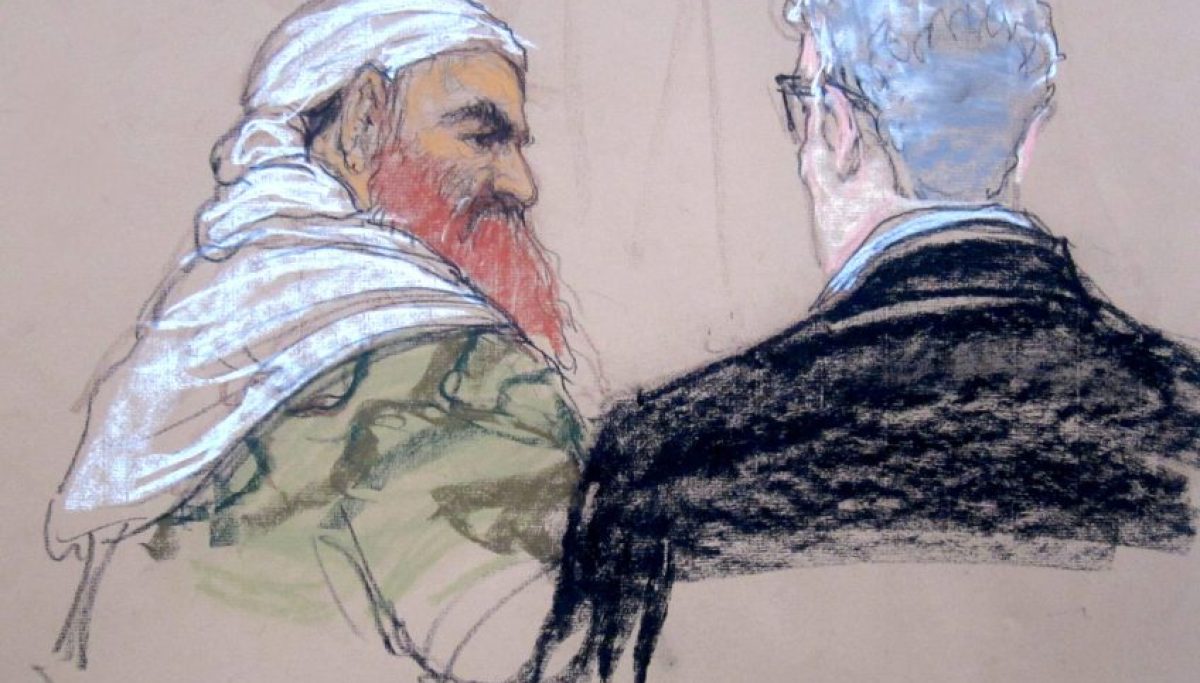
Weeks before the 25th anniversary of the Sept. 11, 2001, terrorist attacks, a military judge excluded accused mastermind Khalid Sheikh Mohammed’s statements to FBI agents, finding that prosecutors had failed to establish they were voluntary following his torture in CIA custody.The ruling in Mohammed’s case, with a trial scheduled to begin June 5, 2028, underpins the legal battles the government faces in trying to prosecute the individuals charged in connection with the attack. Mohammed, known as KSM, was captured by the CIA in March 2003 during a raid on a home near Pakistan’s capital, Islamabad.“The prosecution has failed to prove by a preponderance of the evidence that Mr. Mohammad’s statements to the F.B.I. were voluntarily given,” Air Force Lt. Col. Michael Schrama wrote in the conclusion of his 45-page ruling on Aug. 28. The statements at issue were made to FBI agents in 2007, after Mohammed had been transferred from CIA custody to Guantanamo Bay. The more recent legal dispute had centered on whether the effects of his earlier torture continued to undermine his ability to speak voluntarily. Mohammed was subjected to 183 applications of waterboarding while in CIA custody, according to the Senate Intelligence Committee’s 2014 report.Prosecutors in recent days decided, for the sake of keeping the current summer 2028 trial schedule on track, not to appeal that decision.“An appeal could jeopardize the hard-earned June 5, 2028, trial date,” the prosecution team’s liaison to victims wrote in a letter Friday informing families of those killed in the 9/11 attacks.Families still waiting for accountability For Brett Eagleson, whose late father had been working on the 17th floor of the World Trade Center on the day of the attacks, the delayed justice has left him wondering whether the country is still fighting to ensure the best accountability for victims still waiting all these years later.Brett Eagleson, 40, president of 9/11 Justice, speaks alongside other family members of those lost on 9/11 during a press conference outside the Saudi Consulate in New York, demanding accountability regarding the Kingdom of Saudi Arabia’s role in the Sept. 11, 2001, terrorist attacks, Tuesday, Sept. 8, 2026. (Adam Gray/AP Photo) “Since day one, everything about the post-9/11 response by the U.S. government has been botched, and it started with the decision to bring some of these detainees to black sites and torture them,” Eagleson, president of the 9/11 Justice organization, told the Washington Examiner. “I think that the American government at the time was more concerned about preventing the next attack than they were about future justice and accountability.”Former federal prosecutor Andrew McCarthy, who handled terrorism cases before 9/11, argued that the government’s shift toward fighting a war after the attacks came with consequences for eventual prosecutions.“When you make a decision, which the Bush administration and particularly the intelligence agencies did, to use coercive interrogation tactics for war purposes, what you’re saying is we have to prioritize the collection of intelligence to protect lives, and we’re going to worry about that more than we’re going to worry about due process for people in their ultimate trials,” McCarthy told Fox News’s Shannon Bream on Sunday.McCarthy defended that priority but said the government could not avoid the resulting limits on evidence. “So the problem they’re having is they want to have a regular American trial, but they want to use evidence that we would never let in a regular American trial, and that’s been the quandary for them from the beginning,” he said.Eagleson was 15 when his father, Bruce, was killed. Twenty-five years later, it remains his mission to get the full story out about who was involved in and had knowledge of the attacks.Was the intelligence worth the trade-off? Retired Marine Maj. Gen. Michael Lehnert, who commanded the task force overseeing detainee operations when the first prisoners arrived at Guantanamo Bay in 2002, has criticized the decisions behind the interrogation policies adopted after the attacks.“We also had the mistaken belief that we would get that information through torture, and I’m not going to polish up the words when using enhanced interrogation techniques or anything else. What was proposed was torture,” Lehnert told the Washington Examiner. “I love my country. I just wish that they would, at times, behave better. And when I say behave better, I’m talking about our elected leaders, who sometimes make policies without regard for the Constitution that they took an oath to.”John Yoo, the former Justice Department official who helped write the Bush administration’s legal opinions on interrogation and torture, remains unapologetic about the administration’s approach in a separate interview with the Washington Examiner, arguing that officials were confronting an enemy that required a different intelligence strategy.In this Thursday, June 26, 2008, file photo, John Yoo, a law professor at the University of California at Berkeley, testifies on Capitol Hill in Washington. An appeals court said Wednesday, May 2, 2012, that a former senior Department of Justice lawyer who wrote the so-called “torture memos” authorizing harsh treatment of suspected terrorists is protected from lawsuits. The 9th U.S. Circuit Court of Appeals tossed out a convicted terrorist’s lawsuit filed against John Yoo. Yoo wrote memos on interrogation, detention, and presidential powers for the Department of Justice’s Office of Legal Counsel from 2001 to 2003. (Susan Walsh/AP Photo, File) “In that kind of war, information is the primary commodity — is the most valuable weapon,” Yoo said of his time as head of the DOJ’s Office of Legal Counsel. “And to get that, we had to use aggressive interrogation methods against an enemy, again, that refused to obey any of the rules of civilized warfare.”Asked about criticism of the interrogation policies, Yoo argued that assessments of the administration’s decisions should account for the threat officials believed they faced after 9/11. He credited intelligence operations with weakening al Qaeda and preventing another attack on a comparable scale.“I think the Bush administration, for the most part, got the balance between the government and civil liberties right,” Yoo said.The effectiveness of the CIA’s interrogation methods remains disputed. The Senate Intelligence Committee’s 2014 study concluded that the techniques were ineffective at obtaining accurate information or securing detainees’ cooperation, and that the CIA overstated its contribution to counterterrorism successes.Yoo defended the broader changes to national security policy after the attacks.“I think the reason why there haven’t been any similar attacks on the scale of 9/11 is not because our enemies haven’t tried to carry out more of them,” Yoo said. “It’s because we hardened our defenses and became more effective at stopping attacks and also taking the fight abroad to terrorist networks.”Questions emerged quickly inside the Bush administration But questions about the legal foundations of those interrogation policies quickly arose inside the Bush administration soon after Yoo’s departure. Jack Goldsmith, who took over the DOJ’s Office of Legal Counsel in 2003, described his concerns in his 2007 memoir, The Terror Presidency: Law and Judgment Inside the Bush Administration.“The administration’s aim was to go right to the edge of what the torture law prohibited, to exploit every conceivable loophole in order to do everything legally possible to uncover information that might stop an attack,” Goldsmith wrote.Goldsmith acknowledged that senior officials had more information about terrorist threats than he did and would bear responsibility if another attack followed a decision to forgo aggressive measures. But he distinguished those policy judgments from his responsibility as a government lawyer.“But ultimately my role as the head of OLC was not to decide whether these policies were wise,” he wrote. “It was to make sure that the policies were implemented lawfully.”Goldsmith recalled deciding in December 2003 that two interrogation opinions needed to be withdrawn, corrected, and replaced, before he knew of interrogation abuses.He criticized their treatment of presidential power as resting on “cursory and one-sided legal arguments” that failed to consider Congress’s wartime authority and Supreme Court decisions adequately.His account places the internal doubts about the legal reasoning more than two decades before the latest dispute over Mohammed’s statements.The challenges of turning war into an American trial Another factor that has made prosecutions difficult, Lehnert said, is that the military was not specifically trained for or told to gather evidence while on the battlefield in Afghanistan and subsequently Iraq, which could have been helpful for future legal proceedings.Rep. Tom Barrett (R-MI) served in the Army for more than 20 years and spent a little under a year deployed to Guantanamo Bay in 2004, where “most of my time, probably 80% of my time, was spent as a block sergeant on the actual cell blocks for a shift,” he said.“I think the legal process has to go forward,” Barrett told the Washington Examiner. “Now, there are going to be some that are almost impossible to adjudicate through traditional legal processes, given the complexity and challenges of chain of custody and battlefield dynamics, and all of those other things, I believe that we have to make sure that anyone remaining in Guantanamo Bay before they are released would not present a threat to the United States any longer.”MAMDANI RELEASES THOUSANDS OF 9/11 AIR QUALITY RECORDS, CLAIMING OFFICIALS ‘LIED’ ABOUT HEALTH RISKSBarrett was serving at Guantanamo Bay when the Abu Ghraib scandal broke, which he said affected oversight at the U.S. facility in Cuba. In April 2004, CBS’s 60 Minutes II broadcast photographs of prisoner abuse at Abu Ghraib, a prison outside Baghdad used by U.S. forces after the invasion of Iraq.“We absolutely have to have lessons learned, and I think that we need to always apply our best knowledge going forward,” Barrett said.
CIA torture casts shadow over 9/11 prosecution 25 years later
Full Article
Original Source
Read the full article at Washingtonexaminer →KhanList aggregates and links to publicly available news content. We do not host full articles from third-party sources. Always verify important information with original sources.