
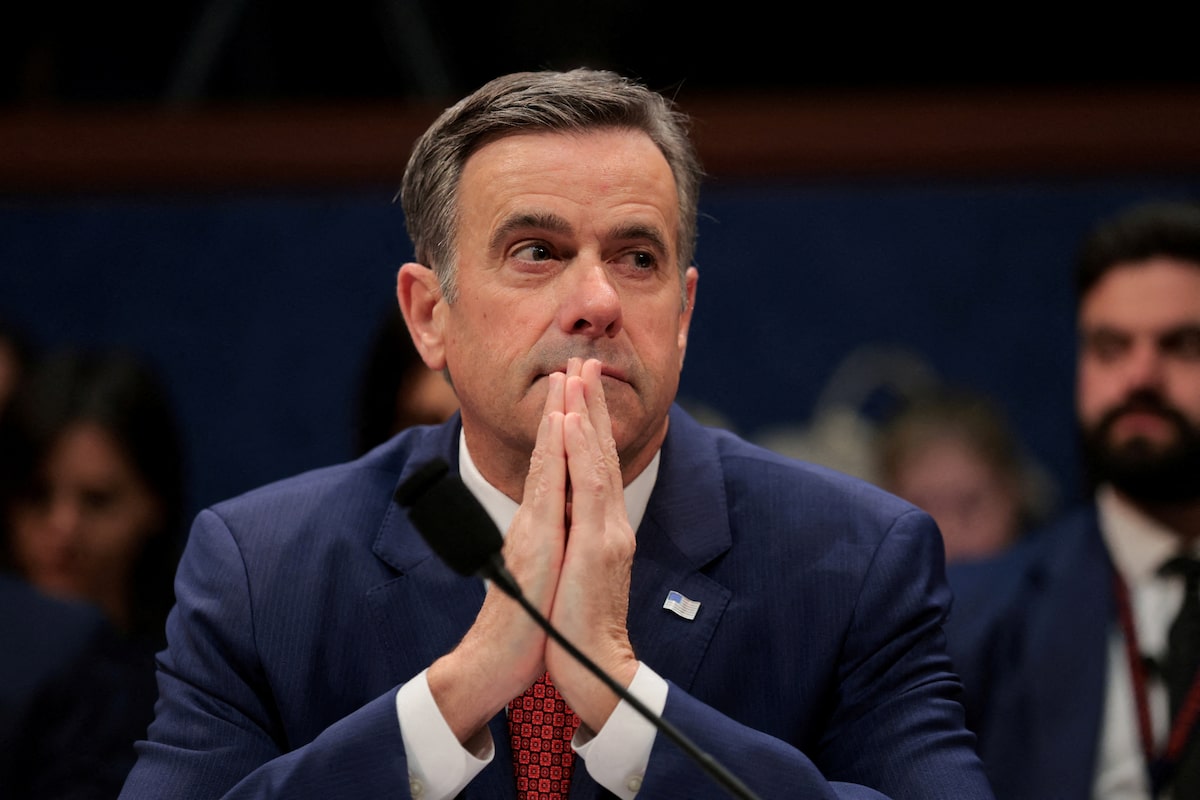
Open this photo in gallery:CIA director John Ratcliffe rushed to Moscow this week for an almost-secret, face-to-face meeting with his top Russian counterparts.Kylie Cooper/ReutersAt first glance, it seems far-fetched: Russian President Vladimir Putin, whose army is already bogged down in Ukraine, is contemplating a direct assault on NATO. The possibility is considered real enough, at least in U.S. intelligence circles, that CIA director John Ratcliffe rushed to Moscow this week for an almost-secret, face-to-face meeting with his top Russian counterparts.It was the first such trip by a senior U.S. official (not counting visits by President Donald Trump’s personal envoys, Steven Witkoff and Jared Kushner) since then-CIA director William Burns travelled to Moscow in November 2021 to try to warn Mr. Putin off the invasion of Ukraine. Russian troops began their full-scale assault on Ukraine three months later.This time, Mr. Ratcliffe’s visit came less than three weeks after the Wall Street Journal reported that U.S. intelligence officials believed Russia was contemplating “a limited assault” on a NATO country in order to test the unity of the 32-member alliance.While the reasons for Mr. Ratcliffe’s trip were initially shrouded in secrecy, details have since dribbled out via U.S. media reports suggesting the CIA boss was sent to Moscow to warn the Kremlin not to test the U.S. commitment to Article 5 of the NATO Treaty, which commits the entire alliance to defend against an attack on any individual member. Some reports have suggested that Mr. Ratcliffe was also tasked with trying to revive negotiations on a peace deal in Ukraine, and to try to convince Moscow to abandon its long-standing support for Iran.None of those versions explained why Mr. Ratcliffe chose this week to travel to Moscow aboard an unmarked C-17 military plane for a visit that lasted a matter of hours. Nor did Mr. Ratcliffe meet directly with Mr. Putin, instead communicating his message via Russia’s own spy chiefs, Sergey Naryshkin and Alexander Bortnikov.As in 2021, the CIA is worried that Mr. Putin is about to launch a new war. This time, the target is believed to be either Poland or one or more of the Baltic states of Estonia, Latvia and Lithuania. All four countries sit on the eastern edge of NATO, an alliance Mr. Trump has publicly questioned the utility of.Left unsaid in the U.S. media reports is why Mr. Putin would seek to widen a conflict that he’s already arguably losing. With nearly all of the Russian military bogged down in Ukraine, the Kremlin lacks the troops and equipment to try to grab more territory in the Baltic states.But from Mr. Putin’s perspective, the war has already been widened, with Ukraine using British-made Storm Shadow cruise missiles to strike targets deep inside Russia. The Baltic states have also allowed Ukrainian drones to fly through their airspace on their way to targets in and around Russia’s second city of St. Petersburg.Moscow has repeatedly warned in recent weeks that it could strike at sites in Europe and beyond that it views as de facto participants in the war. Now Mr. Ratcliffe appears to have delivered a warning of his own.Analysts say the possibility of a Russian escalation against one or more of the Baltic states is real enough that Mr. Ratcliffe’s mission would be welcomed as a sign that the U.S. remains committed to NATO even as Mr. Trump has created concerns about the future of the alliance. U.S. Secretary of War Pete Hegseth has launched a review that is expected to culminate later this year with a major drawdown in the number of American troops stationed in Europe.“In fact, European countries are already taking part in the war against Russia, and Donald Trump is probably afraid of a strong Russian response,” said Sergey Markov, a Moscow-based political scientist and former Kremlin adviser. While Russia doesn’t have the military capability, at the moment, to launch a full-scale attack on NATO, it could seek to test the alliance’s unity through a limited campaign of drone strikes against targets it accuses of being involved in the war in Ukraine, or by staging a pro-Russian “uprising” in one of the Russian-speaking areas of the Baltics.Alexey Eremenko, associate director of Control Risks, a London-based security consultancy, said Moscow’s aim would be to force European countries to scale back their military assistance to Ukraine in order to deal with the threat of a direct confrontation with Russia.“I would say that the Kremlin is not decided yet. They are definitely considering the option, but they have not yet committed to it,” Mr. Eremenko said. “And in that sense, Ratcliffe’s visit, whatever brought it, would still be a deterrent. Because hopefully he would have communicated that NATO is aware of this and is planning a proper response, a tit-for-tat response. That they will not let it slide.”Inside Russia, little was said about the trip, leaving even seasoned observers waiting for the U.S. side to leak details about why Mr. Trump and Mr. Putin decided that their spy chiefs needed to have a face-to-face conversation. The semicovert nature of the meeting – made public only because the C-17 was spotted on plane-tracking apps – was almost as noteworthy as the fact that it happened at all.“The fact that they did not explain what was happening actually drew more attention to it and made it look more suspicious,” said Keir Giles, a Russia specialist at Chatham House, a London-based international affairs think tank. “It makes people think that there is something underhanded going on,” he said, adding that some in Europe are worried that the White House might be offering concessions on Ukraine in exchange for the Kremlin’s help isolating Iran.Back in 2021, Mr. Burns returned from his visit to Moscow, went straight to the White House, and told President Joe Biden that a Russian invasion of Ukraine was likely.What’s not yet known is what Mr. Ratcliffe told Mr. Trump after his own hurried trip to Moscow.
CIA director’s visit to Moscow signals real concern in intelligence circles Putin might widen war
Full Article
Original Source
Read the full article at Theglobeandmail →KhanList aggregates and links to publicly available news content. We do not host full articles from third-party sources. Always verify important information with original sources.