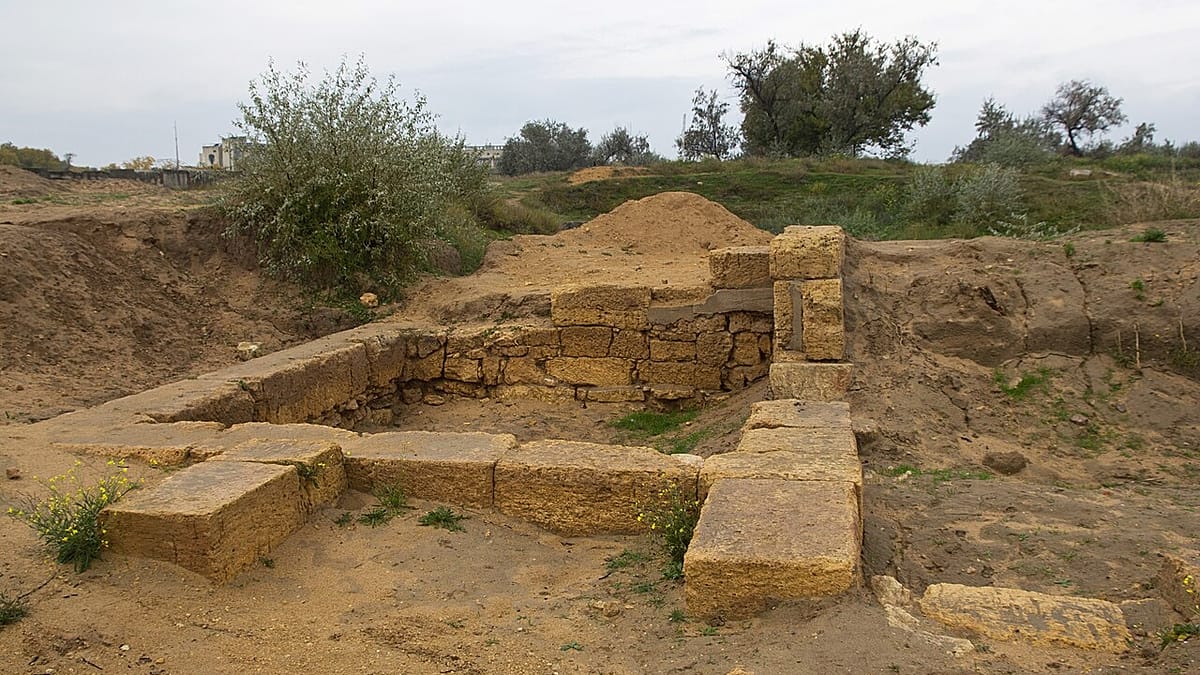
A hill in the north-west of Murcia is forcing historians to rethink some of the most entrenched ideas about the early centuries of Al-Andalus. Excavations on the Cerro de la Virgen de Calasparra have brought to light an early Christian church that not only survived the Muslim conquest of 713, but remained in use for almost two further centuries. ADVERTISEMENT ADVERTISEMENT The study (source in Spanish), published in the scientific journal "Salduie" by researchers David Martínez and Rubén Fernández, documents the existence of a temple founded around the first half of the 5th century that appears to have retained its religious function at least until the 9th century. If this chronology is fully confirmed, it would amount to one of the strongest pieces of evidence for the continuity of Christian worship in the Iberian Peninsula during the early years of Moorish occupation. The church was identified thanks to several survey and excavation campaigns carried out in the area since 2021. Archaeologists describe it as a single-nave building with a tripartite chancel, a layout they consider characteristic of certain "late antique" temples. "This represents an architectural model with notable parallels in Visigothic churches such as Santa Cristina de Lena," the authors of the study point out, referring to this church in Asturias. They also note that the sacristies and apses show similarities with some "parish and episcopal" churches in Syria, a connection that reflects the use of similar architectural models in the Mediterranean during Late Antiquity. Much more than a question of timing Radiocarbon dating places the construction of the building between AD 410 and 440. This is supported by ceramic and stratigraphic analyses that back the hypothesis of prolonged occupation of the site. The site had already attracted researchers' attention in earlier campaigns, when a unique early Christian bronze lamp in the shape of a eucharistic dove was unearthed, at the time considered an exceptional piece in the European context. However, the most significant aspect of the new study is not the age of the temple, but its survival as such after the Muslim conquest of the Peninsula. Traditionally, many historical accounts have portrayed the arrival of Moorish troops in the early 8th century as a relatively sharp break with Visigothic traditions. The Calasparra finds, by contrast, sketch a more complex reality. The researchers argue that there is no evidence that the church was converted into a mosque, or that it immediately lost its religious function. In fact, they state that "the record, which includes storage vessels and cooking pottery, should not be understood as evidence of the desacralisation of the temple or its conversion into Islamic dwellings", the study reads. "On the contrary, these materials should be analysed as indicators of the continued use of the space in community practices that encompassed both worship and resource management," they argue. This reading is reinforced by the central conclusion of the paper: "The typological and stratigraphic study of the ceramics points to the continued liturgical role of the church well into the 9th century." The research also places this phenomenon in the context of the kūra of Tudmīr, the administrative unit that emerged after the pact signed in 713 between the Muslim authorities and the Visigothic noble Teodomiro. That agreement allowed numerous Christian communities to retain for a time parts of their political, religious and economic structures in exchange for paying taxes. Taxation itself is another key to the site. Among the materials recovered are scales, weights and other objects linked to economic control and the collection of taxes. One of these weights even bears an Arabic inscription which translates as "justice is God's". Christian belief, Muslim taxes The presence of these objects shows that the Cerro de la Virgen played a role that went far beyond the purely religious. Its strategic position, overlooking major communication routes and surrounding agricultural resources, turned it into a hub of territorial and economic organisation. In other words, the Christian community that used the church also took part in the fiscal machinery of the new Andalusi power. The authors sum up this situation with a blunt statement: "The hill was a Christian community subject to the taxes of the Islamic state and forced to integrate into regional fiscal and commercial circuits." For the researchers, the Calasparra case helps shed light on how the Islamisation of peninsular society actually took place. Far from an immediate replacement of populations or institutions, the process appears to have been marked by decades of adaptation, coexistence and gradual transformation. According to them, the Christian population "found itself progressively trapped between two converging dynamics: on the one hand, the growing capacity of the Andalusi state to reorganise territory and ensure fiscal extraction; on the other, Islamisation also operated as a pathway to social and legal accommodation." The study concludes that the disappearance of these Christian communities was not necessarily the result of episodes of destruction or expulsion by the Moors, but of a slow process of integration into the new Andalusi society. "The ecclesiastical hierarchy was unable to uphold the advantageous agreements reached at the time of the conquest, while growing centralisation, fiscal efficiency and the urban pull of Córdoba eroded the productive base of churches, monasteries and Christian elites," Martínez and Fernández state in their study. More than thirteen centuries on, the ruins of the Cerro de la Virgen thus offer a new window onto one of the most decisive periods in the history of the Iberian Peninsula. And they suggest that the transition between the Visigothic world and Al-Andalus was, at least in some areas, far more gradual, negotiated and complex than has long been assumed.
Church reshapes Spain's history: did Muslims and Christians once live together in peace?
Full Article
Original Source
Read the full article at Euronews →KhanList aggregates and links to publicly available news content. We do not host full articles from third-party sources. Always verify important information with original sources.