
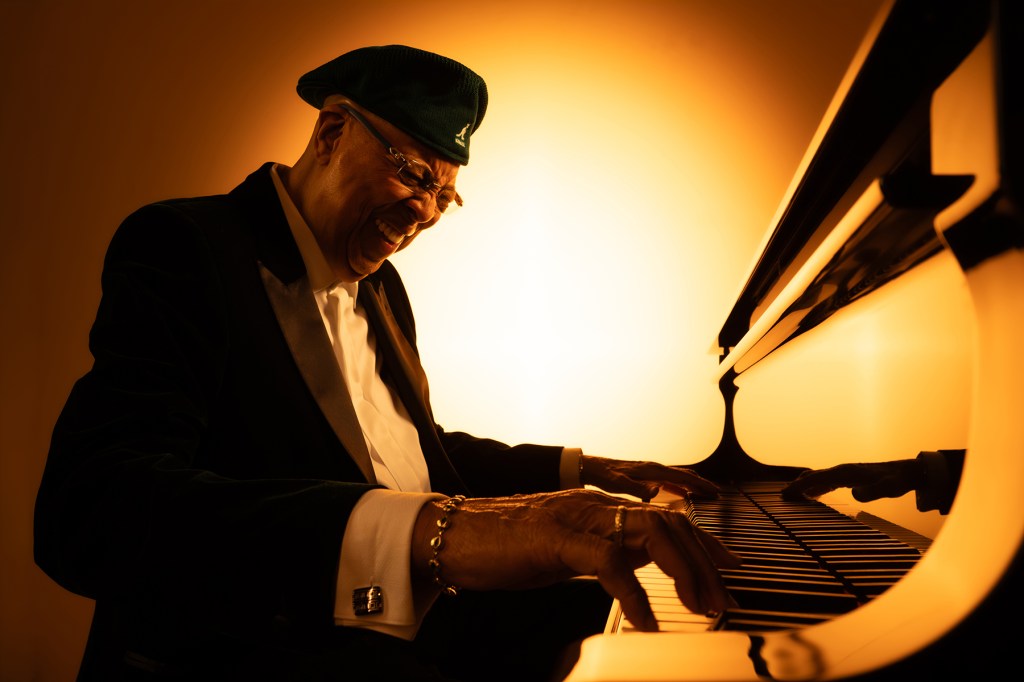
Trending on Billboard Chucho Valdés celebrated his 85th birthday on Oct. 9 with a party at his house (replete with musicians, of course); with a series of concerts across the U.S. during which he played both solo and with an ensemble featuring jazz notables like saxophonist Joe Lovano, bassist John Patitucci, drummer Marcus Gilmore and percussionist Roberto Jr. Vizcaino Torre; and with a solo album, UNCUT, released prior to his big day. Explore See latest videos, charts and news The album was a particularly oversized achievement for Valdés, a towering musical figure with a towering height (6-foot-5) to match. UNCUT — released on indie InnerJazz (part of InnerCat Music, Valdés’ label since the early 2000s) — is an eight-track set recorded completely live by Valdés on his favorite Steinway grand, with no cuts, no edits and no second takes. It’s the kind of exercise in musicianship, inspiration and joy that’s allowed Valdés to remain an essential figure in both the jazz and Latin music worlds; a man whose music spans countries, generations and genres. Reaching back to his origins as the son of another legendary pianist, Bebo Valdés, Chucho has traversed the musical world from classical to experimental jazz, famously creating Cuban experimental group Irakere alongside Paquito D’Rivera and Arturo Sandoval, then launching into other realms with abandon, collecting seven Grammys and seven Latin Grammys along the way. “Imagine. The piano is the soundtrack of my entire life. I was born listening to it and then I learned it,” says Valdés today. In celebration of his monumental year and his 85th birthday, Valdés spoke with Billboard. To what do you attribute the fact that you can still tour, write and compose at 85 years old? I really think it’s because of my passion for learning. Also, the thrill of sharing and connecting with the audience that’s listening. The healthy ambition to create different things, being in love with the piano and with music. It makes you feel like there’s no such thing as age in this sense. It’s incredible. It’s as if you’re still young. UNCUT is not your first solo piano album? I have others. But it had been a long time since I made a solo piano album, and this one was truly improvised. I just sat down to play whatever came to mind. But yes, I’ve done a solo album before. Once, back in 1986, I was traveling from Germany to Austria, and they proposed I do an album, but there was a catch: there was a flight that left at 1 p.m., and the time from the studio to the airport was an hour. So I had one hour to record, from 11 a.m. to 12 p.m. I said, “I’m not sure this is going to work,” but it worked out. It’s called “Lukumí?” What’s your earliest memory of the piano? My first memory of the piano is from when I was very, very, very small—since I can remember. Seeing my father sitting and playing Lecuona, but also playing jazz. And to me, it seemed impossible to do because I was a five-year-old kid. Was there ever a moment when you didn’t want to be a pianist? No. Always, always, my dream was to learn how to play the piano. Inspired by my father, but also because of myself. I wanted to be a pianist. If you didn’t play the piano, what instrument would you play? I think I would play the double bass or the cello. The cello because it sings so beautifully. To me, it’s the most expressive instrument. What do you feel most comfortable with: jazz, classical music or Latin jazz? I swear, listen carefully, I swear. It’s just sitting at the piano without a plan, without premeditation, and starting to play whatever comes to mind in the moment. That’s the thing that gives me the most joy. What has jazz taught you that classical music or Cuban music hasn’t? They’re different things. Cuban music is very rich in rhythms. Years ago, it was extremely rich in rhythm, but it was somewhat limited harmonically. The rhythm of Cuban and Afro-Cuban music was rich, but the harmony of the tumbaos [repeating piano patterns] was quite simple. It was beautiful but a bit limited. Jazz, on the other hand, offered a much richer harmonic field and a much broader harmonic landscape. As I started to mature, what I did was mix the two: adding jazz-influenced harmonies to Cuban music and mambo. What does the piano mean to you? Imagine. Ayayay. The piano is the soundtrack of my whole life. Because I was born listening to it, then I learned it, went to the conservatory, and fell in love with classical music. There are so many geniuses, but there are some who touched me deeply. I’m in love with Bach, Mozart, and Beethoven, but the Romantic period with Chopin touched me a lot, a lot, a lot. And other classical composers like Schubert and Schumann. But Impressionism, the era of Ravel and Debussy, was another musical period that I loved. And when we arrive at the Neo-Romantics, Rachmaninoff is my life. That concerto [the gods] was written by the gods. It’s a beauty. Do you practice every day? Yes. When I’m at home and with my family, I have about three sessions. One after breakfast, one at noon, and the one I enjoy the most is at night, when no TVs are on and there’s peace and quiet. But whenever I can, I sit down and play, and I enjoy it. When you love that instrument, time doesn’t exist. Your wife is a percussionist. Was it important to have another musician by your side? I think so. Because there’s human communication between partners, but also, when it becomes a connection, she can understand what I want and what I’m doing. So we share better. My son started with the piano, then the guitar, then the flute, and then singing. But when he started playing percussion, that’s when he found his path. You just finished your solo piano album and a tour with a jazz trio. Those are very different formats. How do you prepare for each one? That’s something else. They are such, such different worlds. When you’re alone, you’re free from everything. You just have to start playing whatever comes to mind. When you’re in a trio, you’re accompanied by a bassist and a drummer, and you have to think differently. You have to think about how to create a teamwork dynamic, where we’re speaking the same language and giving space to the other musicians. At this point in my life, it comes automatically because I’ve done it so many times. But it’s not the same. It’s the same as playing with a big band. In a big band, the piano is a supporting instrument. You have to add details exactly where they won’t interfere with the band. I learned that from my father and from the orchestras I played in back in Cuba. Every world is different. But sitting there alone, I’m on cloud nine. What’s left for you to do? Right now, I’m working on a symphonic project. I already have a repertoire, but I’m going to enrich it. For example, my version of ‘Mozart a la cubana’ is being expanded for a full orchestra. It’s Cuban Mozart, but suddenly it turns into something rhythmic, while still respecting the melody. I have something so beautiful, which is Gabriel Fauré’s “Pavane.” Ayayaya, I love it so much. Fauré came before Debussy, but he was already entering the realm of Impressionism. There’s such a beautiful part, and every time I play it, there’s a standing ovation at the end. Always, always. So I’m going to include that. When you’re not inspired, where do you go? Sometimes the piano and I kind of fight. Because sometimes I say, I’m over-practicing, and I don’t want to play it. And it says to me, “Fine, don’t play me.” And sometimes I’ll go three days like that. But when I sit down again, it makes me pay for it – without mercy. One finger over here, another finger over there. What do you think when people call you a genius? I’m not a genius at all. I’m just a person who loves music and was raised with a sense of respect and always learning something new. And if that results in someone thinking that it’s genius, I love it. In a life full of memorable moments, what’s the one that’s most engraved in your memory? Let me tell you. We were in Cuba in 1978, and leaving Cuba was practically impossible for a Cuban jazz group. Our dream was to meet the great jazz artists, but to meet them personally… And we were lucky in 1978 to get a contract with Columbia, and our debut in the United States was on June 25, 1978, at Carnegie Hall. It was the first time a Cuban jazz group played at a jazz festival in the United States. And two of the jazz pianists I was obsessed with performed there: Bill Evans and McCoy Tyner, as well as a lady who was an expert in blues, Mary Lou Williams. That was a moment I will never forget. It had been 18 years since I had seen my father because he lived in Sweden, and I couldn’t go to the United States. But my father flew from Sweden to New York, and I knew he was in the audience. And after that concert, we hugged for an hour and cried and kissed. That was the greatest moment of my life. I was 19 years old when my father left. And the emotion of knowing he flew from Sweden, and I was playing but didn’t know where he was sitting, was something incredible. The dream of my life. What do you spend too much money on? I’m not going to lie. I buy a lot of information. I buy a lot of music books, of course. But the truth is, I spend all my money on clothes. I love it. Louis Vuitton, Gucci, Robert Graham. I have a collection of shirts. Who, alive or dead, would you like to share a bottle of wine with? With Bill Evans. He often brings me to tears. He was such an emotional, sincere pianist. Wow. I was lucky that day in Carnegie Hall, I met Bill Evans, and when they told me, “This man wants to meet you,” and he reached out his hand, I hugged him crying and told him that I listened to him all the time. He was and still is my favorite pianist. What’s your most prized possession? The piano. The piano is my life.
Chucho Valdés Turns 85 & Keeps Rocking His 88 Keys
Full Article
Original Source
Read the full article at Billboard →KhanList aggregates and links to publicly available news content. We do not host full articles from third-party sources. Always verify important information with original sources.