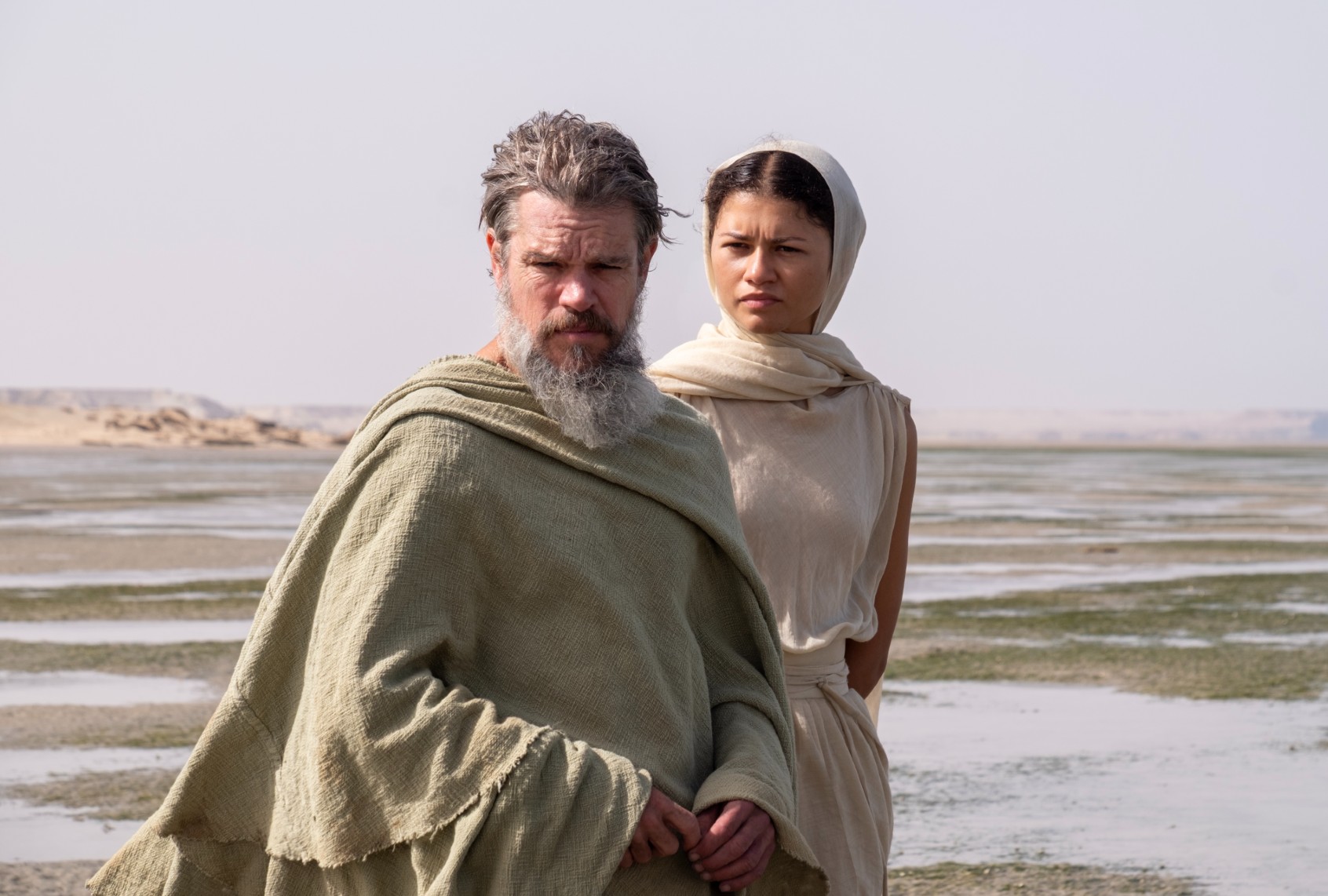
commentary The blockbuster director's latest exercise in cinematic spectacle makes Homer feel hollow Published July 18, 2026 12:00PM (EDT) Matt Damon as Odysseus and Zendaya as Athena in "The Odyssey" (Melinda Sue Gordon/Universal) Throughout all three hours of Christopher Nolan’s “The Odyssey” — the acclaimed writer-director’s take on the ancient Greek epic attributed to Homer — I repeatedly returned to one question. This isn’t entirely atypical. In the past, Nolan’s films have pushed me to ponder ideas both enormous and infinitesimal; much of his work ricochets across this spectrum at a dizzying rate, which is part of why his movies, though always grand in scale, feel different from your typical blockbuster fare. Unlike many of his contemporaries working in the big-budget space, Nolan has no affection for the slow build. His films are designed to be all-consuming experiences, opening in media res, grabbing the viewer by the ankle and dragging them into action already in progress. This technique also makes them difficult to refute based on feeling alone. When you’re swept up into the story immediately and held there for 180 minutes, it’s harder to pinpoint exactly where the film ends and your own impression of it begins. With its exhaustive narrative breadth and action set pieces that only a budget of a cool $250 million could afford, the fact that “The Odyssey” exists at all is intended to feel like a miracle. But that’s precisely why I couldn’t seem to shake that one nagging question: What’s the point of all this? I mean, I know the point. The point is to dazzle. The point is to convey cinema’s great power. The point is to remind us that there is no filmmaker working today other than Christopher Nolan who can make a movie of this size. (Melinda Sue Gordon/Universal) Mia Goth as Melantho and Anne Hathaway as Penelope in “The Odyssey” Fresh from his latest victory, Nolan reaches for the stars and grazes the Gods. His determination may be admirable, but the sheer, futile arrogance of such a display backfires in equally spectacular fashion. But do any of those things warrant “The Odyssey”? Nolan, fresh off the success of “Oppenheimer” — a historical biopic about the father of the atomic bomb that became a runaway hit, generating nearly a billion dollars and seven Oscar wins — had a blank check waiting on his doorstep upon returning home from Oscar night. He could conceivably do whatever he liked, go in whichever direction he pleased. And yet, Nolan returned to Homer’s poem, the structural basis of almost all storytelling throughout human record, which, if you break it down more acutely, includes Nolan’s filmography. Want more from culture than just the latest trend? The Swell highlights art made to last. Sign up here Nolan has called the lack of mainstream adaptations of the work a “curious gap in Hollywood history.” But I’d argue the lack of “Odyssey” films partially stems from the fact that the text speaks for itself. Pursuing an adaptation of this caliber feels like a losing battle, something a filmmaker does just to prove that they can. Without any noteworthy changes that give the source material unexpected new meaning — significance you could only get in a movie theater, and not from the story or any of its scholarly interpretations — that air of self-importance quickly turns to a sour funk. In an ironic twist, Nolan’s own ambition in adapting “The Odyssey” looks something like Odysseus’. Fresh from his latest victory, Nolan reaches for the stars and grazes the Gods. His determination may be admirable, but the sheer, futile arrogance of such a display backfires in equally spectacular fashion. None of this is to say that there isn’t merit in a filmmaker, particularly one of Nolan’s stature, wanting to explore their artistic desires. But that’s also why “The Odyssey” is such a keen disappointment. Someone like Nolan — who has passed just about every bar there is to pass, raised that bar, and then passed it again — probing his ambition within the context of a work as substantial as “The Odyssey” should prove to be compelling in its own right. To use a recent example operating on a similar blockbuster scale, Steven Spielberg’s “Disclosure Day” did this particularly well, assessing humanity and movies together against the backdrop of Spielberg’s favorite themes. One could enjoy “Disclosure Day” as a solitary experience, or measure it against Spielberg’s body of work to explore an even deeper meaning. Sure, one might argue that in “The Odyssey,” Nolan is studying his own hubris, accepting the innate faults that come with bringing Homer to the big screen. But I don’t think Nolan understands that’s what’s happening here, and that’s because his “Odyssey” doesn’t have anything new to say about the original text or his beliefs as a filmmaker. If anything, “The Odyssey” only waters down every artistic statement Nolan has already posed. (Melinda Sue Gordon/Universal) Robert Pattinson as Antinous in “The Odyssey” Like Homer’s poem, Nolan’s “The Odyssey” is told nonlinearly, scattered between the perspectives of Odysseus (Matt Damon), his wife Penelope (Anne Hathaway) and their son, Telemachus (Tom Holland). Ten years after the fall of Troy, Odysseus still hasn’t returned home to Ithaca, and his kingdom has been overtaken by suitors crudely courting his wife’s hand. As their impatience grows, the window for Odysseus to reclaim his kingdom and restore a crumbling world to Zeus’ law — essentially open-hearted hospitality and treating others as you’d be treated — is closing. As Telemachus travels to seek news of his father’s whereabouts, or if he’s even alive, Odysseus recounts his story to the island nymph, Calypso (Charlize Theron): The bloody Trojan War, a cyclops, a sea witch, dalliances with the dead, sirens, and a crew of impatient men. Nolan makes only a handful of changes to the translations of the original text. Instead of Gods like Poseidon and Zeus playing an integral role in the story, they are left as unseen forces that motivate the characters’ actions. (Every 40 minutes or so, Zendaya appears to Odysseus as the goddess Athena to spout some ethereal wisdom before disappearing, but Athena plays more like a postwar trauma manifestation than an actual character.) Characters speak with a more casual, modern dialect. And, perhaps most memorably significant, the Trojan Horse is discovered half-submerged on the beach, and not outside Troy’s gates on wheels. Nolan uses this adjustment to build out the film’s emotional throughline: an extended rumination on the evils of war and the repugnance of men. And while it’s a smart and novel twist on a colloquial metaphor that has almost come to precede Homer’s poem, Nolan’s Trojan Horse doesn’t inspire any reflections on war that weren’t addressed more directly and cleverly in “Oppenheimer.” (Melinda Sue Gordon/Universal) John Leguizamo as Eumaeus in “The Odyssey” Here, a filmmaker who managed to reach the peak of Olympus makes the prideful, ill-fated decision to hoist a ladder toward the stars, trying to get even higher, past where even the Gods can see. And truthfully, there’s dignity in that curiosity, in wanting to know if greatness is all there is. Every question “The Odyssey” poses has been asked dozens of times before by Nolan himself, and in far more interesting ways. Here, Nolan once again returns to his pet themes of playing God, human mistreatment, the passage of time, and bearing witness to the world’s slow, painful destruction. All of these things are surveyed with more thought and care in many of his other works, especially “Oppenheimer,” but also in “Interstellar,” “Tenet,” and even translated into the hyper-accessible superhero fare of his “Batman” films. Many great filmmakers are immersed in the same ideas, returning to them in one way or another with each film. But to do that with something like “The Odyssey” is unnecessary, even haughty. Nolan attempts to assert the text’s relevancy in our contemporary age, but that’s not something any scholar or even the average reader would contest. This is Homer, after all, famously the foundation of all great work. What’s perplexing is that Nolan’s said as much himself. So why try to tackle “The Odyssey” at all, if not only to — as Nolan also acknowledged — be one of the only loyal feature-length film adaptations in history, and have his name forever cemented in the same conversation as Homer’s? In the second act (that is, the second hour of the film’s three), Nolan gets close to revealing why. Tied to the mast of his ship as he and his crew pass the singing sirens, adorned on the jagged rocks at sea, Odysseus screams out with pain and desire. After the ship has made safe passage and the sirens’ voices have drifted into the air, Odysseus’ second-in-command, Eurylochus (Himesh Patel), asks him what he heard. Odysseus tells Eurylochus that their song contains everything he’s ever known and everything he never wanted to admit to himself. And, in a line of dialogue that will stick with me — one that shot straight to my heart faster than any of Nolan’s oft-repeated contemplations on war or morality — Odysseus says, “Their song told me that what you want the most is what you already had.” There’s no better summary of Nolan’s “The Odyssey.” Here, a filmmaker who managed to reach the peak of Olympus makes the prideful, ill-fated decision to hoist a ladder toward the stars, trying to get even higher, past where even the Gods can see. He knows there is no foundation to hold him, nothing to prop his steps against, but he tries anyway. And truthfully, there’s dignity in that curiosity, in wanting to know if greatness is all there is, or if there is something more that exists beyond what we can perceive. But both history and myth have proven that there’s no measuring up to the Gods. Related Topics ------------------------------------------ Related Articles
Christopher Nolan’s “The Odyssey” is pointless
Full Article
📰 Original Source
Read full article at Salon →KhanList aggregates and links to publicly available news content. We do not host full articles from third-party sources. Always verify important information with original sources.