
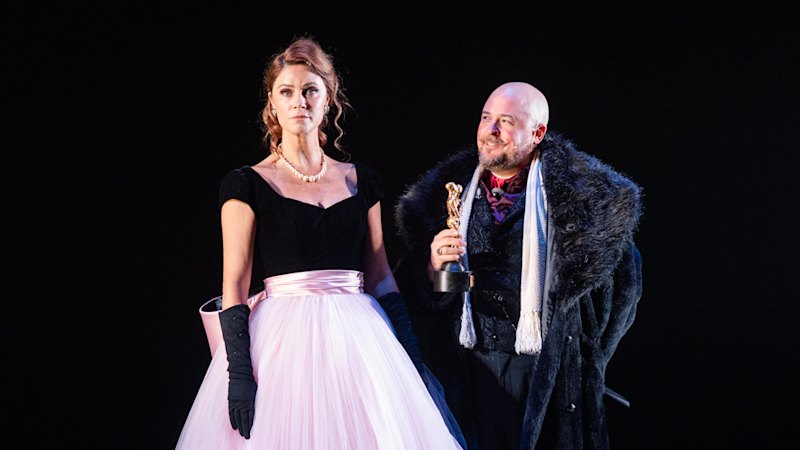
November 26, 2026 — 12:47pmTHEATREAll About Eve ★★★★Malthouse Theatre, until 12 December 12Originally a short story that also evolved into a radio play, All About Eve is best known for its multiple Academy Award-winning 1950 film incarnation, which starred Bette Davis as the brittle stage star Margo Channing, fighting for her place in the sun against a younger upstart, Eve Harrington, who waits impatiently in the shadows, scheming to usurp her mentor’s place.There’s a dark glamour in this sleek, stylish production of All About Eve.Charlie KinrossBased on Ivo Van Hove’s West End adaptation and directed by Dean Bryant, the major difference in this production is that Christie Whelan Browne plays both roles. It’s a bravura tactic that showcases her ability to switch back and forth from the perky 24-year-old newcomer desperate to break into show business to the experienced but jaded professional who’s already paid her dues to demanding theatre moguls.Not only does Browne have to consider voice and pitch changes, but also the nuances of posture and body control, and she manages the transitions superbly, moving seamlessly from meek, soft-spoken Eve to imperious, husky-voiced Margo.The story begins at an award ceremony celebrating Eve’s burgeoning career and then unspools to reveal how she reached such an elevated position.It’s a tale of how a bright-eyed ingenue inveigled herself into the world of a garlanded Broadway diva through the wife (Christina O’Neill) of a playwright (Kevin Hofbauer), and landed a job as a personal assistant, gaining access to the actor’s circle of friends and professional acquaintances.The role of the conniving rival is always interesting to watchCharlie KinrossThe role of the conniving rival is always interesting to watch, and there’s a certain fascination in seeing the measure of Eve’s ruthless ambition. She plays the long game. Margo is, in some ways, complicit in her downfall; her fragile ego feeds off the adulation of her adoring fan before too late realising she’d inadvertently invited a viper into her nest.As the night progresses, the psychological changes in Browne’s dual roles become evident: Eve’s growing impertinence and confidence, and Margo’s jealous unravelling. Having just recently celebrated her 40th birthday, she’s already insecure about her relationship with director Bill Simpson (Junior Nyong’o), who is eight years her junior.Browne is well served by her supporting cast, all of whom put in sterling performances: Brent Hill as the acerbic theatre critic whose oily influence makes him a good foil for Eve, Nyong’o as Margo’s supportive but exasperated partner, O’Neill and Hofbauer as the couple charmed and manipulated by Eve, and Tea Moma and Evelyn Krape, who play several characters, with the latter offering an ebullient portrayal of producer Max Fabian.The set and costumes fully lean into the ’50s aesthetic with its fabulous frocks and glittering surfaces, not just around the mirrored dressing room table but also the reflective floor and video inserts. There’s a dark glamour in this sleek, stylish production.In this age of Botox and Ozempic, it’s not difficult to be sympathetic to Margo’s plight to remain sexually and commercially viable.With its exploration of ageism and the objectification of women, and the tensions between emerging and established forever pertinent, All About Eve will resonate with a modern audience – particularly those in the creative industries who’ve tried to infiltrate what they believe is a tightly controlled, gate-kept arena, and alternatively, with any seasoned artist afraid of losing their hard-won position to an unscrupulous neophyte.Reviewed by Thuy OnDANCEPieces 2026 ★★★WXYZ Studios, North Melbourne, until November 28After stints at the Substation and UMAC, Lucy Guerin Inc’s Pieces has gone inhouse again, returning to the company’s studios. It puts the audience closer to the action, although the crowded rooms and ad hoc seating offer a lot less comfort than a theatre.Luke Currie-Richardson’s work was a highlight of this year’s Pieces. Gregory LorenzuttiLuke Currie-Richardson’s WHOdaU is the strongest of this year’s pieces. It begins with Currie-Richardson beneath a small spotlight, wearing a mask fringed with long, pale grass. Across one long studio wall, a projection shows an idyllic sandy coastline.His torso lists in lazy, liquid circles, movement sloshing in the ample bowl of his hips. Gradually, the oceanic rhythm is disturbed by sharp geometries and isolations, while the coastline glitches into glimpses of Flinders Street Station and other scenes of the city.The fragments of street dance are in their turn gradually absorbed into a rhythmic stomping and low, hunched shapes, a slick transition suggesting something of Currie-Richardson’s six years with Bangarra Dance Theatre.He stays within the narrow spotlight while panoramic images unfold behind. The relationship between body and projection is plain but effective: his dancing becomes a kinetic commentary, developing alongside the changing landscape without labouring its connections.In the smaller Studio Two, Helen Herbertson plays with packing paper, light and shadow,.Jeff BusbyMore emphatic dance figures emerge as he builds towards a final removal of the mask. It’s a strong finish: after so much movement without a visible face, the person comes momentarily into focus, giving gestural force to the work’s concern with visibility.In the smaller Studio Two, Helen Herbertson plays with packing paper, light and shadow, accompanied by quiet piano. A doily becomes a fascinator, a paper sheet becomes a cape, and scraps of text suggest little fairytale characters.Most intriguing is a paper hand attached to her own, its flatness warping as her arm bends. Every rustle and whisper registers, but the packed room feels airless: it’s a somewhat diffident experiment by this influential dance maker.In the final piece, Martin Hansen chops speech and movement into stuttering repetitions in a meandering dance-essay that begins with the concept of hypersea life: the idea that life carried the ocean inland within itself, as the circulatory system. It’s a work full of clever segues and transitions, from topic to topic. At times, however, it feels rather prosaic: Hansen pours in more words than can be managed effectively as choreography.Martin Hansen chops speech and movement into stuttering repetitions in a meandering dance-essay.Gregory LorenzuttiNonetheless, there’s an appealing urgency to this imbrication of movement and thought, even though it’s quite loose. His longing for a paradise that is right now, already with us, under our very feet if we could only see it, is effectively communicated.This is Guerin’s last Pieces before Melanie Lane takes over as company artistic director next year. The showcase deserves to continue, but a return to the old 10-minute commissions might sharpen its focus, especially if it remains in the studios.Reviewed by Andrew FuhrmannThe Booklist is a weekly newsletter for book lovers from Jason Steger. Get it delivered every Friday.From our partners
Christie Whelan Browne plays both ingenue and fading starlet in this sharp tale of rivalry
Full Article
Original Source
Read the full article at Smh →KhanList aggregates and links to publicly available news content. We do not host full articles from third-party sources. Always verify important information with original sources.