
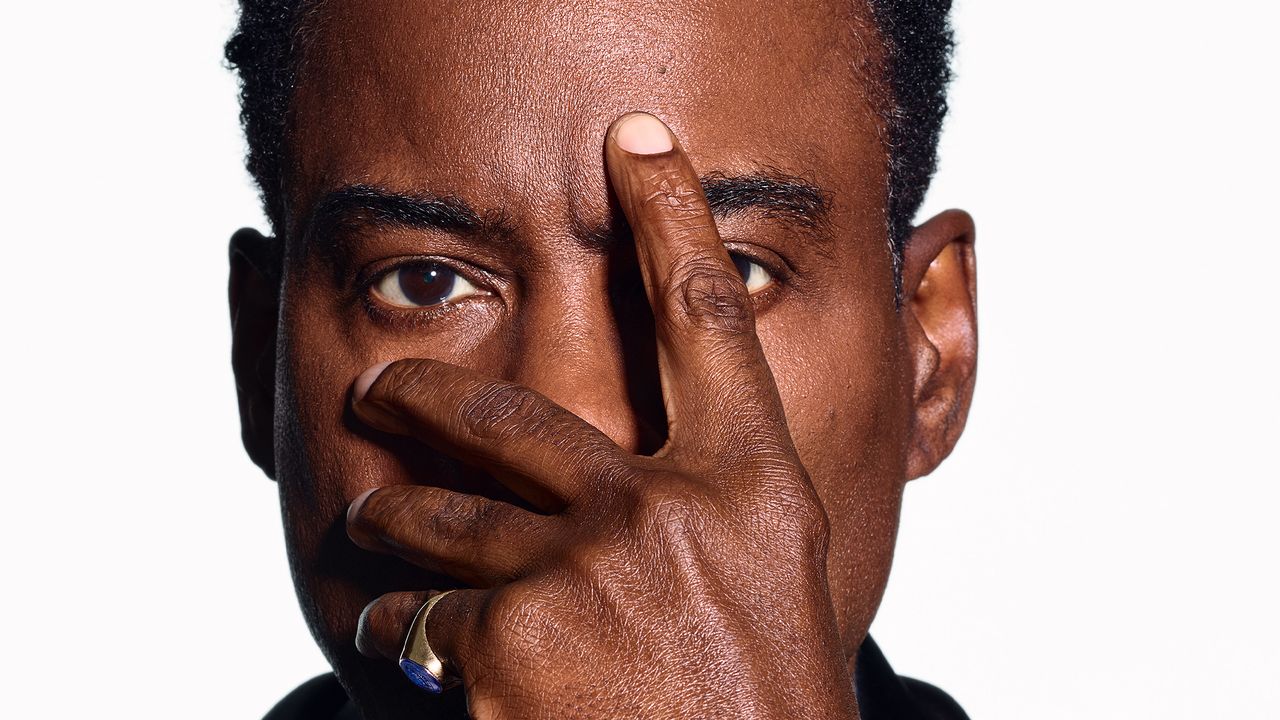
Chris Rock enters a room a bit diffidently, like he’s feeling out what’s inside, making quiet observations about the world around him that sometimes tip over into jokes and sometimes don’t. Because today we’re meeting on the 24th floor of the World Trade Center, I will not repeat the jokes. He looks around at the setup for the interview, which is being filmed: lights and cameras and microphones everywhere. “I just shot a movie with, like, three people,” he says. “It was much lower-budget than this.”That movie is Misty Green, Rock’s fourth feature as a director. It’s about an actress named Misty, played by Rosalind Eleazar, who has talent and who has had success but who cannot quite get out of her own way. Rock identifies and he doesn’t. “I like to say there’s a part of me that’s been every character in the movie,” he says—including Misty’s best friend, played by Anna Kendrick, who is mostly there to crack jokes and report on her own unsatisfying romantic life. The film is a portrait of Hollywood that is dystopian but not cliché; Misty goes through hell, much of it of her own making, but her talent never dims. It has a lived, almost casual quality that belies Rock’s grasp of his craft: At 61, he hasn’t lost his eye for the telling, damning detail or hypocrisy, but there is also a warmth here, a genuine love for his characters. With Misty Green, you can feel both Rock’s lifetime of experience making things for audiences, and also something new—and more finely observed emerging.[All clothing, tie, and sunglasses by Tom Ford. Pocket square by Charvet.All clothing, tie, and sunglasses by Tom Ford. Pocket square by Charvet.Our latest issue is here. Get one year of GQ. Plus, a free hat. Subscribe now.|||](https://www.gq.com/v2/offers/gqa01040?source=Site_0_GQM_EDT_GQM_INBOOK_TEXT_LINK_0_MOTY__ISSUE_2026_ZZ)Misty Green is part of a growing tradition in Rock’s work, including the previous film he directed, 2014’s Top Five, about the highs and lows of show business—something Rock has also chronicled, in exacting autobiographical detail, in his past two comedy specials: 2018’s Tamborine (which is about, among other things, Rock’s divorce) and 2023’s Selective Outrage (about, among other things, his encounter with Will Smith at the 2022 Academy Awards ceremony).Rock has been at times the most famous man in all of comedy. His 1996 special Bring the Pain was a cultural phenomenon on a level few humans will ever experience. But as a director, he has increasingly been drawn to smaller ’70s-style character studies of people making an earnest attempt just to figure out themselves and their demons. “I’d love to make Man on Fire or something,” he says. “It’s not really my thing. I make a tailored suit. My suits are made by hand, by one guy. And it’s okay.”This interview has been condensed and edited; watch this cover story—an episode of GQ’s One More Question—above or on YouTube, and listen on Spotify or Apple Podcasts.GQ: I was preparing for this interview by watching your 2014 film Top Five and was reminded that the central premise of that film is a kind of annoying journalist trying to get a comedy legend to open up to her. How much trouble am I in?Chris Rock: No, no. We’re going to be good. I think.The journalist is played by Rosario Dawson. You play the comedy legend. One of her first questions is terrible, and your character says, “Why don’t you skip the hack questions and go right to something good?” What’s an example of a hack question you get asked?“How’d you get started?” “Were you funny in school?” Stuff like that. Whatever. I get it. You guys have a job. I’m not Harry Styles. Sometimes it requires a reintroduction.The Rosario character, when met with your character’s response, asks, “How come you’re not funny anymore?” I don’t think you’ve ever had that problem before, but tell me if I’m wrong.I mean, it’s a thing you worry about every day. Am I still funny? Well—you don’t worry about being funny. You worry about being professionally funny. On a world-class level. I always had a joke: If I ever did a talk show, I’d do a morning show. I wouldn’t do a late-night show. Because I would only have to be funnier than Al Roker. You know what I mean? Al’s lovely, but I think I could take him in a joke-off.Jacket by Husbands. Shirt and pants by Saint Laurent by Anthony Vaccarello. Pocket square by Anderson & Sheppard. Belt by Artemas Quibble. Necklace, stylist’s own. Cuffs (throughout) by Belperron.Your character in Top Five is kind of living through hell. He’s got this movie that he loves that he’s trying to talk about, and people are asking him about anything but the film. Have you had that experience yourself?You guys have a job, and the job is to get clickbait and things you can turn into controversy, and what’s the headline that has nothing to do with the actual article.I don’t know if that’s how I think about my job, for the record.I mean, it’s your job, though. You might have better intentions, and I appreciate your interest. But a lot of what I read, it’s like: “Oh okay.” People want to talk about your personal life. I get it. We’re in a gossipy culture. We live in a world where Andy Cohen is Norman Lear and Ryan Murphy is Steven Spielberg. That is the world we live in. So people want gossip. We’re righteous people that follow nine commandments. And the one commandment we don’t follow is Thou shall not spread false witness. We are all about spreading false witness now. That is the world we live in. And that’s what journalism, or at least entertainment journalism, has become. Not that everything’s false, but it is definitely amplified to create sides, no matter what the issue is. How’s that? How am I doing?You’re doing great. Misty Green, in theaters now.Misty Green, in theaters now.Speaking of Top Five, there’s a 12-year gap between that film and Misty Green. What accounts for that?Some of it is I got divorced. Nobody has a successful divorce, so that takes time. Then once it’s done, okay, you’re not sitting on the money you had before, so now you got to really make some money. So you go on tour, or two tours. So there was a lot of stand-up. There was a lot of getting my life together. You got a pandemic, you got a bunch of nonsense going on there.I revisited 2018’s Tamborine, which is about the divorce. You say something to the effect of, “I was not a good husband. I was fucked-up. I was addicted to porn.” That’s a pretty harsh litany right there.I was not a great husband. I watched a lot of porn. I don’t watch porn anymore. I haven’t watched porn in five, six years.You go on to say, “I didn’t listen. I wasn’t kind…. I cheated.” When you look back on that person now, how do you judge him?It’s not anything I’m proud of, but it’s something I had to go through. It’s like you watch a Marvel movie, and the guy, he has to test his powers. You know what I mean? Every Marvel movie, man or woman, they have to test their powers. They’re assholes. They get these powers and they’re assholes, and they’re racing trains and they’re lifting up ocean liners and they try to go to the sun, then they crash down because they realize they’re not God. And then they start helping people. I tested my powers. I definitely realized I wasn’t God or anywhere near him, and I was severely humbled, as I should have been.I have heard you advance a theory of how people are different guys at different points in their lives. How long did that guy last and what was the end of him?It’s basically Bring the Pain to Kill the Messenger. That’s one guy. Tamborine’s the beginning of a new guy. And that guy’s in fucking pain in Tamborine. That guy is damn near—Tamborine’s like the blues, man. Where Selective Outrage is like—there’s some pain in that one. Well, there’s a lot of pain in that one, but Tamborine is like: What have I become? [Starts singing Johnny Cash’s cover of Nine Inch Nails’ “Hurt.”] Goes away, in the end. I’m Johnny Cash with Rick Rubin, singing about my empire of dirt. That’s Tamborine. Tamborine is the fucking blues.The other thing that seems to happen in this time is that you were diagnosed with a nonverbal learning disorder, if I understand correctly, which was basically that you have trouble picking up on nonverbal social cues.Yeah. I’m not one for a hint. You got to tell me exactly what the fuck you want. You have to tell me exactly what the fuck you mean.How’d you find out?A friend just kind of blurted it one day. You ever have somebody say something and you’re like, “Okay, let me get this looked into”? And it’s before Tamborine, but around that time. So I’m already quitting porn. You know what I mean? I’m already in a place where, “Okay, what the fuck’s wrong with me?” And I got a cognitive assessment test. And it’s like eight hours of testing to basically see—it’s the kind of thing you would get if you were bipolar or something. So it’s a lot of testing, and that’s what they came up with.Coat by Saint Laurent by Anthony Vaccarello. Turtleneck by Scabal. Sunglasses by Tom Ford. Necklace, stylist’s own.Were there things about your life that had been mysterious that made sense after this?It made me realize how insensitive a lot of my behavior was throughout the years. Because it’s weird. I’ve got a friend who always says, this is a side joke, but he says, “When a schizophrenic sees a famous person, they go, ‘Ha, see? Told you!’ ” Mental illness and celebrity—it’s a weird combination there, because you think people are reacting a certain way because of celebrity. Because it’s this weird thing that you can’t quantify. So I used to just blame everything on celebrity. It’s like, “Oh, we’re not connecting because I had a chronic unique-ism.” I thought I was so fucking unique.It’s funny because comedy is so perception based, and you never seem to have struggled with that aspect of it.But also, okay, what are the symptoms? Black-and-white thinking. It’s an advantageous thing to have if you’re a comedian, black and white. Catastrophizing, great. You know what I mean? When you see one of those specials—okay, the average comedian, or even above average, probably does 40 shows before they record a special. And maybe they did 20 club things before this, so that’s 60 times onstage. My average special, I’ve gone onstage over 250 times. So I’m working it. It looks like I’m just, “Oh my God, he’s got this great insight.” But it’s like, “Yo man, I’m grinding this stuff.” Also, I have a hard time picking up on social cues, but I have a weirdly accurate ear. I can pick up on things in my ear. Sometimes I can pick up on a cue, but I can’t decipher it. I don’t know what just happened for a week, and I’m like, “Oh, that’s what she meant. Oh, that’s what he was trying to say.” It’s like my mind is working on the case. It just can’t solve it at that moment. Does that make sense?You have also talked about doing a lot of therapy in this period of time. You put it in a way that I wanted to follow up on. You did a Variety interview recently, and you said, “I don’t want to be one of those people bragging about their therapy. I crawled in there like everybody else. Nobody struts into therapy. You crawl in there on your knees, soaked from crying.” Is that really how you went in?Well, yeah. We do have this thing where everybody’s like—they brag about their therapy. Put it this way, my personal life wasn’t what I wanted it to be. And I’ll leave it at that. And that’s my relationship with everybody. So yeah, I went in there crying like a bitch. Like: What the fuck is going on?How’d you come out? Or did you come out?You never come out. It’s an ongoing thing. You know what I mean? You’re always an alcoholic. So it’s a combination of therapy and what I have, NVLD, nonverbal learning disorder. So I have a person that helps me with that, and I have another therapist. I mean, it’s okay.The other thing you say in that Variety interview is that you won’t go back to the Oscars unless you’re nominated.I mean, it’s not like a threat or anything. I’m just saying it’s okay. Whatever happened happened. Everybody saw it. I don’t really like talking about it. By the way—any awards show.You’re trying to keep that narrative out of your life is my guess about what you’re saying when you say that.Yeah. Something happened. It wasn’t cool. And I would like to move on. I would like to—I had a nice career before it, and I know there’s a part of that that’s going to follow me the rest of my life. I got jokes. I got scripts. I got movie scripts. I got TV shows. I’m writing a book. I’m doing shit. I have a plethora of art I’m trying to get out, and that’s what I want you to pay attention to, not some crazy night.In this period of time we’re talking about, you also did a lot of work. You did Spiral. You did a season of Fargo. But sometimes I talk to people of your stature and I ask, “What kind of incoming projects do you get as an actor?” And they say, “Actually, nobody sends me anything.” I’m kind of curious what you get.I don’t get a lot of stuff. I honestly don’t. I mean, I probably get more offers as a director, to tell you the truth, than as an actor. It’s weird. When you’re really famous, it works for you and it works against you. So you got name recognition, but you also have people thinking they know what you can do and thinking that there’s a ceiling on your talent. So you got to fight that. The hardest thing you can do in show business is change perception. Reinvention is the hardest thing. So it’s kind of relatively easy to get famous, in the sense that it’s twice as hard to become a new person that is already famous. You know what I mean? The John Travolta that was on Welcome Back, Kotter, that was probably easy compared to the guy that did Pulp Fiction. Like: Wow, I got to change everybody’s perception about who I am. I don’t get a lot of offers, but it’s okay.And what are the kind of things that you turn down?They don’t really make comedies anymore. Not like they used to. I don’t want to be [cast in the role of] the judge. Plus, I’m at this weird place. People are like, “How old is he?”Shirt and pants by Valentino. Hat by Worth & Worth by Orlando Palacios. Belt by Artemas Quibble. Necklace and pendant by FoundRae.Sixty-one, for the record.I’m older than Morgan Freeman was in Shawshank. I’m older than Danny Glover was in Lethal Weapon. You know what I mean? So it’s like: “Is he the guy, or is he like Michael Douglas in Ant-Man?” Like: You go get him, Antie.That’s not for you.Hey, I’ll do it. I’ll shine Michael B. Jordan’s guns. “All right. They’re ready. They’re ready.” I don’t give a fuck. If that’s where I am now, you got to make these adjustments. I’m just trying to stay in the league, man. So I don’t get 25 shots anymore. Now I’m just boxing out. I’m playing good defense. Come in off the bench.The character Misty Green is an actress who’s had some success but is basically struggling to find roles that she feels like are worthy of her. I was like, I wonder if he identifies.Oh, I totally identify. I mean, I like to say there’s a part of me that’s been every character in the movie. So I’m her, I’m the agent, I’m my character. I’m Anna Kendrick, even. I’m everybody in there. And yeah, Misty’s going through what I just said. It is hard when people actually think they know who you are to give you another chance, to think you’re worthy of another chance. And she doesn’t make it easy for herself. You know what I mean?I wonder if you relate to that part too.I mean, not to that extent. But here’s the thing about self-destructive behavior. Can you be nice while you’re doing it? Some addicts are better than others. I’ve never been that guy. I’ve never been poison on a set. I would even say, and I say this about most actors, 40, 50 percent of your work’s going to be from friends, from people just going, “Hey, you know who’s really cool to hang out with? Chris.” You know what I mean?In this movie, she goes on these auditions from hell. They’re these really nightmarish scenarios where she’s really trying to get accepted, and they go very wrong. This is a movie about Hollywood, but it’s very specific, right?I’ve been in that audition. And then Kadeem Hardison walked in the room. You’re like, Kadeem! When I write a Hollywood thing—and I’m not trying to diss anybody—I’ve actually worked jobs. Most of my friends that work in show business have never worked a fucking real job. And if they worked a real job, they were working their way through college, knowing good and well they weren’t going to be there [forever]. So they never really thought the job was going to be their life. So when I write Hollywood, I’m still writing the guy that worked at Red Lobster. I’m writing the guy that loaded trucks at the Daily News. These are jobs that I had. It’s not a Hollywood thing. It’s an everywhere thing.Why’d you cast yourself in Misty Green?Why’d I cast myself? I don’t know. I guess I could have given it to somebody. I did think about it. It’s just like, “Eh, it’s not that time yet.”I ask only because I assume a lot of thought was put into this decision: Why does your character wear the hat that he does?You know what? It was like a quick on-set thing, basically, so I’m not the same guy in Top Five. A lot of directors, a lot of Black directors, have this hat uniform. They have a hat, and the hat’s got the name on it. So it’s Spike. It was the Hughes brothers. It was Matty Rich. There’s this uniform in being a Black director sometimes. It’s my homage to Robert Townsend and Reggie Hudlin and Malcolm Lee, and all these guys.In the film, Misty has a sick brother, played by Daniel Kaluuya. And I don’t know the details, but you had a sick brother, Charles, who passed in 2006, right? I wondered if that had made its way into the film.I mean, a little. I had a brother who struggled with alcohol, yes. It’s a lot of other people I’ve met. We just have so much mental illness now. And there’s something about—it’s weird. When you’re the sibling of somebody like that, or even my brother, your friends, everybody around you, only sees the drunk person, only sees the manic schizophrenic person, but you always see the person you grew up with. You still remember this brother that was like your best friend, and you don’t give that up. No matter what behavior you see, you’re just holding on [to] all the hope in the world that you can get that brother back. And that’s what Misty goes through. A lot of people are like, “Well, just leave him.” It’s like, “Nah, man. You didn’t know him like I knew him.”And that’s what you lived.Yeah. Yeah.In preparing for this interview, it occurred to me that you’ve actually suffered a lot of loss in your life.I know some dead people. I know a lot of dead people. How old are you?Forty-four.I’ll give you about 12 years, 15 years. You start losing the people that just don’t eat right. Just as simple as that. It’s not even the addicts who start going. And it’s not even that they OD; it’s just at some point your body can’t fight this fight anymore. So [in your] 50s, you start losing people. You start losing people to natural causes sometimes. It’s crazy.Well, you lost your father in 1988, which was young. How do you think that shaped you?There’s a weird statistic I read a long time ago. Of the 45 presidents, like 35 of them lost a father or a parent early in life. It makes you grow up. It’ll make you or break you. So yeah, it sobered me up somewhat. My father died in ’88; ’90, I’m on SNL. You know what I mean? So it’s like, Get serious, figure it out. It’s time to figure it out.I mentioned my age to you. Between New Jack City and I’m Gonna Git You Sucka and CB4, my take on this time in your life was: This is the most successful man alive. But I don’t know if it felt that way to you.I was successful, I guess. But you got to also remember, at that time, all of us were in the shadow of Eddie Murphy. That’s what success was.Jacket and pants by Loro Piana. Shirt by Scabal. Pocket square by Anderson & Sheppard. Sunglasses by Jacques Marie Mage.You have a kind of indelible show business experience with your special Bring the Pain, in 1996, which becomes an entire cultural phenomenon. What was your experience of that like?How do I explain it? I bought a house a year and a half, maybe two years before, bought a carriage house in Brooklyn, and I couldn’t afford it. And so I just had to get onstage a lot, and I had to work every gig. You ever read the Gladwell book? The Beatles basically just did more shows than everybody. So it was the Beatles, the Kinks, all these other bands. And the Beatles had the worst boss. The Beatles just did way more shows than everybody. We try to make it into this mythical thing. It’s kind of the same thing, man. I bought a house, and I had to fucking get onstage. Two things happened. I had to get onstage to pay for this house, but I also, privately anyway, I had quit show business in a sense.I had given up because I’d done CB4, I’d done New Jack City, I’d been on SNL, and I was like, “Okay, I’m going to just be a comedian.” Not that there was any shame to it, but my goal was to be George Wallace. George Wallace is a great comedian, and I love George Wallace because all he did was stand-up and he had a real schedule in his life. Most comedians have no schedule, right? George Wallace works from here to here. He goes on vacation these months of the year. I kind of, in the back of my mind, always wanted a family, always wanted kids. So that was my goal. I do this special, and it’s hard to even explain. The world went crazy.And what does it feel like when the world goes crazy?Here’s a funny story. I got Bring the Pain. I have a VHS of Bring the Pain. I left my agent, and I left my manager, but I have Bring the Pain. Now nobody knows what it is. It’s very similar to Dre and Snoop walking around with The Chronic, trying to get a deal. And by the way, it’s around the same time. So I go to this agent. I’m not going to say his name, whatever. He’s made up with me since. I still got a little ego, and I’m like, “Hey, I’d like you to be my agent.” I give him the Bring the Pain tape. He watches it. He says, “It’s okay.” He goes, and I quote, “I got too many Black guys.” He said, “I got too many Black guys.” Whatever. Cut to two months later, Bring the Pain airs and it’s like this big thing. I’m on Oprah, I’m on 60 Minutes, and that agent calls me back, “Hey. I’ll handle you for 5 percent.”What was your response?I thought about it, but then I couldn’t do it. I couldn’t do it. I got too many Black guys. A guy actually said that to me.In that moment you could’ve done anything. Do you feel like, in retrospect, you’re happy with what you did with that opportunity?Bigger & Blacker is bigger than Bring the Pain. It’s like, what if Bad sold more than Thriller? I got a nice body of work. I’m fine with Head of State, I’m fine with I Think I Love My Wife, [which are] the two films before Top Five, but I think I could have been more serious about directing. That’s the only thing I would say. I never let my ego mess up my stand-up. Every special, I put a ton of work into. Kill the Messenger, I remember Mike Nichols calling me and he said, “I like it, but you got onstage too much. It’s like: You worked it too much. And I can see at points you’re a little robotic. You don’t need to work it that hard.” But yeah, I was learning a lot of things on the fly. I didn’t know anything about money. Lorne Michaels said to me a long time ago, “Everybody loses their first money. But if you’re talented, you’ll make more.” I knew nothing about just the dynamics of fame and how it affected the people around you and all that stuff. It was a lot.I was thinking that money is actually one of your great subjects. It feels like it comes up in everything you do. But with something like Misty Green, I feel confident that you’re not doing that for money.No, I’m not doing it for money. I mean, I’ll make money off of it, but the thing with Misty Green, what I realized when I did Top Five, it’s like: This is my lane as a filmmaker. I’d love to make Man on Fire or something. I would love to make fill-in-the-blank big-budget movie and have this big-budget Rush Hour–esque idea. Those guys are really good at that. It’s not really my thing. I make a tailored suit. My suits are made by hand, by one guy. And it’s okay. A little movie is what I should probably be doing, and it’s where my interest is. And some of those other movies I did was kind of me trying to get famous.Jacket by Emporio Armani. Pants by Valentino. Scarf by Charvet.You, as we mentioned before, are 61. This is not me retiring you, but I’m curious how you think about—Robert De Niro’s like 84. He’s got a little baby. He’s my man. He’s got literally a two-year-old or something. I mean, I never plan too much ahead. I’m just trying to get as much work done as possible. Having kids that are grown, it seems like I got a little more time on my hands. So hopefully that results in more work. I’m probably going to direct more. I don’t know how much [more] stand-up I’m going to do.Interesting. Why not?I got like six, seven specials, man. That’s a lot. So I don’t know. I’m not announcing anything or anything, but if I do it, I want to do it right. In sports, especially in football, they always talk about separation. “Can he get separation?” You know what I mean? “Yeah, he’s fast, but is he fast enough? Can he get separation?” And that’s the way I feel, like, as far as stand-up. As long as I can get separation, I’ll do it. Yeah, I’m going to write. That’s basically what it boils down to. Wake up, write. That’s it. Just write, write, write, write, write. Get it all out. ✦PRODUCTION CREDITS:Photography by Richard BurbridgeStyling by George CortinaGrooming by Lisa DeveauxTailoring by Martin KeehnProduction by Kendal Steensa and Felix Cadieu for NEIGHBORSA version of this story originally appeared in the December 2026 issue of GQ with the title “Chris Rock’s ‘Small Movie’ Is a Really Big Deal.”
Chris Rock on Directing an A24 Movie and ‘Crying Like a Bitch’ in Therapy
Full Article
Original Source
Read the full article at Gq →KhanList aggregates and links to publicly available news content. We do not host full articles from third-party sources. Always verify important information with original sources.