
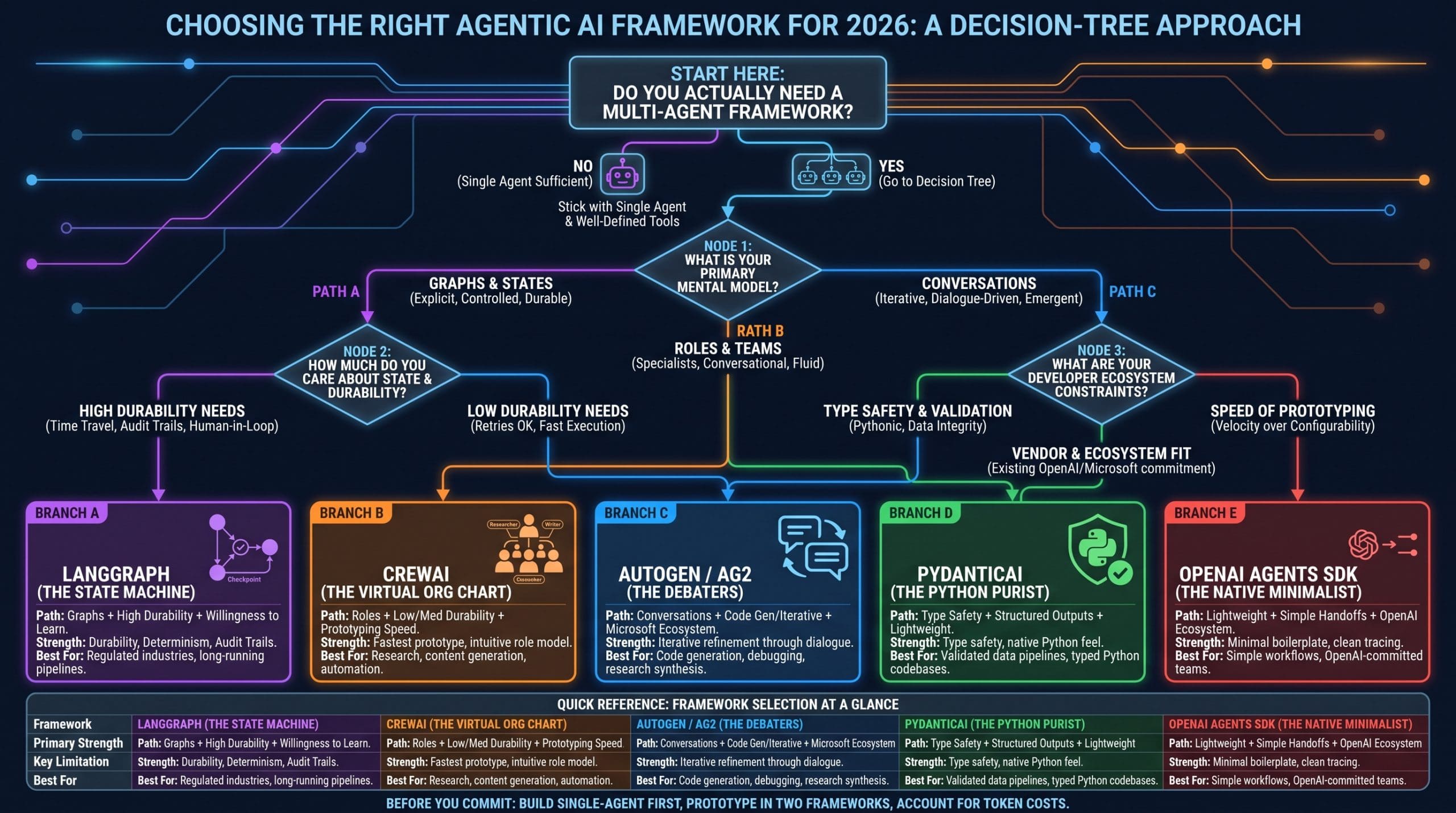
In this article, you will learn how to choose the right agentic AI framework for your production system by working through a structured decision-tree based on your workload’s actual requirements. Topics we will cover include: How to determine whether your task actually requires a multi-agent framework at all. Three key decision nodes — mental model, durability needs, and ecosystem constraints — that narrow the field of candidates. An honest comparison of five major frameworks (LangGraph, CrewAI, AutoGen/AG2, PydanticAI, and the OpenAI Agents SDK), including their best-fit scenarios and watch-out cases. Introduction The agentic AI space has matured fast. What was experimental scaffolding in 2023 is now a crowded category of serious orchestration frameworks, each with strong opinions about how agents should think, coordinate, and fail. Developers facing this choice in 2026 are not dealing with toy projects. They are deciding on the architecture that will shape their production systems for years. The problem is that most framework comparisons measure the wrong things. GitHub stars, benchmark scores, and “easiest to get started” rankings tell you almost nothing about how a framework will behave when your workflow hits an edge case at 2 a.m. on a Sunday. A framework that excels at open-ended collaborative research will fall apart in a tightly regulated compliance pipeline. A framework optimized for strict deterministic branching will feel like bureaucratic overhead for a simple conversational assistant. This guide takes a decision-tree approach: a set of structured questions about your workload that map directly to a framework recommendation, plus an honest look at the trade-offs on each path. Starting Here: Do You Actually Need a Multi-Agent Framework? Before evaluating frameworks, answer this question honestly: does your task require multiple agents at all? The single most common mistake developers make is reaching for orchestration complexity before it’s warranted. A single agent with well-defined tools and a clear system prompt can handle a surprisingly large range of tasks, and it’s dramatically easier to debug, monitor, and reason about. Reach for a multi-agent framework only when a single agent hits a clear limitation. The most common triggers are: The context window fills up before a task completes The task involves genuinely parallel subtasks that don’t depend on each other Different subtasks require radically different system prompts or tool sets You need a separate agent to critique or verify another agent’s output If none of these apply, build a single-agent system first and add orchestration later when you have a concrete reason. If you do need a multi-agent framework, the decision tree below will guide your choice. The Decision Tree: Three Nodes That Narrow the Field Node 1: What Is Your Primary Mental Model? The first question is architectural. How do you naturally think about the work your system needs to do? Option A: You think in graphs and states. Your workflow has defined steps, explicit transitions between them, and you care deeply about what happens when a step fails, needs to be retried, or requires a human to approve before continuing. You might sketch this on a whiteboard as a flowchart with labeled edges. Option B: You think in roles and teams. Your workflow maps naturally to specialist contributors — a researcher, a writer, a reviewer — handing work to each other. The coordination is conversational and the boundaries between responsibilities are somewhat fluid. Option C: You think in conversations. Your workflow is iterative: two or more agents discussing a problem, one generating and the other critiquing, until the output meets a quality threshold. The “structure” emerges from the dialogue rather than being prescribed in advance. Node 2: How Much Do You Care About State and Durability? The second question is about what happens between steps. High durability needs: Your workflow may run for minutes or hours. You need to pause it, inspect its state, resume it, or roll it back. Humans need to approve certain transitions. You need an audit trail for compliance or debugging purposes. If your workflow touches money, medical records, or legal documents, you almost certainly need this. Low durability needs: Your workflow runs in seconds or a few minutes. If it fails, you can simply retry from the beginning. You don’t need to inspect intermediate states. Node 3: What Are Your Developer Ecosystem Constraints? The third question is pragmatic. Type safety and validation: Your team writes Python with strict typing. Data integrity at the boundary of each function is non-negotiable. You want your agent framework to feel like the rest of your codebase. Vendor and ecosystem fit: Your team already uses OpenAI’s API extensively, or you’re building in the Microsoft ecosystem. Tight integration with your existing vendor relationship matters more than framework neutrality. Speed of prototyping: You need to go from idea to a working multi-agent prototype in hours, not days. You’re willing to trade configurability for velocity. The Five Framework Branches Branch A: LangGraph (The State Machine) Path: Graph-based mental model + High durability needs + Willingness to invest in a learning curve LangGraph, now a standalone project within the LangChain ecosystem, models your workflow as an explicit directed graph. Nodes are functions. Edges are transitions. State is a typed dictionary that flows through the graph and can be persisted at any checkpoint. This architectural choice has real consequences. Because state is explicit and serializable, LangGraph supports “time travel”: pausing a workflow mid-execution, inspecting the state at any node, modifying it, and resuming. Human-in-the-loop approvals become a first-class feature rather than an afterthought. Audit trails are built in. LangGraph is the go-to for workflows in regulated industries: banking compliance pipelines, legal document review, medical record processing. Anywhere that “what did the agent decide and why?” is a question you’ll need to answer after the fact, LangGraph gives you the infrastructure to answer it. The trade-off is real, though. LangGraph requires you to be explicit about everything. Defining your state schema, specifying each node, wiring the edges, configuring checkpointers — all of this is code that doesn’t exist in more opinionated frameworks. Teams report that initial setup takes significantly longer than with competing frameworks, and the mental model requires genuine investment to internalize. Best fit: Production pipelines with compliance requirements, long-running workflows needing human approval steps, teams that prioritize determinism and debuggability over development speed. Watch out for: Teams that underestimate the verbosity. LangGraph rewards patience and punishes developers who want something running in an afternoon. Branch B: CrewAI (The Virtual Org Chart) Path: Role-based mental model + Low-to-medium durability needs + Prioritizing prototyping speed CrewAI structures multi-agent workflows around the metaphor of a team. You define agents as specialists with roles, goals, and backstories. You define tasks and assign them to agents. You assemble a crew and let them coordinate. This mental model clicks immediately for most developers because it maps to how humans already think about knowledge work. A crew with a Researcher, an Analyst, and a Writer is immediately understandable, and CrewAI’s declarative configuration makes this structure fast to express. Teams consistently report going from idea to working multi-agent prototype in under two hours. The metaphor is also the limitation. Because coordination happens through role definition and task handoffs rather than explicit state transitions, CrewAI gives you less control when an agent goes off-script. An agent that over-generates, misinterprets its goal, or gets stuck in a loop is harder to constrain than in a graph-based framework. Debugging means reading agent outputs rather than inspecting structured state. Best fit: Research pipelines, content generation workflows, business process automation, any domain where the “team of specialists” metaphor maps naturally to the task and where moderate unpredictability is acceptable. Watch out for: Enterprise workflows where every agent action must be auditable or where a misbehaving agent could cause irreversible side effects. Branch C: AutoGen / AG2 (The Debaters) Path: Conversational mental model + Code generation or iterative refinement workflows + Microsoft ecosystem AutoGen / AG2 (now formalized as AG2 under a new governance structure) was built around a deceptively simple idea: agents that talk to each other, in natural language, until they converge on a result. One agent generates code. Another executes it, observes the output, and reports back. The first revises. This loop continues until the code passes. This conversational pattern makes AG2 well-suited for code generation, data analysis, and any workflow where iterative refinement through dialogue is the natural shape of the task. It integrates tightly with the Microsoft ecosystem, Azure OpenAI in particular, and has strong community support in enterprise environments. The conversational nature is also where AG2 introduces unpredictability. In a multi-turn dialogue between agents, the conversation can drift, over-expand, or enter circular patterns in ways that are harder to detect and interrupt than a failed graph transition. Managing termination conditions, controlling conversation length, and handling edge cases requires careful system prompt engineering. Best fit: Code generation and debugging workflows, iterative data analysis, research synthesis tasks, teams already embedded in the Microsoft/Azure ecosystem. Watch out for: Strict, deterministic enterprise pipelines where the emergent nature of conversational coordination becomes a liability rather than an asset. Branch D: PydanticAI (The Python Purist) Path: Lightweight tool execution + Strict type safety and validation + Structured data outputs PydanticAI takes a deliberately minimalist position. It’s not trying to be a full orchestration framework. Instead, it brings the FastAPI-style developer experience to agents: define your agent with typed inputs and outputs, declare your tools with Pydantic models, and let the validation layer enforce data integrity at every step. For developers who already live in a Pydantic-typed codebase, PydanticAI feels native in a way that larger frameworks don’t. There’s no new mental model to learn, no graph abstraction to internalize, no crew metaphor to map your workflow onto. You’re writing typed Python with an agent flavor. PydanticAI is opinionated about validation and structured outputs but intentionally un-opinionated about orchestration. It doesn’t prescribe how agents hand off to each other or how state persists across long workflows. Teams that need durable multi-agent orchestration with checkpointing will need to build that layer themselves or pull in a complementary framework. Best fit: Agents that produce structured, validated outputs for downstream systems, teams with strong Python typing discipline, use cases where data integrity is the primary concern rather than complex agent coordination. Watch out for: Teams expecting a full orchestration solution. PydanticAI is an agent framework, not an orchestration framework, and that distinction matters. Branch E: OpenAI Agents SDK (The Native Minimalist) Path: Lightweight tool execution + Simple handoffs + Already committed to the OpenAI ecosystem The OpenAI Agents SDK (released in early 2025) is the cleanest path to a working agent if you’re already using OpenAI’s API. Agents, tools, and handoffs are defined with minimal boilerplate. The built-in tracing makes observability accessible without additional configuration. For a one-to-two agent workflow with a handful of tools, the SDK gets you to production faster than any other option here. The constraint is tight vendor coupling. The OpenAI Agents SDK is designed for the OpenAI API and, to a limited extent, compatible APIs. Teams that want to switch models, use open-source inference, or build provider-agnostic architectures will find themselves fighting the framework rather than working with it. The handoff model is also optimized for simplicity: it handles sequential, clean handoffs well but wasn’t designed for complex branching, parallel execution, or stateful checkpointing. Best fit: Small to medium workflows built entirely on OpenAI’s API, internal tools and prototypes where vendor lock-in is acceptable, teams that want something production-ready quickly. Watch out for: Any architecture requirement that pushes beyond simple linear handoffs, or any business requirement that might drive a switch to a different model provider. Quick Reference: Framework Selection at a Glance Framework Primary Strength Key Limitation Best For LangGraph Durability, determinism, audit trails Steep learning curve, verbose setup Regulated industries, long-running workflows CrewAI Fastest path to prototype, intuitive role model Harder to constrain misbehaving agents Research, content generation, process automation AutoGen / AG2 Iterative refinement through dialogue Conversational drift, unpredictable in strict pipelines Code generation, Microsoft ecosystem PydanticAI Type safety, structured outputs, native Python feel Not a full orchestration framework Validated data pipelines, typed Python codebases OpenAI Agents SDK Minimal boilerplate, clean tracing Vendor lock-in, limited orchestration complexity Simple workflows, OpenAI-committed teams Before You Commit: Three Practical Recommendations Build single-agent first. No matter which framework you choose, start with a single agent that handles your core task. You’ll learn what the task actually requires before adding coordination overhead. Prototype in two frameworks. If your requirements put you at the boundary between two branches, spend a day building the same workflow in both. The trade-offs will become obvious when they meet your actual data and edge cases. Account for operational costs. Multi-agent systems multiply token consumption. A four-agent crew running in parallel can consume four times the tokens of a single agent completing the same task sequentially. Factor this into your cost model before committing to an architecture. The right framework is the one that makes your specific failure modes easiest to prevent and recover from, not the one with the best documentation or the largest community. Define your constraints first, then let the decision tree do the work. No comments yet.
Choosing the Right Agentic AI Framework for 2026: A Decision-Tree Approach
Full Article
Original Source
Read the full article at Machinelearningmastery →KhanList aggregates and links to publicly available news content. We do not host full articles from third-party sources. Always verify important information with original sources.