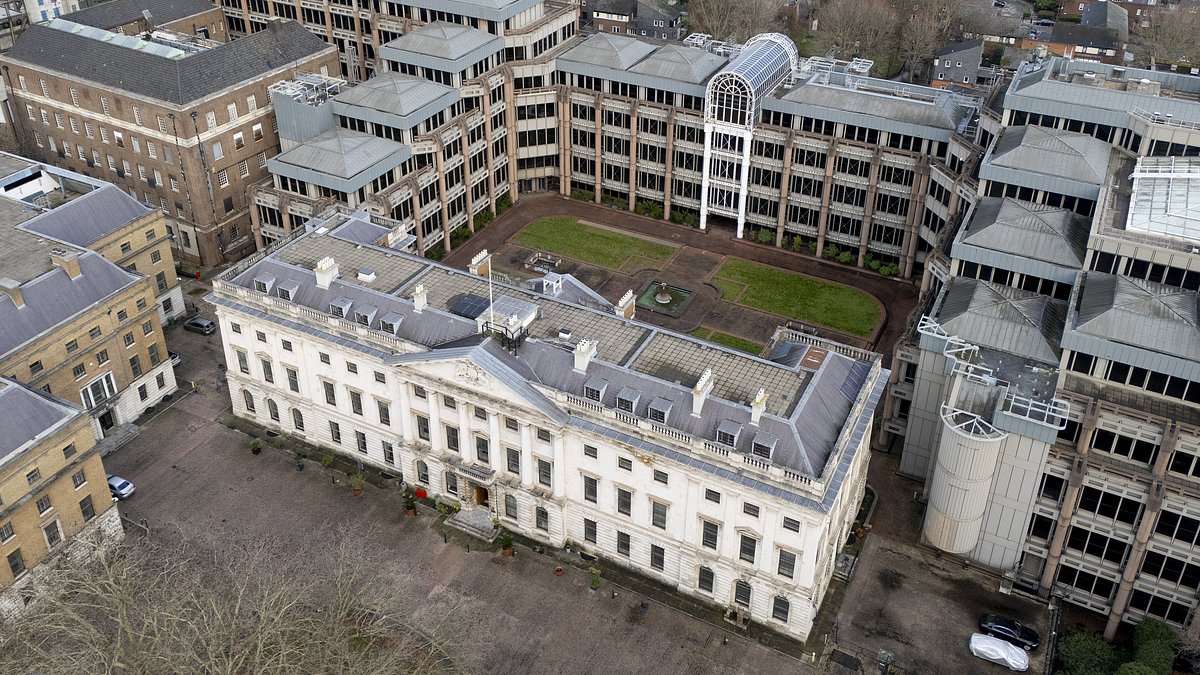
Construction of the new Chinese super embassy in London can go ahead after a High Court challenge by neighbours was thrown out.The Royal Mint Court Residents' Association (RMCRA) brought legal action against the Ministry of Housing, Communities and Local Government and the London Borough of Tower Hamlets over the decision to grant planning permission.Once built on the site of the Royal Mint near the Tower of London, the five-acre embassy will be the largest diplomatic mission in London – but concerns have been raised over national security amid fears the site could be used for espionage. Fighting Sir Keir Starmer's decision to grant permission, the residents' association argued the embassy's presence could lead to terrorist attacks or the repression of protests, and be used to enforce 'draconian' Chinese laws in the UK and to target dissidents.The association, which represents families and businesses in about 100 properties, was also concerned about the Chinese government creating a fire risk by ignoring safety obligations, which it said would not be enforceable because of diplomatic immunity.The Government and the council defended the claim, saying they 'conscientiously and carefully had regard' to the residents' concerns.Following a hearing at the High Court earlier this month, two judges dismissed RMCRA's challenge. RMCRA has indicated it will appeal.They rejected RMCRA's claim that the planning decision had been made unlawfully, that there was a failure to disclose a blast assessment and security statement, that the Government had not followed planning regulations and that it had not identified and assessed human rights. Mrs Justice Lieven, sitting with Lord Justice Dingemans, said in a judgment on Friday there was 'no doubt' that the Government took into account that it was the Chinese government applying for planning permission. The new embassy is planned for the site of the old Royal Mint near the Tower of London (pictured) She also said that the RMCRA was not disadvantaged by not receiving a copy of a 'blast assessment' at the time of the planning decision, which detailed the effect of a possible terrorist explosion.The judge said: 'There was no unfairness to the claimant by reason of these documents not having been disclosed.'But residents said they will seek to continue their legal battle against the complex and the RMCRA has instructed lawyers to apply for permission to appeal.Dave Lake of the RMCRA said: 'They might have the billions, but we are in for the long haul and will be seeking to win permission for an appeal.'We live here. This is our home and a rubber-stamp decision doesn't change the fact that a fortress doesn't belong in our community.'If they think this is the end of the road, they're going to discover that they are wrong. We fight on.'Critics of the Chinese Communist Party also said the legal fight would continue.Luke de Pulford, executive director of the Inter-Parliamentary Alliance on China said: 'Beijing thinks this judgment is the final word. It isn't. The appeal is already in the works.'If they expect us to roll over and allow our own capital to become a CCP power centre, they have completely misjudged the strength of opposition to this mega-embassy.'Shadow foreign secretary Dame Priti Patel warned 'Britain's national security is set to be compromised by a new Chinese super embassy spy hub' after the ruling was handed down.The Conservative frontbencher said: 'Thanks to this unserious Labour Government, Britain's national security is set to be compromised by a new Chinese super embassy spy hub operating in the heart of our capital.'The court's decision is a clear test for Andy Burnham.'Will he put our country's interests first, stand up to Beijing, protect our national security and do the right thing by ditching this dreadful plan – a legacy of the failed Starmer years?'China bought the Royal Mint site near the Tower of London for £225million in 2018 to build its campus embassy, with at least 200 rooms in the sprawling 20,000 square metre estate.But the application has been dogged by controversy with the local Tower Hamlets council refusing to allow planning permission for the embassy twice.Earlier this year, the Government called in the application and Starmer gave the go-ahead for the embassy.His decision was condemned by Tory MPs, who said 'kow-tow Keir' was being 'spineless' and compromising national security for better trade with Beijing. Residents of Royal Mint Court alleged the government's decision to approve permission was 'unlawful, procedurally unfair, and failed to take into account key factors'. Pictured is a concept for the embassy The Mail on Sunday revealed that planning documents for the embassy included 'spy dungeons' (highlighted in red above) - two suites of basement rooms and a tunnel, with their purpose redacted for security reasonsJust before the Government's decision, the heads of the security services made a rare intervention, saying the risk from the mega-embassy could not be fully eliminated, but mitigatory steps could be taken.One such step was to re-route underground fibre optic cables that carried the most commercially sensitive data between the City of London and Canary Wharf, so that Chinese spies could not eavesdrop on them.There were also fears that the new embassy will become a 'nest' for Beijing spies, who could even use the embassy to detain Chinese dissidents in secret underground rooms.There was particular concern after plans revealed the presence of a 'secret room' metres away from a vital cable network connecting some of the capital's top financial sectors.The triangular room measures up to 40m across and 2-3m deep and includes at least two air extraction systems, indicating it could house heat-generating equipment such as high-tech computers.It is part of a network of 208 secret rooms – a majority of which are hidden from the public in planning proposals – beneath the embassy.There were also fears China could tap into nearby cables and eavesdrop on key information. The cables along Mansell Street, which belong to companies including BT, Colt Technologies and Verizon, carry communications to and from financial institutions in the City of London.They sit directly between financial hubs in the City and Canary Wharf and close to three major data centres, including the Stock Exchange.Those who have fled Hong Kong's Chinese regime also fear the huge embassy would be used as a base to hunt them down.There was fierce opposition to the new embassy from residents and Conservatives including party leader Kemi Badenoch and Sir Iain Duncan-Smith.The RMCRA raised over £200,000 through crowdfunding to fund its legal challenge.A Ministry of Housing, Communities and Local Government spokesperson said: 'We acknowledge the judgment.'The challenge against the Secretary of State's decision to approve planning permission and listed building consent for a new Chinese embassy was unsuccessful.'As the case may still be subject to litigation, it would not be appropriate to comment further.'
Chinese super embassy in London gets the go-ahead after neighbours' High Court challenge is thrown out
Full Article
Original Source
Read the full article at Dailymail →KhanList aggregates and links to publicly available news content. We do not host full articles from third-party sources. Always verify important information with original sources.